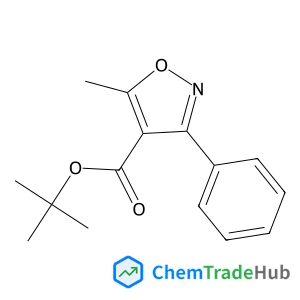
2-Methyl-2-propanyl 5-methyl-3-phenyl-1,2-oxazole-4-carboxylate
CAS Number:
211429-79-7
Molecular Formula:
C15H17NO3
J.-S. McEwen, J. M. Bray
Many DFT studies of O2 dissociation on Pt(111) give conflicting information on preferred paths and final states. Here we report large p(4 × 4) unit cell minimum energy pathway evaluations and compare O2 adsorption and dissociated states on Pt(111). Calculations reveal how the pathways for O2 dissociation starting from top-fcc-bridge, top-hcp-bridge, and top-bridge-top sites are interconnected. They also provide a direct reaction pathway for the dissociation of an O2 molecule from a top-fcc-bridge into an hcp and an fcc site, which is consistent with low temperature scanning tunneling microscope experiments. Such a pathway is shown to be considerably perturbed by the presence of co-adsorbed oxygen atoms. We quantify the coverage dependence through the construction of a Brønsted–Evans–Polanyi relationship relating the O2 dissociation activation energies to the binding energies of the dissociated O atoms. We also show that all pathways starting from a top-fcc-bridge site give the smallest barriers for O2 dissociation.

Journal of Catalysis

Journal of Heterocyclic Chemistry

Fibre Chemistry

Organic Preparations and Procedures International

Proceedings of the National Academy of Sciences of the United States of America

Pharmacological Reviews

Kinetics and Catalysis

Planta Medica

Journal of Medicinal Chemistry

Israel Journal of Chemistry
Fahri Alkan, C. Dybowski
DOI: 10.1039/C5CP03348A
Inmaculada García Cuesta, Barnaby Pownall, Stefano Pelloni, Alfredo M. Sánchez de Merás
DOI: 10.1039/C5CP03732H
Miriam Marqués, Angel Morales-García, José Manuel Menéndez, Valentín G. Baonza, José Manuel Recio
DOI: 10.1039/C5CP03673A
Xiao Lin, Zhao-Yang Chen, P. Hu, Shi-Gang Sun, You-Qun Chu
DOI: 10.1039/C5CP02072G
DOI: 10.1039/C5CP04189A
Jerzy Gorecki, Joanna N. Gorecka, Hiroshi Ueno, Kenichi Yoshikawa
DOI: 10.1039/C6CP03860C
Niels Boon, René van Roij
DOI: 10.1039/C5CP02945G
Binghui Ge, Qing Jie, Udara Saparamadu, Weishu Liu, Zhifeng Ren
DOI: 10.1039/C6CP03944H
Marnik Bercx, Nasrin Sarmadian, Rolando Saniz, Bart Partoens, Dirk Lamoen
DOI: 10.1039/C6CP03468C
Praloy Mondal, Debajyoti Das
DOI: 10.1039/C6CP03613A
When handling 4-Methyl-6-(trifluoromethyl)quinoline (CAS: 40716-16-3), safety go...
4-(3,5-Difluorophenyl)aniline is an aromatic organic compound with the CAS numbe...
5-{[4-(Trifluoromethyl)phenyl]sulfanyl}-1,2,3-thiadiazole-4-carboxylic acid can ...
The market for 4-Benzylaniline hydrochloride (CAS: 6317-57-3) is steadily growin...
[3-(Diethylsulfamoyl)phenyl]boronic acid is generally considered safe when handl...
3-Bromo-2,5-dimethoxyaniline is mainly used in the pharmaceutical and chemical i...
N-Methyl-1-(5-methyl-1H-indol-3-yl)methanamine (CAS: 915922-67-7) is subject to ...
This compound is primarily used in the pharmaceutical industry for the synthesis...
2-Methyl-2-propanyl [(1S,3R)-3-aminocyclohexyl]carbamate (CAS: 1298101-47-9) sho...
Ethyl 2-bromo-4,4,4-trifluorobutanoate (CAS: 367-33-9) is utilized in the pharma...

Physical Chemistry Chemical Physics (PCCP) is an international journal co-owned by 19 physical chemistry and physics societies from around the world. This journal publishes original, cutting-edge research in physical chemistry, chemical physics and biophysical chemistry. To be suitable for publication in PCCP, articles must include significant innovation and/or insight into physical chemistry; this is the most important criterion that reviewers and Editors will judge against when evaluating submissions. The journal has a broad scope and welcomes contributions spanning experiment, theory, computation and data science. Topical coverage includes spectroscopy, dynamics, kinetics, statistical mechanics, thermodynamics, electrochemistry, catalysis, surface science, quantum mechanics, quantum computing and machine learning. Interdisciplinary research areas such as polymers and soft matter, materials, nanoscience, energy, surfaces/interfaces, and biophysical chemistry are welcomed if they demonstrate significant innovation and/or insight into physical chemistry. Joined experimental/theoretical studies are particularly appreciated when complementary and based on up-to-date approaches.

![Methyl 3-({2'-[(E)-(hydroxyhydrazono)methyl]-4-biphenylyl}methyl)-2-oxo-2,3-dihydro-1H-benzimidazole-4-carboxylate structure](https://static.chemtradehub.com/structs/149/1499167-72-4-034a.webp "Methyl 3-({2'-[(E)-(hydroxyhydrazono)methyl]-4-biphenylyl}methyl)-2-oxo-2,3-dihydro-1H-benzimidazole-4-carboxylate structure")