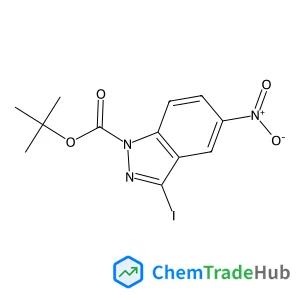
Tert-butyl 3-iodo-5-nitro-1H-indazole-1-carboxylate
CAS Number:
459133-69-8
Molecular Formula:
C12H12IN3O4
Wei-Li Li, Constantin Romanescu, Zachary A. Piazza, Lai-Sheng Wang
A class of transition-metal-centered aromatic boron wheels (Dnh-M©Bnq−) have been recently produced and characterized according to an electronic design principle. Here we investigate the interplay between electronic and geometric requirements for the molecular wheels using the case of VB10−, which is isoelectronic to the decacoordinated molecular wheels, Ta©B10− and Nb©B10−. Photoelectron spectra of VB10− are observed to be broad and complicated with relatively low electron binding energies, in contrast to the simple and high electron binding energies observed for the molecular wheels of its heavier congeners. An unbiased global minimum search found the most stable isomer of VB10− to be a singlet “boat”-like structure (C2), in which the V atom is coordinated to a quasi-planar B10 unit. A similar triplet C2v boat-like isomer is found to be almost degenerate to the C2 structure, whereas the beautiful molecular wheel structure, D10h-V©B10−, is significantly higher in energy on the potential energy surface. Therefore, even though the VB10− system fulfills the electronic requirement to form a D10h-M©B10− aromatic molecular wheel, the V atom is too small to stabilize the ten-membered boron ring.
Jerzy Gorecki, Joanna N. Gorecka, Hiroshi Ueno, Kenichi Yoshikawa
DOI: 10.1039/C6CP03860C
Jeffrey J. Black, Thomas Murphy, Rob Atkin, Andrew Dolan, Leigh Aldous
DOI: 10.1039/C6CP02255C
Xiao Lin, Zhao-Yang Chen, P. Hu, Shi-Gang Sun, You-Qun Chu
DOI: 10.1039/C5CP02072G
Mohan Zhang
DOI: 10.1039/C6CP03435G
YoungAh Kwon
DOI: 10.1039/C5CP02833G
Camila S. Monteiro, Daniele C. Ferreira, Gustavo A. M. Sáfar, Rafael N. Gontijo, Cristiano Fantini, Dayse C. S. Martins, Ynara M. Idemori, Maurício V. B. Pinheiro, Klaus Krambrock
DOI: 10.1039/C6CP03366K
Zhong-hua Cui, Abhinav Gupta, Miklos Kertesz
DOI: 10.1039/C5CP03759J
Geetha S. Remya, Cherumuttathu H. Suresh
DOI: 10.1039/C6CP02936A
Patrick Kölle, Igor Pugliesi, Heinz Langhals, Roland Wilcken, Andreas J. Esterbauer, Regina de Vivie-Riedle, Eberhard Riedle
DOI: 10.1039/C5CP02981C
Yassin A. Jeilani, Chelesa Fearce, Minh Tho Nguyen
DOI: 10.1039/C5CP03247D
When handling 4-Methyl-6-(trifluoromethyl)quinoline (CAS: 40716-16-3), safety go...
4-(3,5-Difluorophenyl)aniline is an aromatic organic compound with the CAS numbe...
5-{[4-(Trifluoromethyl)phenyl]sulfanyl}-1,2,3-thiadiazole-4-carboxylic acid can ...
The market for 4-Benzylaniline hydrochloride (CAS: 6317-57-3) is steadily growin...
[3-(Diethylsulfamoyl)phenyl]boronic acid is generally considered safe when handl...
3-Bromo-2,5-dimethoxyaniline is mainly used in the pharmaceutical and chemical i...
N-Methyl-1-(5-methyl-1H-indol-3-yl)methanamine (CAS: 915922-67-7) is subject to ...
This compound is primarily used in the pharmaceutical industry for the synthesis...
2-Methyl-2-propanyl [(1S,3R)-3-aminocyclohexyl]carbamate (CAS: 1298101-47-9) sho...
Ethyl 2-bromo-4,4,4-trifluorobutanoate (CAS: 367-33-9) is utilized in the pharma...

Physical Chemistry Chemical Physics (PCCP) is an international journal co-owned by 19 physical chemistry and physics societies from around the world. This journal publishes original, cutting-edge research in physical chemistry, chemical physics and biophysical chemistry. To be suitable for publication in PCCP, articles must include significant innovation and/or insight into physical chemistry; this is the most important criterion that reviewers and Editors will judge against when evaluating submissions. The journal has a broad scope and welcomes contributions spanning experiment, theory, computation and data science. Topical coverage includes spectroscopy, dynamics, kinetics, statistical mechanics, thermodynamics, electrochemistry, catalysis, surface science, quantum mechanics, quantum computing and machine learning. Interdisciplinary research areas such as polymers and soft matter, materials, nanoscience, energy, surfaces/interfaces, and biophysical chemistry are welcomed if they demonstrate significant innovation and/or insight into physical chemistry. Joined experimental/theoretical studies are particularly appreciated when complementary and based on up-to-date approaches.