












How are small endohedral silicon clusters stabilized?
Literature Information
Publication Date
2012-08-24
DOI
10.1039/C2CP42097J
Impact Factor
3.676
Authors
Fabrice Avaltroni, Stephan N. Steinmann, Clémence Corminboeuf
View Original
Abstract
Clusters in the (Be, B, C)@Sin(0,1,2+) (n = 6–10) series, isoelectronic to Sin2−, present multiple symmetric structures, including rings, cages and open structures, which the doping atom stabilizes using contrasting bonding mechanisms. The most striking feature of these clusters is the absence of electron transfer (for Be) or even the inversion (for B and C) in comparison to classic endohedral metallofullerenes (e.g. from the outer frameworks towards the enclosed atom). The relatively small cavity of the highly symmetric Si8 cubic cage benefits more strongly from the encapsulation of a boron atom than from the insertion of a too large beryllium atom. Overall, the maximization of multicenter-type bonding, as visualized by the Localized Orbital Locator (LOL), is the key to the stabilization of the small Sin cages. Boron offers the best balance between size, electronegativity and delocalized bonding pattern when compared to beryllium and carbon.
Recommended Journals
Related Literature
Methanol electro-oxidation on platinum modified tungsten carbides in direct methanol fuel cells: a DFT study
Xiao Lin, Zhao-Yang Chen, P. Hu, Shi-Gang Sun, You-Qun Chu
2015-08-25
Paper
DOI: 10.1039/C5CP02072G
Fluorescence fluctuation of an antigen–antibody complex: circular dichroism, FCS and smFRET of enhanced GFP and its antibody
Debmalya Bhunia, Rajdeep Chowdhury, Kankan Bhattacharyya
2015-08-28
Paper
DOI: 10.1039/C5CP04908C
Probing of molecular replication and accumulation in shallow heat gradients through numerical simulations
Lorenz Keil, Michael Hartmann, Simon Lanzmich, Dieter Braun
2016-05-06
Paper
DOI: 10.1039/C6CP00577B
Concave or convex π-dimers: the role of the pancake bond in substituted phenalenyl radical dimers
Zhong-hua Cui, Abhinav Gupta, Miklos Kertesz
2015-08-11
Paper
DOI: 10.1039/C5CP03759J
Modulation of the aggregation properties of sodium deoxycholate in presence of hydrophilic imidazolium based ionic liquid: water dynamics study to probe the structural alteration of the aggregates
Niloy Kundu, Debasis Banik, Arpita Roy, Jagannath Kuchlyan, Nilmoni Sarkar
2015-09-01
Paper
DOI: 10.1039/C5CP03906A
Photodissociation of aniline N–H bonds in clusters of different nature
Viktoriya Poterya, Dana Nachtigallová, Jozef Lengyel, Michal Fárník
2015-09-01
Paper
DOI: 10.1039/C5CP04485E
Hole-transfer induced energy transfer in perylene diimide dyads with a donor–spacer–acceptor motif
Patrick Kölle, Igor Pugliesi, Heinz Langhals, Roland Wilcken, Andreas J. Esterbauer, Regina de Vivie-Riedle, Eberhard Riedle
2015-08-24
Paper
DOI: 10.1039/C5CP02981C
Near infrared absorbing near infrared emitting highly-sensitive luminescent nanothermometer based on Nd3+ to Yb3+ energy transfer
Ł. Marciniak, A. Bednarkiewicz, M. Stefanski, R. Tomala, D. Hreniak, W. Strek
2015-08-17
Paper
DOI: 10.1039/C5CP03861H
The thermoelectrochemistry of lithium–glyme solvate ionic liquids: towards waste heat harvesting
Jeffrey J. Black, Thomas Murphy, Rob Atkin, Andrew Dolan, Leigh Aldous
2016-07-01
Paper
DOI: 10.1039/C6CP02255C
100 fs photo-isomerization with vibrational coherences but low quantum yield in Anabaena Sensory Rhodopsin
Alexandre Cheminal, Jérémie Léonard, So-Young Kim, Kwang-Hwan Jung, Hideki Kandori, Stefan Haacke
2015-09-03
Paper
DOI: 10.1039/C5CP04353K
You might also like
Compound Q&A
What precautions should be taken when handling 4-Methyl-6-(trifluoromethyl)quinoline (CAS: 40716-16-3)?
When handling 4-Methyl-6-(trifluoromethyl)quinoline (CAS: 40716-16-3), safety go...
40716-16-34-Methyl-6-(trifluor...
Compound Q&A
What is 4-(3,5-Difluorophenyl)aniline (CAS: 405058-00-6)?
4-(3,5-Difluorophenyl)aniline is an aromatic organic compound with the CAS numbe...
405058-00-64-(3,5-Difluoropheny...
Compound Q&A
How is 5-{[4-(Trifluoromethyl)phenyl]sulfanyl}-1,2,3-thiadiazole-4-carboxylic acid (CAS: 338982-07-3) typically synthesized?
5-{[4-(Trifluoromethyl)phenyl]sulfanyl}-1,2,3-thiadiazole-4-carboxylic acid can ...
338982-07-35-{[4-(Trifluorometh...
Compound Q&A
What is the market or research trend for 4-Benzylaniline hydrochloride (CAS: 6317-57-3)?
The market for 4-Benzylaniline hydrochloride (CAS: 6317-57-3) is steadily growin...
6317-57-34-Benzylaniline hydr...
Compound Q&A
Is [3-(Diethylsulfamoyl)phenyl]boronic acid (CAS: 871329-58-7) safe?
[3-(Diethylsulfamoyl)phenyl]boronic acid is generally considered safe when handl...
871329-58-7[3-(Diethylsulfamoyl...
Compound Q&A
What are the main uses of 3-Bromo-2,5-dimethoxyaniline (CAS: 115929-62-9)?
3-Bromo-2,5-dimethoxyaniline is mainly used in the pharmaceutical and chemical i...
115929-62-93-Bromo-2,5-dimethox...
Compound Q&A
What regulatory guidelines apply to N-Methyl-1-(5-methyl-1H-indol-3-yl)methanamine (CAS: 915922-67-7)?
N-Methyl-1-(5-methyl-1H-indol-3-yl)methanamine (CAS: 915922-67-7) is subject to ...
915922-67-7N-Methyl-1-(5-methyl...
Compound Q&A
What industries use Carbamic acid, N-[(5S)-5,6-diamino-6-oxohexyl]-, 1,1-dimethylethyl ester (CAS: 24828-96-4)?
This compound is primarily used in the pharmaceutical industry for the synthesis...
24828-96-4Carbamic acid, N-[(5...
Compound Q&A
How should 2-Methyl-2-propanyl [(1S,3R)-3-aminocyclohexyl]carbamate (CAS: 1298101-47-9) be stored?
2-Methyl-2-propanyl [(1S,3R)-3-aminocyclohexyl]carbamate (CAS: 1298101-47-9) sho...
1298101-47-92-Methyl-2-propanyl ...
Compound Q&A
What industries use Ethyl 2-bromo-4,4,4-trifluorobutanoate (CAS: 367-33-9)?
Ethyl 2-bromo-4,4,4-trifluorobutanoate (CAS: 367-33-9) is utilized in the pharma...
367-33-9Ethyl 2-bromo-4,4,4-...
Source Journal
Physical Chemistry Chemical Physics

CiteScore:
5.5
Self-citation Rate:
10.3%
Articles per Year:
3036
Physical Chemistry Chemical Physics (PCCP) is an international journal co-owned by 19 physical chemistry and physics societies from around the world. This journal publishes original, cutting-edge research in physical chemistry, chemical physics and biophysical chemistry. To be suitable for publication in PCCP, articles must include significant innovation and/or insight into physical chemistry; this is the most important criterion that reviewers and Editors will judge against when evaluating submissions. The journal has a broad scope and welcomes contributions spanning experiment, theory, computation and data science. Topical coverage includes spectroscopy, dynamics, kinetics, statistical mechanics, thermodynamics, electrochemistry, catalysis, surface science, quantum mechanics, quantum computing and machine learning. Interdisciplinary research areas such as polymers and soft matter, materials, nanoscience, energy, surfaces/interfaces, and biophysical chemistry are welcomed if they demonstrate significant innovation and/or insight into physical chemistry. Joined experimental/theoretical studies are particularly appreciated when complementary and based on up-to-date approaches.
Recommended Compounds
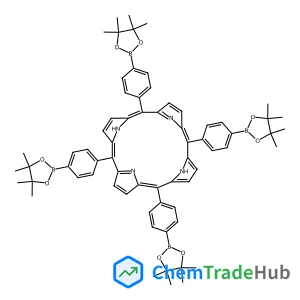
5,10,15,20-tetrakis(4-boronic acid pinacol ester phenyl) porphyrin
CAS Number:
1332748-00-1
Molecular Formula:
C68H74B4N4O8
![N-{3-[Benzyl(methyl)amino]propyl}-9-chloro-5,6,7,8-tetrahydro-2-acridinecarboxamide structure](https://static.chemtradehub.com/structs/142/1426944-49-1-1e4c.webp "N-{3-[Benzyl(methyl)amino]propyl}-9-chloro-5,6,7,8-tetrahydro-2-acridinecarboxamide structure")
N-{3-[Benzyl(methyl)amino]propyl}-9-chloro-5,6,7,8-tetrahydro-2-acridinecarboxamide
CAS Number:
1426944-49-1
Molecular Formula:
C25H28ClN3O
Recommended Suppliers





Disclaimer
This page provides academic journal information for reference and research purposes only. We are not affiliated with any journal publishers and do not handle publication submissions. For publication-related inquiries, please contact the respective journal publishers directly.
If you notice any inaccuracies in the information displayed, please contact us at support@chemtradehub.com. We will promptly review and address your concerns.