


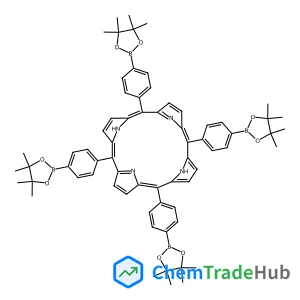
5,10,15,20-tetrakis(4-boronic acid pinacol ester phenyl) porphyrin
CAS Number:
1332748-00-1
Molecular Formula:
C68H74B4N4O8
Y. Chen, B. Lee, H. T. Yi, S. S. Lee, M. M. Payne, S. Pola, C.-H. Kuo, Y.-L. Loo, J. E. Anthony, Y. T. Tao
In this perspective article, we discuss the dynamic instability of charge carrier transport in a range of popular organic semiconductors. We observe that in many cases field-effect mobility, an important parameter used to characterize the performance of organic field-effect transistors (OFETs), strongly depends on the rate of the gate voltage sweep during the measurement. Some molecular systems are so dynamic that their nominal mobility can vary by more than one order of magnitude, depending on how fast the measurements are performed, making an assignment of a single mobility value to devices meaningless. It appears that dispersive transport in OFETs based on disordered semiconductors, those with a high density of localized trap states distributed over a wide energy range, is responsible for the gate voltage sweep rate dependence of nominal mobility. We compare such rate dependence in different materials and across different device architectures, including pristine and trap-dominated single-crystal OFETs, as well as solution-processed polycrystalline thin-film OFETs. The paramount significance given to a single mobility value in the organic electronics community and the practical importance of OFETs for applications thus suggest that such an issue, previously either overlooked or ignored, is in fact a very important point to consider when engaging in fundamental studies of charge carrier mobility in organic semiconductors or designing applied circuits with organic semiconductors.

Science

Kinetics and Catalysis

Proceedings of the National Academy of Sciences of the United States of America

Nature

Science Progress

Organic Preparations and Procedures International

Journal of Organometallic Chemistry

Journal of Physics and Chemistry of Solids

Molecular Pharmacology

Israel Journal of Chemistry
J. H. K. Pfisterer, P. S. Deimel, R. G. Acres, M. Fritton, P. Feulner, J. V. Barth, F. Allegretti
DOI: 10.1039/C6CP02541B
Mercè Deumal
DOI: 10.1039/C6CP02699K
Sherdil Khan, Maximiliano J. M. Zapata, Marcelo B. Pereira, Renato V. Gonçalves, Lukas Strizik, Jairton Dupont, Marcos J. L. Santos, Sérgio R. Teixeira
DOI: 10.1039/C5CP03645C
DOI: 10.1039/C6CP00632A
Fahri Alkan, C. Dybowski
DOI: 10.1039/C5CP03348A
Lucia Amidani, Pieter Glatzel, Paola Luches
DOI: 10.1039/C6CP04407G
DOI: 10.1039/C5CP04189A
Bertrand Siboulet, Jean-François Dufrêche
DOI: 10.1039/C5CP03818A
Yassin Aweis Jeilani, Phoenix N. Williams, Sofia Walton, Minh Tho Nguyen
DOI: 10.1039/C6CP02686A
YoungAh Kwon
DOI: 10.1039/C5CP02833G
When handling 4-Methyl-6-(trifluoromethyl)quinoline (CAS: 40716-16-3), safety go...
4-(3,5-Difluorophenyl)aniline is an aromatic organic compound with the CAS numbe...
5-{[4-(Trifluoromethyl)phenyl]sulfanyl}-1,2,3-thiadiazole-4-carboxylic acid can ...
The market for 4-Benzylaniline hydrochloride (CAS: 6317-57-3) is steadily growin...
[3-(Diethylsulfamoyl)phenyl]boronic acid is generally considered safe when handl...
3-Bromo-2,5-dimethoxyaniline is mainly used in the pharmaceutical and chemical i...
N-Methyl-1-(5-methyl-1H-indol-3-yl)methanamine (CAS: 915922-67-7) is subject to ...
This compound is primarily used in the pharmaceutical industry for the synthesis...
2-Methyl-2-propanyl [(1S,3R)-3-aminocyclohexyl]carbamate (CAS: 1298101-47-9) sho...
Ethyl 2-bromo-4,4,4-trifluorobutanoate (CAS: 367-33-9) is utilized in the pharma...

Physical Chemistry Chemical Physics (PCCP) is an international journal co-owned by 19 physical chemistry and physics societies from around the world. This journal publishes original, cutting-edge research in physical chemistry, chemical physics and biophysical chemistry. To be suitable for publication in PCCP, articles must include significant innovation and/or insight into physical chemistry; this is the most important criterion that reviewers and Editors will judge against when evaluating submissions. The journal has a broad scope and welcomes contributions spanning experiment, theory, computation and data science. Topical coverage includes spectroscopy, dynamics, kinetics, statistical mechanics, thermodynamics, electrochemistry, catalysis, surface science, quantum mechanics, quantum computing and machine learning. Interdisciplinary research areas such as polymers and soft matter, materials, nanoscience, energy, surfaces/interfaces, and biophysical chemistry are welcomed if they demonstrate significant innovation and/or insight into physical chemistry. Joined experimental/theoretical studies are particularly appreciated when complementary and based on up-to-date approaches.

![Imidazo[1,2-c]pyrimidine structure](https://static.chemtradehub.com/structs/274/274-78-2-8b4c.webp "Imidazo[1,2-c]pyrimidine structure")




