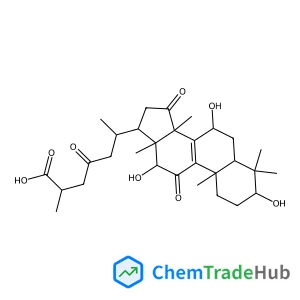
(3beta,7beta,12beta)-3,7,12-Trihydroxy-11,15,23-trioxolanost-8-en-26-oic acid
CAS Number:
98665-22-6
Molecular Formula:
C30H44O8
Daniele Fazzi, Margherita Maiuri, Daniele Brida, Giulio Cerullo
Ultrafast dynamics upon photoexcitation in a low band gap polymer for photovoltaics is investigated both experimentally and theoretically. Our work sheds light on the excess energy relaxation processes occurring immediately after photon absorption and responsible for dissipation in the photovoltaic process of light harvesting and energy storage. A peculiar non-adiabatic decay path through a conical intersection (CI) between the higher excited state S2 and the first singlet state S1 is identified by ultrafast spectroscopy and theoretical calculations. Ultrafast twisting of the initially flat conformation in S2 drives the system to the CI connecting the two potential energy surfaces, actually eliciting an internal conversion within 60 femtoseconds, followed by planarization along the adiabatic surface in S1. Relaxed potential energy profiles (PEPs) of ground and lowest excited states along a dihedral coordinate, calculated within the time dependent density functional theory (TDDFT) approach, support the S2/S1 CI mechanism. Furthermore a screening of the widely used hybrid and range separated exchange–correlation (XC) DFT functionals has been carried out finding different descriptions of S2/S1 PEPs and good agreement between experimental data and long-range corrected DFT.
Xiaomei Yang, Zhirong Li, Jun Zhang, Wenjie Zhao
DOI: 10.1039/D2AN01468H
Ilkka Lähdesmäki, Petr Chocholouš, Andrea D. Carroll, Judy Anderson, Peter S. Rabinovitch, Jaromir Ruzicka
DOI: 10.1039/B822070K
Melissa M. Mariani, Peter Lampen, Bayden R. Wood
DOI: 10.1039/B822408K
Juliette Phillips, Elizabeth Harrild, Rebecca J. Tidy, Lincoln Codd, Kirsty Richardson, Liesl Celliers
DOI: 10.1039/D2AN01271E
Shenghua Lv, Shan Liang, Jingjing Zuo, Shanshan Zhang, Dequan Wei
DOI: 10.1039/D2AN01070D
Luiz Fernando Moreira, Marcos Roberto de Vasconcelos Lanza, Auro Atsushi Tanaka, Maria Del Pilar Taboada Sotomayor
DOI: 10.1039/B902273B
Zengming Zhang, Shuhao Zhao, Lei Jiang, Junjun Wu, Wenhan Zhao, Xiaoniu Guo, Niancai Peng, Fei Hu
DOI: 10.1039/D2AN00908K
Xin Wang, Xiangqun Guo
DOI: 10.1039/B822744F
Yu-Chin Lin, Ying-Yu Chen, Bang-Ying Yu, Wei-Chun Lin
DOI: 10.1039/B814729A
Ana Belén Ruiz-Muelle, Felipe Lestón-Cabeo, Ignacio Fernández
DOI: 10.1039/D2AN00759B
When handling 4-(2-Furylmethyl)thiomorpholine 1,1-dioxide (CAS: 79206-94-3), it ...
When handling 4-Chloro-N-[2-(4-morpholinyl)ethyl]benzamide (CAS: 71320-77-9), it...
Waste containing this compound (CAS: 62921-74-8) should be handled according to ...
Waste containing (S)-Methyl 2-amino-3-cyclohexylpropanoate should be collected i...
This compound can be synthesized using a multi-step process involving the conjug...
There are several alternatives to (2E)-3-(3,4-Dichlorophenyl)acrylic acid in syn...
Ethyl 6-(2-nitrophenyl)imidazo[2,1-b][1,3]thiazole-3-carboxylate (CAS: 925437-84...
Waste containing 2-(1,3-Thiazol-2-yl)ethanamine (CAS: 18453-07-1) should be coll...
Methyl 5-iodo-2-methylbenzoate can be synthesized through the iodination of meth...
5-Chloro[1,2,4]triazolo[1,5-a]pyridine is commonly synthesized via the condensat...

Physical Chemistry Chemical Physics (PCCP) is an international journal co-owned by 19 physical chemistry and physics societies from around the world. This journal publishes original, cutting-edge research in physical chemistry, chemical physics and biophysical chemistry. To be suitable for publication in PCCP, articles must include significant innovation and/or insight into physical chemistry; this is the most important criterion that reviewers and Editors will judge against when evaluating submissions. The journal has a broad scope and welcomes contributions spanning experiment, theory, computation and data science. Topical coverage includes spectroscopy, dynamics, kinetics, statistical mechanics, thermodynamics, electrochemistry, catalysis, surface science, quantum mechanics, quantum computing and machine learning. Interdisciplinary research areas such as polymers and soft matter, materials, nanoscience, energy, surfaces/interfaces, and biophysical chemistry are welcomed if they demonstrate significant innovation and/or insight into physical chemistry. Joined experimental/theoretical studies are particularly appreciated when complementary and based on up-to-date approaches.
![5-Acetyl-2,3-dihydrobenzo[b]furan structure](https://static.chemtradehub.com/structs/908/90843-31-5-eea4.webp "5-Acetyl-2,3-dihydrobenzo[b]furan structure")