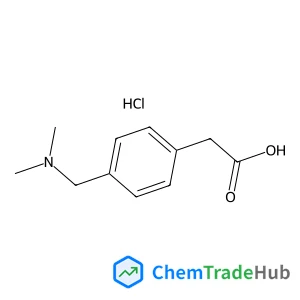
4-(Dimethylaminomethyl)phenylacetic acid hydrochloride
CAS Number:
99985-52-1
Molecular Formula:
C11H16ClNO2
Jiemin Wang, Fangzhi Li, Lei Wen, Xiaohui Wang
Improving electrochemical properties of hydrothermally synthesized LiFePO4 powders is of immense technological significance and has been a subject of much scientific inquiry for many years. As reported previously, reversing the feeding sequence of starting materials and/or introducing ethylene glycol (EG) could significantly improve the electrochemical performance of hydrothermally synthesized LiFePO4. However, the mechanism remains unclear. Here, we report a systematic study to understand the mechanism from viewpoints of crystal growth and defect concentration control. Combining the results of experimental and theoretical investigations, the improvement in electrochemical performance is attributed to simultaneous suppression of crystal growth along the [010] direction and reduced defect concentration of the antisite. The reduction in antisite defects is readily monitored by significant red shift of the infrared (IR) absorption band around 1000 cm−1 which is assigned to the symmetric stretching P–O vibration of the PO4 tetrahedron, as indicated by theoretical calculation. With this knowledge in mind, an output as high as 450 g L−1 (autoclave volume), and an enhanced specific discharge capacity of 165 A h kg−1 (close to the theoretical unity of 170 A h kg−1) at 0.1 C are achieved.

Herald of the Russian Academy of Sciences

Medicinal Chemistry Research

NDT & E International

Critical Reviews in Solid State and Materials Sciences

Journal of Asian Natural Products Research

Atomization and Sprays

Cellulose

Bioorganic & Medicinal Chemistry

Bioorganic & Medicinal Chemistry Letters

Main Group Chemistry
Johann V. Pototschnig, Martin Ratschek, Andreas W. Hauser, Wolfgang E. Ernst
DOI: 10.1039/C4CP00559G
I. Nishiyama
DOI: 10.1039/C4CP04643A
Christophe Morell, Alberto Vela, Frédéric Guégan, Henry Chermette
DOI: 10.1039/C4CP03167A
Marie Olšinová, Piotr Jurkiewicz, Michal Pozník, Radek Šachl, Tereza Prausová, Martin Hof, Václav Kozmík, Filip Teplý, Jiří Svoboda, Marek Cebecauer
DOI: 10.1039/C4CP00888J
Vedi Kuyil Azhagan
DOI: 10.1039/C4CP01497A
Jiahua Zhang, Zhendong Hao, Xia Zhang, Guohui Pan, Yongshi Luo, Shaozhe Lü, Haifeng Zhao
DOI: 10.1039/C4CP01184H
Tim Krah, Nadia Ben Amor, Vincent Robert
DOI: 10.1039/C4CP00662C
T. S. Kuhlman, K. B. Møller, A.-N. Unterreiner
DOI: 10.1039/C4CP00977K
Chengxi Huang, Haiping Wu, Kaiming Deng, Weihua Tang
DOI: 10.1039/C4CP04385E
Zhiming Wang, Ying Feng, Hui Li, Zhao Gao, Xiaojuan Zhang, Ping Lu, Ping Chen, Yuguang Ma, Shiyong Liu
DOI: 10.1039/C4CP00209A
Waste containing N-Methoxy-N-methyl-1,3-thiazole-5-carboxamide (CAS: 898825-89-3...
N-(4-Biphenylyl)dibenzo[b,d]furan-4-amine should be stored in a tightly sealed c...
The market for 3-Acetamido-5-amino-2,4,6-triiodobenzoic acid (CAS: 1713-07-1) is...
Benzyl 2-O-acetyl-3,4,6-tri-O-benzyl-beta-D-galactopyranoside (CAS: 61820-03-9) ...
2-Ethylpiperazine dihydrochloride (CAS: 438050-52-3) is regulated under the Glob...
1,1'-[1,3-Phenylenebis(methylene)]bis(3-methyl-1H-pyrrole-2,5-dione) (CAS: 11946...
Several alternatives can be used in the synthesis of 5-Fluoro-2-(1-pyrrolidinyl)...
Proper personal protective equipment (PPE) must be worn when handling this compo...
When handling 6-Bromoimidazo[1,2-a]pyridin-8-amine, it is important to wear appr...
Alternatives to (2S,4R)-4-(4-Nitrobenzyl)pyrrolidine-2-carboxylic acid hydrochlo...

Physical Chemistry Chemical Physics (PCCP) is an international journal co-owned by 19 physical chemistry and physics societies from around the world. This journal publishes original, cutting-edge research in physical chemistry, chemical physics and biophysical chemistry. To be suitable for publication in PCCP, articles must include significant innovation and/or insight into physical chemistry; this is the most important criterion that reviewers and Editors will judge against when evaluating submissions. The journal has a broad scope and welcomes contributions spanning experiment, theory, computation and data science. Topical coverage includes spectroscopy, dynamics, kinetics, statistical mechanics, thermodynamics, electrochemistry, catalysis, surface science, quantum mechanics, quantum computing and machine learning. Interdisciplinary research areas such as polymers and soft matter, materials, nanoscience, energy, surfaces/interfaces, and biophysical chemistry are welcomed if they demonstrate significant innovation and/or insight into physical chemistry. Joined experimental/theoretical studies are particularly appreciated when complementary and based on up-to-date approaches.