













Characterisation of an intrinsically disordered protein complex of Swi5–Sfr1 by ion mobility mass spectrometry and small-angle X-ray scattering
Literature Information
Publication Date
2012-12-18
DOI
10.1039/C2AN35878F
Impact Factor
4.616
Authors
Kazumi Saikusa, Naoyuki Kuwabara, Yuichi Kokabu, Yu Inoue, Mamoru Sato, Hiroshi Iwasaki, Toshiyuki Shimizu, Mitsunori Ikeguchi, Satoko Akashi
View Original
Abstract
It is now recognized that intrinsically disordered proteins (IDPs) play important roles as hubs in intracellular networks, and their structural characterisation is of significance. However, due to their highly dynamic features, it is challenging to investigate the structures of IDPs solely by conventional methods. In the present study, we demonstrate a novel method to characterise protein complexes using electrospray ionization ion mobility mass spectrometry (ESI-IM-MS) in combination with small-angle X-ray scattering (SAXS). This method enables structural characterisation even of proteins that have difficulties in crystallisation. With this method, we have characterised the Schizosaccharomyces pombe Swi5–Sfr1 complex, which is expected to have a long disordered region at the N-terminal portion of Sfr1. ESI-IM-MS analysis of the Swi5–Sfr1 complex revealed that its experimental collision cross-section (CCS) had a wide distribution, and the CCS values of the most dominant ions were ∼56% of the theoretically calculated value based on the SAXS low-resolution model, suggesting a significant size reduction in the gas phase. The present study demonstrates that the newly developed method for calculation of the theoretical CCSs of the SAXS low-resolution models of proteins allows accurate evaluation of the experimental CCS values of IDPs provided by ESI-IM-MS by comparing with the low-resolution solution structures. Furthermore, it was revealed that the combination of ESI-IM-MS and SAXS is a promising method for structural characterisation of protein complexes that are unable to crystallise.
Related Literature
Two-dimensional graphene-like C2N: an experimentally available porous membrane for hydrogen purification
B. Xu, H. Xiang, Q. Wei, J. Q. Liu, Y. D. Xia
2015-05-07
Communication
DOI: 10.1039/C5CP01789K
Phase separation induced shell thickness variations in electrospun hollow Bioglass 45S5 fiber mats for drug delivery applications
D. Durgalakshmi, S. Balakumar
2015-05-06
Paper
DOI: 10.1039/C5CP01738F
Molecular functionalization of silicene/Ag(111) by covalent bonds: a DFT study
Régis Stephan, Marie-Christine Hanf, Philippe Sonnet
2015-03-25
Paper
DOI: 10.1039/C5CP00613A
Effect of sodium salicylate and sodium deoxycholate on fibrillation of bovine serum albumin: comparison of fluorescence, SANS and DLS techniques
J. Dey, S. Kumar, V. K. Aswal, L. V. Panicker, K. Ismail, P. A. Hassan
2015-05-12
Paper
DOI: 10.1039/C5CP01666E
Origin of enhanced visible light driven water splitting by (Rh, Sb)-SrTiO3
Brindaban Modak, Swapan K. Ghosh
2015-05-06
Paper
DOI: 10.1039/C5CP01374G
Co-solvent enhanced zinc oxysulfide buffer layers in Kesterite copper zinc tin selenide solar cells
K. Xerxes Steirer, Rebekah L. Garris, Jian V. Li, Michael J. Dzara, Paul F. Ndione, Kannan Ramanathan, Ingrid Repins, Glenn Teeter, Craig L. Perkins
2015-05-13
Paper
DOI: 10.1039/C5CP01607J
Subsystem-DFT potential-energy curves for weakly interacting systems
Danny Schlüns, Kevin Klahr, Christian Mück-Lichtenfeld, Lucas Visscher, Johannes Neugebauer
2014-12-23
Paper
DOI: 10.1039/C4CP04936E
Transmission electron microscopy finds plenty of room on the surface
Wei Zhang, Wei Tao Zheng
2015-05-06
Perspective
DOI: 10.1039/C5CP01705J
Structure of a liquid/liquid interface during solvent extraction combining X-ray and neutron reflectivity measurements
E. Scoppola, E. Watkins, G. Li Destri, L. Porcar, R. A. Campbell, O. Konovalov, G. Fragneto, O. Diat
2015-05-07
Communication
DOI: 10.1039/C5CP01809A
Half-metallicity induced by boron adsorption on an Fe3O4(100) surface
Y. Yamauchi
2015-05-11
Paper
DOI: 10.1039/C5CP02466H
You might also like
Compound Q&A
What are the main uses of (5-Sulfamoyl-3-pyridinyl)boronic acid (CAS: 951233-61-7)?
(5-Sulfamoyl-3-pyridinyl)boronic acid is primarily used in chemical synthesis, p...
951233-61-7(5-Sulfamoyl-3-pyrid...
Compound Q&A
How is Benzyl 2-methyl-2-(methylsulfonyl)-4-pentenoate (CAS: 1942858-50-5) typically synthesized?
Benzyl 2-methyl-2-(methylsulfonyl)-4-pentenoate is typically synthesized via est...
1942858-50-5Benzyl 2-methyl-2-(m...
Compound Q&A
What precautions should be taken when handling 8-Fluoroquinolin-6-ol (CAS: 209353-22-0)?
When handling 8-Fluoroquinolin-6-ol (CAS: 209353-22-0), it is important to use p...
209353-22-08-Fluoroquinolin-6-o...
Compound Q&A
What are the physical and chemical properties of 1,3-Dibromo-5-(2-methyl-2-propanyl)benzene (CAS: 129316-09-2)?
1,3-Dibromo-5-(2-methyl-2-propanyl)benzene (CAS: 129316-09-2) is a crystalline c...
129316-09-21,3-Dibromo-5-(2-met...
Compound Q&A
What industries use Ethyl 7-chloro-4-oxo-1-(1,3-thiazol-2-yl)-1,4-dihydro-1,8-naphthyridine-3-carboxylate (CAS: 174726-87-5)?
Ethyl 7-chloro-4-oxo-1-(1,3-thiazol-2-yl)-1,4-dihydro-1,8-naphthyridine-3-carbox...
174726-87-5Ethyl 7-chloro-4-oxo...
Compound Q&A
What precautions should be taken when handling Delta-7-Avenasterol (CAS: 23290-26-8)?
When handling Delta-7-Avenasterol (CAS: 23290-26-8), it is important to wear app...
23290-26-8Delta-7-Avenasterol
Compound Q&A
What precautions should be taken when handling N-({(5R)-3-[3-Fluoro-4-(4-morpholinyl)phenyl]-2-oxo-1,3-oxazolidin-5-yl}methyl)acetamide (CAS: 872992-20-6)?
Proper handling involves the use of personal protective equipment such as gloves...
872992-20-6N-({(5R)-3-[3-Fluoro...
Compound Q&A
What precautions should be taken when handling 2-Methyl-2-proanyl 4-[(2-aminophenyl)amino]-1-piperidinecarboxylate (CAS: 79099-00-6)?
When handling 2-Methyl-2-proanyl 4-[(2-aminophenyl)amino]-1-piperidinecarboxylat...
79099-00-62-Methyl-2-propanyl ...
Compound Q&A
What is N-Methyl-4-chlorobenzylamine hydrochloride (CAS: 65542-24-7)?
N-Methyl-4-chlorobenzylamine hydrochloride (CAS: 65542-24-7) is a organic compou...
65542-24-7N-Methyl-4-chloroben...
Compound Q&A
Is [2-(Dodecyloxy)ethoxy]acetic acid (CAS: 27306-90-7) safe?
[2-(Dodecyloxy)ethoxy]acetic acid (CAS: 27306-90-7) is generally considered safe...
27306-90-7[2-(Dodecyloxy)ethox...
Source Journal
Analyst

CiteScore:
7.8
Self-citation Rate:
5.6%
Articles per Year:
653
Analyst publishes analytical and bioanalytical research that reports premier fundamental discoveries and inventions, and the applications of those discoveries, unconfined by traditional discipline barriers.
Recommended Compounds
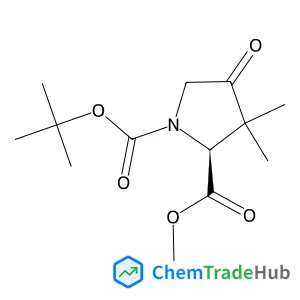
2-Methyl 1-(2-methyl-2-propanyl) (2S)-3,3-dimethyl-4-oxo-1,2-pyrrolidinedicarboxylate
CAS Number:
478698-30-5
Molecular Formula:
C13H21NO5
![2-Azaspiro[4.5]decane-3,8-dione structure](https://static.chemtradehub.com/structs/914/914780-96-4-e94b.webp "2-Azaspiro[4.5]decane-3,8-dione structure")
Recommended Suppliers





Disclaimer
This page provides academic journal information for reference and research purposes only. We are not affiliated with any journal publishers and do not handle publication submissions. For publication-related inquiries, please contact the respective journal publishers directly.
If you notice any inaccuracies in the information displayed, please contact us at support@chemtradehub.com. We will promptly review and address your concerns.