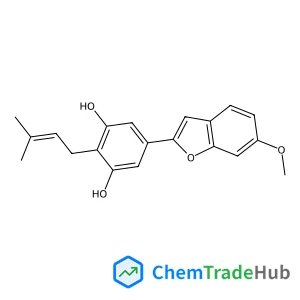
5-(6-Methoxy-1-benzofuran-2-yl)-2-(3-methyl-2-buten-1-yl)-1,3-benzenediol
CAS Number:
1017277-40-5
Molecular Formula:
C20H20O4
Xiaoteng Jia, Danming Chao, Hongtao Liu, Libing He, Tian Zheng, Xiujie Bian, Ce Wang
A series of novel electroactive copolymers of poly(amic acid) (PAA) bearing pendant aniline tetramer groups were prepared via direct polycondensation from novel electroactive diamine (EDA), 4,4'-diaminodiphenyl ether (p-ODA) and 3,3',4,4'-biphenyltetracarboxylic dianhydride (s-BPDA). The structures of the copolymers were confirmed by FT-IR and 1H NMR measurements. Then the prepared PAA copolymers were heated at 300 °C to induce cyclization, and transformed into polyimide (PI) films. The obtained PI films exhibited excellent thermal stability and outstanding mechanical properties. The PAA copolymers films had reversible redox couples with good cycle stability. The stepwise oxidation of as-prepared PAA copolymers by ammonium persulfate is monitored by UV-vis spectroscopy. The absorption peak at 571 nm underwent a red shift when it transformed from emeraldine state to pernigraniline state. Moreover, the PAA copolymers films revealed electrochromic behaviors with a color change from yellowish at its neutral state, to green, and finally to dark blue. They also exhibited extremely high optical contrast (%ΔT) up to 63% at 700 nm, moderate coloration efficiency (CE ≈ 100 cm2 C−1) and low switching times of 3.9 s at 0.8 V and 1.3 s for fast bleaching.
Wulan Tri Wahyuni, Frank Marken
DOI: 10.1039/C9AN02186H
Jinpeng Mao, Yuexiang Lu, Ning Chang, Jiaoe Yang, Jiacheng Yang, Sichun Zhang, Yueying Liu
DOI: 10.1039/C6AN00302H
Nicole A. Schneck, Vera B. Ivleva, Cindy X. Cai, Jonathan W. Cooper, Q. Paula Lei
DOI: 10.1039/C9AN02098E
Fei Xing, Shan Zhang, Yong Yang, Wenshuai Jiang, Zhibo Liu, Siwei Zhu, Xiaocong Yuan
DOI: 10.1039/C6AN00552G
Xiangtang Li, Rui Xu, Li Pan, Yi-Ming Liu
DOI: 10.1039/C9AN02064K
Brandon L. Thompson, Christopher Birch, Jingyi Li, Jacquelyn A. DuVall, Delphine Le Roux, Daniel A. Nelson, An-Chi Tsuei, Daniel L. Mills, Shannon T. Krauss, Brian E. Root
DOI: 10.1039/C6AN00209A
Ai-Li Sun, Qing-An Qi
DOI: 10.1039/C6AN00696E
B. Jill Venton, Qun Cao
DOI: 10.1039/C9AN01586H
Wushuang Bai, Qinglin Sheng, Jianbin Zheng
DOI: 10.1039/C6AN00632A
When handling 2-Methyl-2-propanyl 5-amino-2-thiophenecarboxylate (CAS: 1498311-5...
5-Bromo-1,2-dichloro-3-fluorobenzene (CAS: 1000572-93-9) is a crystalline solid ...
(2R)-2-Amino-2-(4-bromophenyl)ethanol (CAS: 354153-64-3) should be stored in a c...
Methyl 4-(aminomethyl)tetrahydro-2H-pyran-4-carboxylate hydrochloride (CAS: 3627...
1,4-Dimethyl-1H-pyrazole-5-sulfonyl chloride is primarily used as an intermediat...
Dinaphtho[1,2-b:2',1'-d]furan is generally safe when handled with appropriate pe...
The market for 7-Methyl-7,9-dihydro-1H-purine-2,6,8(3H)-trione (CAS: 612-37-3) i...
2-(4-Chlorophenyl)malonaldehyde (CAS: 205676-17-1) is a colorless or light yello...
2-Methylchrysene (CAS: 3351-32-4) is typically synthesized via the reaction of c...
N-(6-aminopyrimidin-4-yl)acetamide (CAS: 89533-23-3) is generally considered saf...

Polymer Chemistry welcomes submissions in all areas of polymer science that have a strong focus on macromolecular chemistry. Manuscripts may cover a broad range of fields, yet no direct application focus is required.
![3-[7-Amino-3-(3-pyridinyl)pyrazolo[1,5-a]pyrimidin-6-yl]phenol structure](https://static.chemtradehub.com/structs/861/861249-77-6-025b.webp "3-[7-Amino-3-(3-pyridinyl)pyrazolo[1,5-a]pyrimidin-6-yl]phenol structure")