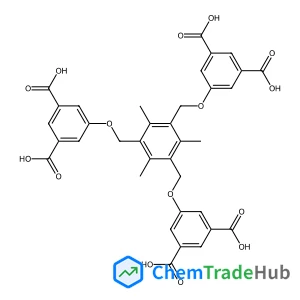
5,5',5''-(((2,4,6-Trimethylbenzene-1,3,5-triyl)tris(methylene))tris(oxy))triisophthalic acid
CAS Number:
1159974-70-5
Molecular Formula:
C36H30O15
Mahasin Alam Sk, Man-Fai Ng, Shuo-Wang Yang, Kok Hwa Lim
Germanium nanowires (GeNWs) with single, double, quadruple and octuple surface dangling bonds (SDBs) are investigated using density-functional-theory calculations. We show that single SDB defected GeNWs remain semiconducting as their non-defected form while double or multiple SDB defects result in either semiconducting or metallic GeNWs, depending on the defect's locations on the surface. More importantly, we show that the electronic properties of surface defected GeNWs can also be fine-tuned by applying tensile and compressive strains. Upon the right loading, the surface defected GeNWs become half-metallic. In addition, we determine that the surface defected GeNWs can be classified into three classes: (1) GeNWs with zero magnetic moment, which are either metallic or semiconducting; (2) GeNWs with net magnetic moments equal to the number of SDBs, which are semiconducting with distinct spin-up and spin-down configurations; and (3) GeNWs with net magnetic moments significantly lower than the number of SDBs. We also find that only the defected GeNWs that fall under (3) are potentially half-metallic. Our results predict that half-metallic GeNWs can be obtained via engineering of the surface defects and the structures without the presence of impurity dopants.
Lanqing Xu, Xiaoman Zhang, Yongping Zheng
DOI: 10.1039/C4CP06014H
Sai Duan, Guangjun Tian, Jun Jiang, Xin Xu
DOI: 10.1039/C5CP01378J
R. Z. Martínez, D. Bermejo
DOI: 10.1039/C5CP01264C
Jing Zhang, Nan Chen, Zheng Tang, Yang Yu, Qili Hu, Chuanping Feng
DOI: 10.1039/C5CP00817D
Shaobing Lin, Jun Xu, Ling Xu, Kunji Chen
DOI: 10.1039/C5CP00246J
Jia-Kai Zhou, Dah-Yen Yang
DOI: 10.1039/C5CP00378D
Per E. M. Siegbahn
DOI: 10.1039/C5CP00138B
Chao-Feng Wu, Tian-Ran Wei, Jing-Feng Li
DOI: 10.1039/C4CP06021K
Arpan Bhattacharya, Surajit Chatterjee, Roopali Prajapati, Tushar Kanti Mukherjee
DOI: 10.1039/C5CP00543D
P. Alarcón, B. Bohn
DOI: 10.1039/C5CP00253B
Waste containing N-Methoxy-N-methyl-1,3-thiazole-5-carboxamide (CAS: 898825-89-3...
N-(4-Biphenylyl)dibenzo[b,d]furan-4-amine should be stored in a tightly sealed c...
The market for 3-Acetamido-5-amino-2,4,6-triiodobenzoic acid (CAS: 1713-07-1) is...
Benzyl 2-O-acetyl-3,4,6-tri-O-benzyl-beta-D-galactopyranoside (CAS: 61820-03-9) ...
2-Ethylpiperazine dihydrochloride (CAS: 438050-52-3) is regulated under the Glob...
1,1'-[1,3-Phenylenebis(methylene)]bis(3-methyl-1H-pyrrole-2,5-dione) (CAS: 11946...
Several alternatives can be used in the synthesis of 5-Fluoro-2-(1-pyrrolidinyl)...
Proper personal protective equipment (PPE) must be worn when handling this compo...
When handling 6-Bromoimidazo[1,2-a]pyridin-8-amine, it is important to wear appr...
Alternatives to (2S,4R)-4-(4-Nitrobenzyl)pyrrolidine-2-carboxylic acid hydrochlo...

Physical Chemistry Chemical Physics (PCCP) is an international journal co-owned by 19 physical chemistry and physics societies from around the world. This journal publishes original, cutting-edge research in physical chemistry, chemical physics and biophysical chemistry. To be suitable for publication in PCCP, articles must include significant innovation and/or insight into physical chemistry; this is the most important criterion that reviewers and Editors will judge against when evaluating submissions. The journal has a broad scope and welcomes contributions spanning experiment, theory, computation and data science. Topical coverage includes spectroscopy, dynamics, kinetics, statistical mechanics, thermodynamics, electrochemistry, catalysis, surface science, quantum mechanics, quantum computing and machine learning. Interdisciplinary research areas such as polymers and soft matter, materials, nanoscience, energy, surfaces/interfaces, and biophysical chemistry are welcomed if they demonstrate significant innovation and/or insight into physical chemistry. Joined experimental/theoretical studies are particularly appreciated when complementary and based on up-to-date approaches.
![[(5-Methyl-1,3,4-thiadiazol-2-yl)sulfanyl]acetic acid structure](https://static.chemtradehub.com/structs/509/50918-26-8-4ce8.webp "[(5-Methyl-1,3,4-thiadiazol-2-yl)sulfanyl]acetic acid structure")