













Salting out in organic solvents: a new route to carbon nanotube bundle engineering
Literature Information
Publication Date
2011-06-09
DOI
10.1039/C1CP21440C
Impact Factor
3.676
Authors
Maxim V. Fedorov, Raz N. Arif, Andrey I. Frolov, Anastasia O. Romanova, Aleksey G. Rozhin
View Original
Abstract
In this study we investigate salt effects on bundle formation of carbon nanotubes (CNTs) dispersed in an organic solvent, N-methyl-2-pyrrolidone (NMP). Addition of NaI salt leads to self-assembly of CNTs into well-recognizable bundles. It is possible to control the size of the CNT bundles by varying the salt concentration.
Related Literature
Density functional tight binding: values of semi-empirical methods in an ab initio era
Qiang Cui, Marcus Elstner
2014-05-13
Perspective
DOI: 10.1039/C4CP00908H
Catalytic oxygen activation versus autoxidation for industrial applications: a physicochemical approach
Xi Liu, Yulia Ryabenkova, Marco Conte
2014-09-26
Perspective
DOI: 10.1039/C4CP03568B
Role of oxygen impurity on the mechanical stability and atomic cohesion of Ta3N5 semiconductor photocatalyst
Jiajia Wang, Jianyong Feng, Li Zhang, Zhaosheng Li, Zhigang Zou
2014-05-15
Paper
DOI: 10.1039/C4CP00120F
Solvent dependence of excited-state proton transfer from pyranine-derived photoacids
Christian Spies, Shay Shomer, Björn Finkler, Dina Pines, Ehud Pines, Gregor Jung, Dan Huppert
2014-03-26
Paper
DOI: 10.1039/C3CP55292F
SO2 – yet another two-faced ligand
Jingbai Li, Andrey Yu. Rogachev
2014-12-01
Paper
DOI: 10.1039/C4CP04208E
Observation of highly decoupled conductivity in protic ionic conductors
Yangyang Wang, Krzysztof J. Paluch
2014-03-27
Paper
DOI: 10.1039/C4CP00899E
Density functional theory and its applications
Michael J. G. Peach
2014-06-16
Editorial
DOI: 10.1039/C4CP90074J
The dynamic crossover in dielectric relaxation behavior of ice Ih
Ivan Popov, Alexander Puzenko, Airat Khamzin, Yuri Feldman
2014-11-19
Paper
DOI: 10.1039/C4CP04271A
Nanoscale spinel LiFeTiO4 for intercalation pseudocapacitive Li+ storage
Shuhua Ren, Ralf Heinzmann
2014-11-21
Paper
DOI: 10.1039/C4CP04655B
You might also like
Compound Q&A
What are the main uses of 1H-Indazole-6-carbonitrile (CAS: 141290-59-7)?
1H-Indazole-6-carbonitrile finds applications in pharmaceuticals, where it serve...
141290-59-71H-Indazole-6-carbon...
Compound Q&A
How should waste containing Dioctyl (2E)-2-butenedioate (CAS: 2997-85-5) be handled?
Waste containing Dioctyl (2E)-2-butenedioate (CAS: 2997-85-5) should be collecte...
2997-85-5Dioctyl (2E)-2-buten...
Compound Q&A
What industries use Sodium [(1,2-benzoxazol-3-ylmethyl)sulfonyl]azanide (CAS: 68291-98-5)?
Sodium [(1,2-benzoxazol-3-ylmethyl)sulfonyl]azanide is primarily used in pharmac...
68291-98-5Sodium [(1,2-benzoxa...
Compound Q&A
Are there alternatives to Dimethyl 4-(4,4,5,5-tetramethyl-1,3,2-dioxaborolan-2-yl)-2,6-pyridinedicarboxylate (CAS: 741709-66-0) in synthesis?
Dimethyl 4-(4,4,5,5-tetramethyl-1,3,2-dioxaborolan-2-yl)-2,6-pyridinedicarboxyla...
741709-66-0Dimethyl 4-(4,4,5,5-...
Compound Q&A
How should waste containing 2-Fluoro-6-hydrazinopyridine (CAS: 80714-39-2) be handled?
Waste containing 2-Fluoro-6-hydrazinopyridine (CAS: 80714-39-2) should be manage...
80714-39-22-Fluoro-6-hydrazino...
Compound Q&A
What is 6-Formyl-2-pyridinecarboxylic acid (CAS: 499214-11-8)?
6-Formyl-2-pyridinecarboxylic acid is an organic compound with the molecular for...
499214-11-86-Formyl-2-pyridinec...
Compound Q&A
What is the market or research trend for 3-(3,4-dimethoxyphenyl)-2,5-dimethyl-N-(2-morpholin-4-ylethyl)pyrazolo[1,5-a]pyrimidin-7-amine (CAS: 900874-91-1)?
Research trends for this compound indicate a focus on its potential applications...
900874-91-13-(3,4-dimethoxyphen...
Compound Q&A
How is 9H-Tribenzo[b,d,f]azepine (CAS: 29875-73-8) typically synthesized?
9H-Tribenzo[b,d,f]azepine is typically synthesized via a multi-step process invo...
29875-73-89H-Tribenzo[b,d,f]az...
Compound Q&A
How is 1-Cyclopropyl-7-ethoxy-6-fluoro-8-methoxy-4-oxo-1,4-dihydro-3-quinolinecarboxylic acid (CAS: 1797982-51-4) typically synthesized?
1-Cyclopropyl-7-ethoxy-6-fluoro-8-methoxy-4-oxo-1,4-dihydro-3-quinolinecarboxyli...
1797982-51-41-Cyclopropyl-7-etho...
Compound Q&A
How should waste containing Methyl 3-oxo-1,2,3,4-tetrahydro-6-quinoxalinecarboxylate (CAS: 671820-52-3) be handled?
Waste containing Methyl 3-oxo-1,2,3,4-tetrahydro-6-quinoxalinecarboxylate (CAS: ...
671820-52-3Methyl 3-oxo-1,2,3,4...
Source Journal
Physical Chemistry Chemical Physics

CiteScore:
5.5
Self-citation Rate:
10.3%
Articles per Year:
3036
Physical Chemistry Chemical Physics (PCCP) is an international journal co-owned by 19 physical chemistry and physics societies from around the world. This journal publishes original, cutting-edge research in physical chemistry, chemical physics and biophysical chemistry. To be suitable for publication in PCCP, articles must include significant innovation and/or insight into physical chemistry; this is the most important criterion that reviewers and Editors will judge against when evaluating submissions. The journal has a broad scope and welcomes contributions spanning experiment, theory, computation and data science. Topical coverage includes spectroscopy, dynamics, kinetics, statistical mechanics, thermodynamics, electrochemistry, catalysis, surface science, quantum mechanics, quantum computing and machine learning. Interdisciplinary research areas such as polymers and soft matter, materials, nanoscience, energy, surfaces/interfaces, and biophysical chemistry are welcomed if they demonstrate significant innovation and/or insight into physical chemistry. Joined experimental/theoretical studies are particularly appreciated when complementary and based on up-to-date approaches.
Recommended Compounds


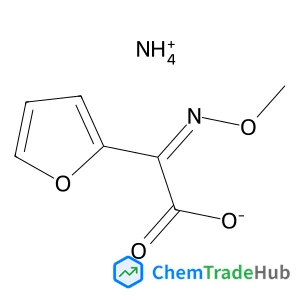
Ammonium (Z)-2-(furan-2-yl)-2-(methoxyimino)acetate
CAS Number:
97148-39-5
Molecular Formula:
C7H10N2O4

Recommended Suppliers



Disclaimer
This page provides academic journal information for reference and research purposes only. We are not affiliated with any journal publishers and do not handle publication submissions. For publication-related inquiries, please contact the respective journal publishers directly.
If you notice any inaccuracies in the information displayed, please contact us at support@chemtradehub.com. We will promptly review and address your concerns.