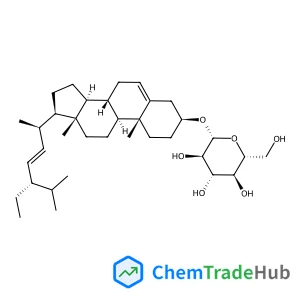
(3beta,22E)-Stigmasta-5,22-dien-3-yl beta-D-glucopyranoside
CAS Number:
19716-26-8
Molecular Formula:
C35H58O6
The first page of this article is displayed as the abstract.
Vankayala Kiran, Kancharlapalli Srinivasu, Srinivasan Sampath
DOI: 10.1039/C3CP50731A
Jiangli Xue, Yang Zhao, Huhu Cheng, Chuangang Hu, Yue Hu, Yuning Meng, Huibo Shao, Zhipan Zhang, Liangti Qu
DOI: 10.1039/C3CP51571K
Xiangchao Ma, Ying Dai, Meng Guo, Yingtao Zhu, Baibiao Huang
DOI: 10.1039/C3CP44519D
Jakub Goclon, Bernd Meyer
DOI: 10.1039/C3CP44546A
Ying Dai, Baibiao Huang, Timo Jacob
DOI: 10.1039/C3CP51078F
Edlira Suljoti, Kai F. Hodeck, Kathrin M. Lange, Mikhail A. Soldatov
DOI: 10.1039/C3CP50686J
Anke Horneber, Anne-Laure Baudrion, Pierre-Michel Adam, Alfred J. Meixner, Dai Zhang
DOI: 10.1039/C3CP43349H
Sirous Asgari, Doretta Capsoni, Piercarlo Mustarelli
DOI: 10.1039/C3CP51481A
Piotr Bernatowicz
DOI: 10.1039/C3CP50963J
When handling 2-Chloro-1,2-bis(4-methylphenyl)ethanone (CAS: 71193-32-3), it is ...
4-Ethoxy-3-(5-methyl-4-oxo-7-propyl-1,4-dihydroimidazo[5,1-f][1,2,4]triazin-2-yl...
Methyl 3-Oxo-4-Androsten-17-Carboxylate (CAS: 2681-55-2) should be stored in a c...
(R)-3-Amino-4-(3-hexylphenylamino)-4-oxobutylphosphonic acid is primarily used i...
2-Methyl-2-propanyl 3-amino-3-carbamoyl-1-azetidinecarboxylate (CAS: 1254120-14-...
There are alternative reagents that can be used in synthesis instead of (E)-4-(t...
[2-(3-Chlorophenyl)-1,3-thiazol-4-yl]methanol (CAS: 121202-20-8) is a crystallin...
The market and research trends for Methyl (2S)-[(4S)-2,2-dimethyl-1,3-dioxolan-4...
The market for 1-Bromo-2-isocyanatoethane (CAS: 42865-19-0) is driven by its use...
4-Nitro-D-phenylalanine hydrochloride (CAS: 147065-06-3) is primarily used in re...

Physical Chemistry Chemical Physics (PCCP) is an international journal co-owned by 19 physical chemistry and physics societies from around the world. This journal publishes original, cutting-edge research in physical chemistry, chemical physics and biophysical chemistry. To be suitable for publication in PCCP, articles must include significant innovation and/or insight into physical chemistry; this is the most important criterion that reviewers and Editors will judge against when evaluating submissions. The journal has a broad scope and welcomes contributions spanning experiment, theory, computation and data science. Topical coverage includes spectroscopy, dynamics, kinetics, statistical mechanics, thermodynamics, electrochemistry, catalysis, surface science, quantum mechanics, quantum computing and machine learning. Interdisciplinary research areas such as polymers and soft matter, materials, nanoscience, energy, surfaces/interfaces, and biophysical chemistry are welcomed if they demonstrate significant innovation and/or insight into physical chemistry. Joined experimental/theoretical studies are particularly appreciated when complementary and based on up-to-date approaches.