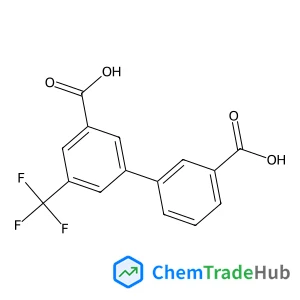
3-(3-Carboxyphenyl)-5-(trifluoromethyl)benzoic acid
CAS Number:
1261930-96-4
Molecular Formula:
C15H9F3O4
Kai-Ge Zhou, Yong-Hui Zhang, Le-Jia Wang, Ke-Feng Xie, Yu-Qing Xiong, Hao-Li Zhang, Cheng-Wei Wang
The feasibility of employing azulene-like molecules as a new type of high performance substitution-free molecular rectifier has been explored using NEGF-DFT calculation. The electronic transport behaviors of metal-molecule-metal junctions consisting of various azulene-like dithiol molecules are investigated, which reveals that the azulene-like molecules exhibit high conductance and bias-dependent rectification effects. Among all the substitution-free azulene-like structures, cyclohepta[b]cyclopenta[g]naphthalene exhibits the highest rectification ratio, revealing that the all fused aromatic ring structure and an appropriate separation between the pentagon and heptagon rings are essential for achieving both high conductance and high rectification ratio. The rectification ratio can be increased by substituting the pentagon ring with electron-withdrawing group and/or the heptagon ring with electron donating groups. Further increase of the rectification ratio may also be obtained by lithium adsorption on the pentagon ring. This work reveals that azulene-like molecules may be used as a new class of highly conductive unimolecular rectifiers.

Journal of Enzyme inhibition and Medicinal Chemistry

Advanced Engineering Materials

Mini-Reviews in Medicinal Chemistry

Coloration Technology

Nature Reviews Drug Discovery

Foundations of Chemistry

Physical Chemistry Chemical Physics

Current Pharmaceutical Biotechnology

Environmental Toxicology and Pharmacology

Photochemical & Photobiological Sciences
L. Cheng, H. J. Liu, J. Zhang, J. Wei, J. H. Liang, P. H. Jiang, D. D. Fan, L. Sun, J. Shi
DOI: 10.1039/C6CP01958G
Robert G. Northcutt, Christian Heinemann, Vishnu Baba Sundaresan
DOI: 10.1039/C6CP03071H
Zhiqi He, Paschalis Alexandridis
DOI: 10.1039/C5CP01620G
Tetiana Lemishko, Jorge Simancas, Manuel Hernández-Rodríguez, Mónica Jiménez-Ruiz, German Sastre, Fernando Rey
DOI: 10.1039/C6CP00971A
Tatsuya Miyatou, Ryutaro Ohashi, Tomonori Ida, Shigeharu Kittaka, Motohiro Mizuno
DOI: 10.1039/C6CP03111K
Lei Huang, Zhaochi Feng, Xiuli Wang, Can Li
DOI: 10.1039/C6CP02808J
Lei Liu, Edison Osorio
DOI: 10.1039/C6CP02445A
Ying-Lu Cui, Fang Xu
DOI: 10.1039/C6CP01128D
4-Amino-3-bromophenol (CAS: 74440-80-5) falls under the classification of a haza...
(17beta)-3-Oxoestr-4-en-17-yl acetate should be stored in a cool, dry place away...
2-[(2,2-Diethoxyethyl)disulfanyl]-1,1-diethoxyethane (CAS: 76505-71-0) is a colo...
The market and research for 1-(β-D-ribofuranosyl)-1H-imidazo[4,5-c]pyridin-4-ami...
Waste containing Conjugated Estrogen (CAS: 12126-59-9) should be collected and d...
The market for Bis(2,2,2-trifluoroethyl) (methoxycarbonylmethyl)phosphonate (CAS...
There are several alternatives to 3,4'-Di-O-methylellagic acid (CAS: 57499-59-9)...
2-Chloro-N,N-dimethylpyridin-4-amine (CAS: 59047-70-0) is regulated under the Gl...
Cerium(3+);oxygen(2-);vanadium(5+) (CAS: 13597-19-8) is a complex inorganic comp...
7-Chloro-1-iodoisoquinoline (CAS: 1203579-27-4) is generally considered safe whe...
Physical Chemistry Chemical Physics (PCCP) is an international journal co-owned by 19 physical chemistry and physics societies from around the world. This journal publishes original, cutting-edge research in physical chemistry, chemical physics and biophysical chemistry. To be suitable for publication in PCCP, articles must include significant innovation and/or insight into physical chemistry; this is the most important criterion that reviewers and Editors will judge against when evaluating submissions. The journal has a broad scope and welcomes contributions spanning experiment, theory, computation and data science. Topical coverage includes spectroscopy, dynamics, kinetics, statistical mechanics, thermodynamics, electrochemistry, catalysis, surface science, quantum mechanics, quantum computing and machine learning. Interdisciplinary research areas such as polymers and soft matter, materials, nanoscience, energy, surfaces/interfaces, and biophysical chemistry are welcomed if they demonstrate significant innovation and/or insight into physical chemistry. Joined experimental/theoretical studies are particularly appreciated when complementary and based on up-to-date approaches.
![Ethyl 5-[({[(2-methyl-2-propanyl)oxy]carbonyl}amino)methyl]-1,2-oxazole-3-carboxylate structure](https://static.chemtradehub.com/structs/253/253196-37-1-8450.webp "Ethyl 5-[({[(2-methyl-2-propanyl)oxy]carbonyl}amino)methyl]-1,2-oxazole-3-carboxylate structure")