












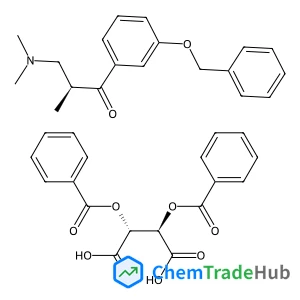
(S)-1-(3-(Benzyloxy)phenyl)-3-(dimethylamino)-2-methylpropan-1-one (2r,3r)-2,3-bis(benzoyloxy)succinate
CAS Number:
1004315-81-4
Molecular Formula:
C37H37NO10
Gábor Bazsó, György Tarczay, Géza Fogarasi, Péter G. Szalay
We have measured the IR and UV spectra of cytosine in a low-temperature argon matrix. An attempt was made to determine the tautomeric ratios existing in the matrix, making use of the matrix-isolation IR spectrum and computed IR intensities of the tautomers in a least squares fitting procedure. The mole fractions are about 0.22 for oxo(-amino) form, 0.26 and 0.44 for the two rotamers, respectively, of the hydroxy(-amino) form and 0.08 for the (oxo-)imino tautomer. These ratios were then used to simulate the matrix-isolation UV spectrum as a composite of the individual spectra, the latter calculated ab initio at high levels of electron correlation theory. The agreement between simulated and experimental UV spectra seems satisfactory. This indicates that, in contrast to the solid state and solution spectra described up to now by the oxo(-amino) form alone, the reproduction of the matrix-isolation UV spectrum needs at least the hydroxy(-amino) and oxo(-amino) forms, and probably also the (oxo-)imino form.
Chao Liu, Ji-yuan Liang, Rui-rui Han, Yong-zheng Wang, Jin Zhao, Qian-jin Huang, Jing Chen, Wen-hua Hou
DOI: 10.1039/C5CP01552A
DOI: 10.1039/C5CP01568E
G. Gerogiokas, M. W. Y. Southey, M. P. Mazanetz, A. Hefeitz, M. Bodkin, R. J. Law, J. Michel
DOI: 10.1039/C5CP90084K
Tianyu Zhu, Peng Chen, Hongfeng Li, Wenbin Sun, Ting Gao, Pengfei Yan
DOI: 10.1039/C5CP01392E
D. W. Boukhvalov, A. N. Rudenko, D. A. Prishchenko, V. G. Mazurenko
DOI: 10.1039/C5CP01901J
S. R. Tripathi, K. Kawase, A. Puzenko, Yu. Feldman
DOI: 10.1039/C5CP01871D
C. A. Barrero, A. Punnoose
DOI: 10.1039/C5CP01408E
Deby Fapyane, Andrey Kartashov, Claes von Wachenfeldt, Elena E. Ferapontova
DOI: 10.1039/C5CP00960J
2-Methylbenzene-1,4-diamine dihydrochloride (CAS: 615-45-2) should be stored in ...
(1S,4S)-2,5-Diazabicyclo[2.2.1]heptane dihydrobromide is generally considered sa...
(6-Chloropyridazin-3-YL)methanamine finds applications in the pharmaceutical ind...
2-Fluoro-3-methylphenol is primarily used in the synthesis of pharmaceuticals, p...
When handling 3-Methoxy-4-nitrobenzonitrile, it is important to wear appropriate...
When handling 1,3-Oxazolo[4,5-b]pyridine-2(3H)-thione (CAS: 211949-57-4), it is ...
4-Ethynylbenzamide (CAS: 90347-86-7) falls under various regulatory guidelines i...
3-(2-Ethylphenyl)-2-thioxo-4-imidazolidinone is primarily used as an intermediat...
(2-Fluoro-6-methoxyphenyl)acetic acid, also known as 4-fluoro-3-methoxybenzoic a...
Market trends for 2-[4-(Hydroxymethyl)phenoxy]ethanol (CAS: 102196-18-9) indicat...

Physical Chemistry Chemical Physics (PCCP) is an international journal co-owned by 19 physical chemistry and physics societies from around the world. This journal publishes original, cutting-edge research in physical chemistry, chemical physics and biophysical chemistry. To be suitable for publication in PCCP, articles must include significant innovation and/or insight into physical chemistry; this is the most important criterion that reviewers and Editors will judge against when evaluating submissions. The journal has a broad scope and welcomes contributions spanning experiment, theory, computation and data science. Topical coverage includes spectroscopy, dynamics, kinetics, statistical mechanics, thermodynamics, electrochemistry, catalysis, surface science, quantum mechanics, quantum computing and machine learning. Interdisciplinary research areas such as polymers and soft matter, materials, nanoscience, energy, surfaces/interfaces, and biophysical chemistry are welcomed if they demonstrate significant innovation and/or insight into physical chemistry. Joined experimental/theoretical studies are particularly appreciated when complementary and based on up-to-date approaches.
![(1R,6R)-6-({[(2-Methyl-2-propanyl)oxy]carbonyl}amino)-3-cyclohexene-1-carboxylic acid structure](https://static.chemtradehub.com/structs/865/865689-24-3-5fef.webp "(1R,6R)-6-({[(2-Methyl-2-propanyl)oxy]carbonyl}amino)-3-cyclohexene-1-carboxylic acid structure")





