












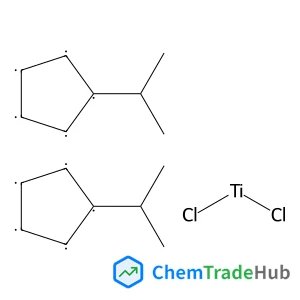
BIS(I-PROPYLCYCLOPENTADIENYL)TITANIUM DICHLORIDE
CAS Number:
12130-65-3
Molecular Formula:
C16H22Cl2Ti
Nitzan Mayorkas, Itamar Malka, Ilana Bar
The approach of studying structural and dynamical properties of flexible molecules is of substantial interest, as it allows decoding the shapes and intrinsic properties of isolated molecular constituents, which have an influence on the selectivity and functionality in biological processes. Combining quantum computation methods with double resonance or infrared hole burning techniques, mainly covering hydride stretch vibrations, recently led to great progress in understanding the structure of a variety of biological building blocks. Measurements of spectra in the lower frequency range, with relatively compact and convenient laser sources, still pose major challenges. For this reason, the method of ionization-loss stimulated Raman spectroscopy (ILSRS) has been developed and applied for monitoring the spectral features of the 2-phenylethanol prototype. The bands observed in the Raman spectra of its two conformers uniquely identify their structures and are in accord with anharmonic results obtained by density functional theory calculations. These findings point to future opportunities for ILSRS as a powerful conformational probe and set new standards for detailed interrogation of structure and intra- and inter-molecular interactions.
Vitaly Alexandrov, Kevin M. Rosso
DOI: 10.1039/C5CP00921A
Tao Zhang, Zhiguang Xu, Zengxiao Cai, Qipeng Guo
DOI: 10.1039/C5CP01157D
D. W. Boukhvalov, A. N. Rudenko, D. A. Prishchenko, V. G. Mazurenko
DOI: 10.1039/C5CP01901J
PengHui Wang, ZhiQiang Li, Walter J. Salcedo, Zhuo Sun, SuMei Huang, Alexandre G. Brolo
DOI: 10.1039/C5CP02249E
T. Jüstel, C. Ronda, A. Meijerink
DOI: 10.1039/C5CP01095K
Y. Yamauchi
DOI: 10.1039/C5CP02466H
Nicolas Ferré, Nathalie Guihéry, Jean-Paul Malrieu
DOI: 10.1039/C4CP05531D
Deby Fapyane, Andrey Kartashov, Claes von Wachenfeldt, Elena E. Ferapontova
DOI: 10.1039/C5CP00960J
Xiang Xiao, Guangming Jiang, Yuxin Zhang, Wen Cui, Jinzhu Ma
DOI: 10.1039/C5CP02460A
Oksana Plekan, Vitaliy Feyer, Andrew Cassidy, Victor Lyamayev, Nataliya Tsud, Sylwia Ptasińska, Sara Reiff, Rober G. Acres
DOI: 10.1039/C5CP01886B
2-Methylbenzene-1,4-diamine dihydrochloride (CAS: 615-45-2) should be stored in ...
(1S,4S)-2,5-Diazabicyclo[2.2.1]heptane dihydrobromide is generally considered sa...
(6-Chloropyridazin-3-YL)methanamine finds applications in the pharmaceutical ind...
2-Fluoro-3-methylphenol is primarily used in the synthesis of pharmaceuticals, p...
When handling 3-Methoxy-4-nitrobenzonitrile, it is important to wear appropriate...
When handling 1,3-Oxazolo[4,5-b]pyridine-2(3H)-thione (CAS: 211949-57-4), it is ...
4-Ethynylbenzamide (CAS: 90347-86-7) falls under various regulatory guidelines i...
3-(2-Ethylphenyl)-2-thioxo-4-imidazolidinone is primarily used as an intermediat...
(2-Fluoro-6-methoxyphenyl)acetic acid, also known as 4-fluoro-3-methoxybenzoic a...
Market trends for 2-[4-(Hydroxymethyl)phenoxy]ethanol (CAS: 102196-18-9) indicat...

Physical Chemistry Chemical Physics (PCCP) is an international journal co-owned by 19 physical chemistry and physics societies from around the world. This journal publishes original, cutting-edge research in physical chemistry, chemical physics and biophysical chemistry. To be suitable for publication in PCCP, articles must include significant innovation and/or insight into physical chemistry; this is the most important criterion that reviewers and Editors will judge against when evaluating submissions. The journal has a broad scope and welcomes contributions spanning experiment, theory, computation and data science. Topical coverage includes spectroscopy, dynamics, kinetics, statistical mechanics, thermodynamics, electrochemistry, catalysis, surface science, quantum mechanics, quantum computing and machine learning. Interdisciplinary research areas such as polymers and soft matter, materials, nanoscience, energy, surfaces/interfaces, and biophysical chemistry are welcomed if they demonstrate significant innovation and/or insight into physical chemistry. Joined experimental/theoretical studies are particularly appreciated when complementary and based on up-to-date approaches.

![1-Benzyl-1,7-diazaspiro[4.4]nonane dihydrochloride structure](https://static.chemtradehub.com/structs/115/1159822-71-5-0320.webp "1-Benzyl-1,7-diazaspiro[4.4]nonane dihydrochloride structure")




