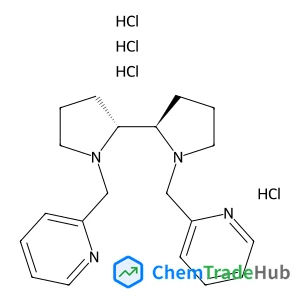
(2R,2'R)-1,1'-Bis(2-pyridinylmethyl)-2,2'-bipyrrolidine tetrahydrochloride
CAS Number:
1228077-88-0
Molecular Formula:
C20H30Cl4N4
Jing Guo, Benjamin Koeppe
A series of strong H-bonded complexes of trimethylglycine, also known as betaine, with acetic, chloroacetic, dichloroacetic, trifluoroacetic and hydrofluoric acids as well as the homo-conjugated cation of betaine with trifluoroacetate as the counteranion were investigated by low-temperature (120–160 K) liquid-state NMR spectroscopy using CDF3/CDF2Cl mixture as the solvent. The temperature dependencies of 1H NMR chemical shifts are analyzed in terms of the solvent–solute interactions. The experimental data are explained assuming the combined action of two main effects. Firstly, the solvent ordering around the negatively charged OHX region of the complex (X = O, F) at low temperatures, which leads to a contraction and symmetrisation of the H-bond; this effect dominates for the homo-conjugated cation of betaine. Secondly, at low temperatures structures with a larger dipole moment are preferentially stabilized, an effect which dominates for the neutral betaine–acid complexes. The way this second contribution affects the H-bond geometry seems to depend on the proton position. For the Be+COO−⋯HOOCCH3 complex (Be = (CH3)3NCH2–) the proton displaces towards the hydrogen bond center (H-bond symmetrisation, O⋯O contraction). In contrast, for the Be+COOH⋯−OOCCF3 complex the proton shifts further away from the center, closer to the betaine moiety (H-bond asymmetrisation, O⋯O elongation). Hydrogen bond geometries and their changes upon lowering the temperature were estimated using previously published H-bond correlations.
Cristina Lavilla, Sebastián Muñoz-Guerra
DOI: 10.1039/C2GC36480H
Wenchao Wan, Shiqian Wei, Jingguo Li, Carlos A. Triana, Ying Zhou, Greta R. Patzke
DOI: 10.1039/C9TA03213D
Xing Li, Priya Yadav, Kian Ping Loh
DOI: 10.1039/D0CS00236D
Evgeny A. Uslamin, Nikolay A. Kosinov, Evgeny A. Pidko, Emiel J. M. Hensen
DOI: 10.1039/C8GC01528G
Zhenzhen Zhou, Jian-Gong Ma, Jianbo Gao
DOI: 10.1039/D1GC01677F
Gangjian Tan, Fengyuan Shi, Jeff W. Doak, Hui Sun, Li-Dong Zhao, Pengli Wang, Ctirad Uher, Chris Wolverton, Vinayak P. Dravid
DOI: 10.1039/C4EE01463D
S. H. Jensen, C. Graves, M. Mogensen, C. Wendel, R. Braun, G. Hughes, Z. Gao, S. A. Barnett
DOI: 10.1039/C6EE90064J
Andrea Marcucci, Francesca Zurlo, Isabella Natali Sora, Stefano Casciardi, Silvia Licoccia, Elisabetta Di Bartolomeo
DOI: 10.1039/C8TA10645B
Sachin Kumar, Ghuzanfar Saeed, Nam Hoon Kim
DOI: 10.1039/C8TA00889B
(5-Sulfamoyl-3-pyridinyl)boronic acid is primarily used in chemical synthesis, p...
Benzyl 2-methyl-2-(methylsulfonyl)-4-pentenoate is typically synthesized via est...
When handling 8-Fluoroquinolin-6-ol (CAS: 209353-22-0), it is important to use p...
1,3-Dibromo-5-(2-methyl-2-propanyl)benzene (CAS: 129316-09-2) is a crystalline c...
Ethyl 7-chloro-4-oxo-1-(1,3-thiazol-2-yl)-1,4-dihydro-1,8-naphthyridine-3-carbox...
When handling Delta-7-Avenasterol (CAS: 23290-26-8), it is important to wear app...
Proper handling involves the use of personal protective equipment such as gloves...
When handling 2-Methyl-2-proanyl 4-[(2-aminophenyl)amino]-1-piperidinecarboxylat...
N-Methyl-4-chlorobenzylamine hydrochloride (CAS: 65542-24-7) is a organic compou...
[2-(Dodecyloxy)ethoxy]acetic acid (CAS: 27306-90-7) is generally considered safe...

Physical Chemistry Chemical Physics (PCCP) is an international journal co-owned by 19 physical chemistry and physics societies from around the world. This journal publishes original, cutting-edge research in physical chemistry, chemical physics and biophysical chemistry. To be suitable for publication in PCCP, articles must include significant innovation and/or insight into physical chemistry; this is the most important criterion that reviewers and Editors will judge against when evaluating submissions. The journal has a broad scope and welcomes contributions spanning experiment, theory, computation and data science. Topical coverage includes spectroscopy, dynamics, kinetics, statistical mechanics, thermodynamics, electrochemistry, catalysis, surface science, quantum mechanics, quantum computing and machine learning. Interdisciplinary research areas such as polymers and soft matter, materials, nanoscience, energy, surfaces/interfaces, and biophysical chemistry are welcomed if they demonstrate significant innovation and/or insight into physical chemistry. Joined experimental/theoretical studies are particularly appreciated when complementary and based on up-to-date approaches.
![(3E)-3-[4-Hydroxy-3,5-bis(2-methyl-2-propanyl)benzylidene]dihydro-2(3H)-furanone structure](https://static.chemtradehub.com/structs/102/102271-49-8-cba7.webp "(3E)-3-[4-Hydroxy-3,5-bis(2-methyl-2-propanyl)benzylidene]dihydro-2(3H)-furanone structure")