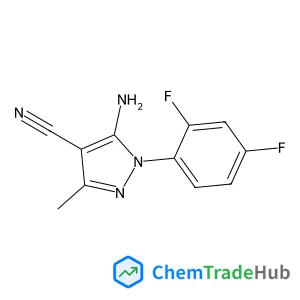
5-Amino-1-(2,4-difluorophenyl)-3-methyl-1H-pyrazole-4-carbonitrile
CAS Number:
1020057-92-4
Molecular Formula:
C11H8F2N4
E. Hazrati, G. Brocks, B. Buurman, G. A. de Wijs
The lithium amide (LiNH2) + lithium hydride (LiH) system is one of the most attractive light-weight materials options for hydrogen storage. Its dehydrogenation involves mass transport in the bulk (amide) crystal through lattice defects. We present a first-principles study of native point defects and dopants in LiNH2 using density functional theory. We find that both Li-related defects (the positive interstitial Li+i and the negative vacancy V−Li) and H-related defects (H+i and V−H) are charged. Li-related defects are most abundant. Having diffusion barriers of 0.3–0.5 eV, they diffuse rapidly at moderate temperatures. V−H corresponds to the [NH]2− ion. It is the dominant species available for proton transport with a diffusion barrier of ∼0.7 eV. The equilibrium concentration of H+i, which corresponds to the NH3 molecule, is negligible in bulk LiNH2. Dopants such as Ti and Sc do not affect the concentration of intrinsic defects, whereas Mg and Ca can alter it by a moderate amount. Ti and Mg are easily incorporated into the LiNH2 lattice, which may affect the crystal morphology on the nano-scale.

Journal of Physics and Chemistry of Solids

Proceedings of the National Academy of Sciences of the United States of America

Pure and Applied Chemistry

Pharmacological Reviews

Science Progress

Journal of Medicinal Chemistry

Russian Chemical Reviews

Planta Medica

Kinetics and Catalysis

Journal of Heterocyclic Chemistry
Hashem Shahroosvand, Fahimeh Nasouti, Ahmad Sousaraei, Ezeddin Mohajerani, Amir Khabbazi
DOI: 10.1039/C3CP51141C
C. Marchetti, R. Lazzaroni, D. Jore, M. Gardès-Albert
DOI: 10.1039/C3CP50602A
Lauro Oliver Paz-Borbón, Anders Hellman, John Meurig Thomas, Henrik Grönbeck
DOI: 10.1039/C3CP51384J
Jingling Liu, Muhammad Shahid, Young-Seon Ko, Eunchul Kim, Tae Kyu Ahn, Jong Hyeok Park
DOI: 10.1039/C3CP51053K
De-Gong Wang, Li-Gang Niu, Bin-Bin Xu, Jun-Feng Song, Qi-Dai Chen, Hong-Bo Sun
DOI: 10.1039/C3CP44051F
Sil Wellens, Ben Thijs, Claudia Möller, Koen Binnemans
DOI: 10.1039/C3CP50819F
Mario Chiesa, Maria Cristina Paganini, Stefano Livraghi, Elio Giamello
DOI: 10.1039/C3CP50658D
Hiromasa Shiiba, Toshihiro Kasuga, Robin W. Grimes, John A. Kilner
DOI: 10.1039/C3CP50316J
Hongmin Ma, Picheng Gao, Dawei Fan, Guobao Li, Dan Wu, Bin Du, Qin Wei
DOI: 10.1039/C3CP50341K
Ethyl 4-chlorothieno[2,3-b]pyridine-5-carboxylate (CAS: 59713-58-5) can be synth...
5-Methyl-1H-indole-3-carbaldehyde (CAS: 52562-50-2) is subject to various regula...
(1,3-Dimethyl-2,4-dioxo-1,2,3,4-tetrahydro-5-pyrimidinyl)boronic acid is a white...
Waste containing Sulfocostunolide A (CAS: 1016983-51-9) should be handled with c...
When handling Murraxocin (CAS: 88478-44-8), ensure proper personal protective eq...
Formvar (CAS: 63148-64-1) is an alkyd resin characterized by a high molecular we...
(S)-4-benzyl-2-((benzyloxy)methyl)morpholine is generally safe when handled with...
Methyl 1-(5-bromo-2-pyrimidinyl)cyclopropanecarboxylate (CAS: 1447607-69-3) is p...
2-Methyl-1-phenyl-1-propanamine hydrochloride (CAS: 24290-47-9) is generally con...
3-(4-Bromophenyl)-2-methylpropanoic acid is synthesized through a multi-step pro...

Physical Chemistry Chemical Physics (PCCP) is an international journal co-owned by 19 physical chemistry and physics societies from around the world. This journal publishes original, cutting-edge research in physical chemistry, chemical physics and biophysical chemistry. To be suitable for publication in PCCP, articles must include significant innovation and/or insight into physical chemistry; this is the most important criterion that reviewers and Editors will judge against when evaluating submissions. The journal has a broad scope and welcomes contributions spanning experiment, theory, computation and data science. Topical coverage includes spectroscopy, dynamics, kinetics, statistical mechanics, thermodynamics, electrochemistry, catalysis, surface science, quantum mechanics, quantum computing and machine learning. Interdisciplinary research areas such as polymers and soft matter, materials, nanoscience, energy, surfaces/interfaces, and biophysical chemistry are welcomed if they demonstrate significant innovation and/or insight into physical chemistry. Joined experimental/theoretical studies are particularly appreciated when complementary and based on up-to-date approaches.