













Molecular dynamics simulations of structure and dynamics of organic molecular crystals
Literature Information
Publication Date
2010-10-14
DOI
10.1039/C0CP01409E
Impact Factor
3.676
Authors
Alexandra Nemkevich, Mark A. Spackman, Ben Corry
View Original
Abstract
A set of model compounds covering a range of polarity and flexibility have been simulated using GAFF, CHARMM22, OPLS and MM3 force fields to examine how well classical molecular dynamics simulations can reproduce structural and dynamic aspects of organic molecular crystals. Molecular structure, crystal structure and thermal motion, including molecular reorientations and internal rotations, found from the simulations have been compared between force fields and with experimental data. The MM3 force field does not perform well in condensed phase simulations, while GAFF, CHARMM and OPLS perform very similarly. Generally molecular and crystal structure are reproduced well, with a few exceptions. The atomic displacement parameters (ADPs) are mostly underestimated in the simulations with a relative error of up to 70%. Examples of molecular reorientation and internal rotation, observed in the simulations, include in-plane reorientations of benzene, methyl rotations in alanine, decane, isopropylcyclohexane, pyramidal inversion of nitrogen in amino group and rotation of the whole group around the C–N bond. Frequencies of such dynamic processes were calculated, as well as thermodynamic properties for reorientations in benzene and alanine. We conclude that MD simulations can be used for qualitative analysis, while quantitative results should be taken with caution. It is important to compare the outcomes from simulations with as many experimental quantities as available before using them to study or quantify crystal properties not available from experiment.
Related Literature
A QCM study of ORR-OER and an in situ study of a redox mediator in DMSO for Li–O2 batteries
Stijn Schaltin, Gijs Vanhoutte, Minxian Wu, Fanny Bardé, Jan Fransaer
2015-04-13
Paper
DOI: 10.1039/C5CP00386E
Identifying and tracing potential energy surfaces of electronic excitations with specific character via their transition origins: application to oxirane
Jian-Hao Li, T. J. Zuehlsdorff, M. C. Payne, N. D. M. Hine
2015-04-01
Paper
DOI: 10.1039/C5CP01018G
Modelling bio-electrosynthesis in a reverse microbial fuel cell to produce acetate from CO2 and H2O
M. Kazemi, D. Biria, H. Rismani-Yazdi
2015-04-13
Paper
DOI: 10.1039/C5CP00904A
New particle formation and growth from methanesulfonic acid, trimethylamine and water
Haihan Chen, Michael J. Ezell, Kristine D. Arquero, Mychel E. Varner, Matthew L. Dawson, R. Benny Gerber, Barbara J. Finlayson-Pitts
2015-04-27
Paper
DOI: 10.1039/C5CP00838G
Multiwalled carbon nanotube coated polyester fabric as textile based flexible counter electrode for dye sensitized solar cell
Alvira Ayoub Arbab, Kyung Chul Sun, Iftikhar Ali Sahito, Muhammad Bilal Qadir, Sung Hoon Jeong
2015-04-10
Paper
DOI: 10.1039/C5CP00818B
Coherent resonance of quantum plasmons in the graphene–gold cluster hybrid system
Chikang Li
2015-04-15
Paper
DOI: 10.1039/C4CP05049E
Modelling proton tunnelling in the adenine–thymine base pair
A. D. Godbeer, J. S. Al-Khalili, P. D. Stevenson
2015-04-20
Paper
DOI: 10.1039/C5CP00472A
Tunable electronic properties in the van der Waals heterostructure of germanene/germanane
Run-wu Zhang, Chang-wen Zhang, Wei-xiao Ji, Feng Li, Miao-juan Ren, Ping Li, Min Yuan, Pei-ji Wang
2015-03-31
Paper
DOI: 10.1039/C5CP00875A
Experimental determination of the rate of V–V collisional relaxation in 14N2 in its ground (X1Σg+) electronic state between 77 and 300 K
R. Z. Martínez, D. Bermejo
2015-04-23
Paper
DOI: 10.1039/C5CP01264C
You might also like
Compound Q&A
What are the main uses of (5-Sulfamoyl-3-pyridinyl)boronic acid (CAS: 951233-61-7)?
(5-Sulfamoyl-3-pyridinyl)boronic acid is primarily used in chemical synthesis, p...
951233-61-7(5-Sulfamoyl-3-pyrid...
Compound Q&A
How is Benzyl 2-methyl-2-(methylsulfonyl)-4-pentenoate (CAS: 1942858-50-5) typically synthesized?
Benzyl 2-methyl-2-(methylsulfonyl)-4-pentenoate is typically synthesized via est...
1942858-50-5Benzyl 2-methyl-2-(m...
Compound Q&A
What precautions should be taken when handling 8-Fluoroquinolin-6-ol (CAS: 209353-22-0)?
When handling 8-Fluoroquinolin-6-ol (CAS: 209353-22-0), it is important to use p...
209353-22-08-Fluoroquinolin-6-o...
Compound Q&A
What are the physical and chemical properties of 1,3-Dibromo-5-(2-methyl-2-propanyl)benzene (CAS: 129316-09-2)?
1,3-Dibromo-5-(2-methyl-2-propanyl)benzene (CAS: 129316-09-2) is a crystalline c...
129316-09-21,3-Dibromo-5-(2-met...
Compound Q&A
What industries use Ethyl 7-chloro-4-oxo-1-(1,3-thiazol-2-yl)-1,4-dihydro-1,8-naphthyridine-3-carboxylate (CAS: 174726-87-5)?
Ethyl 7-chloro-4-oxo-1-(1,3-thiazol-2-yl)-1,4-dihydro-1,8-naphthyridine-3-carbox...
174726-87-5Ethyl 7-chloro-4-oxo...
Compound Q&A
What precautions should be taken when handling Delta-7-Avenasterol (CAS: 23290-26-8)?
When handling Delta-7-Avenasterol (CAS: 23290-26-8), it is important to wear app...
23290-26-8Delta-7-Avenasterol
Compound Q&A
What precautions should be taken when handling N-({(5R)-3-[3-Fluoro-4-(4-morpholinyl)phenyl]-2-oxo-1,3-oxazolidin-5-yl}methyl)acetamide (CAS: 872992-20-6)?
Proper handling involves the use of personal protective equipment such as gloves...
872992-20-6N-({(5R)-3-[3-Fluoro...
Compound Q&A
What precautions should be taken when handling 2-Methyl-2-proanyl 4-[(2-aminophenyl)amino]-1-piperidinecarboxylate (CAS: 79099-00-6)?
When handling 2-Methyl-2-proanyl 4-[(2-aminophenyl)amino]-1-piperidinecarboxylat...
79099-00-62-Methyl-2-propanyl ...
Compound Q&A
What is N-Methyl-4-chlorobenzylamine hydrochloride (CAS: 65542-24-7)?
N-Methyl-4-chlorobenzylamine hydrochloride (CAS: 65542-24-7) is a organic compou...
65542-24-7N-Methyl-4-chloroben...
Compound Q&A
Is [2-(Dodecyloxy)ethoxy]acetic acid (CAS: 27306-90-7) safe?
[2-(Dodecyloxy)ethoxy]acetic acid (CAS: 27306-90-7) is generally considered safe...
27306-90-7[2-(Dodecyloxy)ethox...
Source Journal
Physical Chemistry Chemical Physics

CiteScore:
5.5
Self-citation Rate:
10.3%
Articles per Year:
3036
Physical Chemistry Chemical Physics (PCCP) is an international journal co-owned by 19 physical chemistry and physics societies from around the world. This journal publishes original, cutting-edge research in physical chemistry, chemical physics and biophysical chemistry. To be suitable for publication in PCCP, articles must include significant innovation and/or insight into physical chemistry; this is the most important criterion that reviewers and Editors will judge against when evaluating submissions. The journal has a broad scope and welcomes contributions spanning experiment, theory, computation and data science. Topical coverage includes spectroscopy, dynamics, kinetics, statistical mechanics, thermodynamics, electrochemistry, catalysis, surface science, quantum mechanics, quantum computing and machine learning. Interdisciplinary research areas such as polymers and soft matter, materials, nanoscience, energy, surfaces/interfaces, and biophysical chemistry are welcomed if they demonstrate significant innovation and/or insight into physical chemistry. Joined experimental/theoretical studies are particularly appreciated when complementary and based on up-to-date approaches.
Recommended Compounds
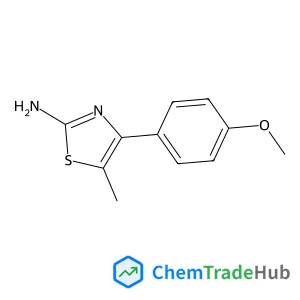
4-(4-Methoxyphenyl)-5-methyl-1,3-thiazol-2-amine
CAS Number:
105512-88-7
Molecular Formula:
C11H12N2OS
![[3-Fluoro-4-(1-pyrrolidinylcarbonyl)phenyl]boronic acid structure](https://static.chemtradehub.com/structs/874/874289-09-5-e3d4.webp "[3-Fluoro-4-(1-pyrrolidinylcarbonyl)phenyl]boronic acid structure")
[3-Fluoro-4-(1-pyrrolidinylcarbonyl)phenyl]boronic acid
CAS Number:
874289-09-5
Molecular Formula:
C11H13BFNO3
Recommended Suppliers





Disclaimer
This page provides academic journal information for reference and research purposes only. We are not affiliated with any journal publishers and do not handle publication submissions. For publication-related inquiries, please contact the respective journal publishers directly.
If you notice any inaccuracies in the information displayed, please contact us at support@chemtradehub.com. We will promptly review and address your concerns.