












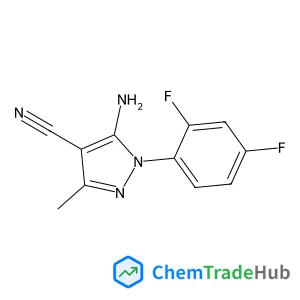
5-Amino-1-(2,4-difluorophenyl)-3-methyl-1H-pyrazole-4-carbonitrile
CAS Number:
1020057-92-4
Molecular Formula:
C11H8F2N4
Marion Bauer, Daniel M. Többens, Erwin Mayer, Thomas Loerting
A range of techniques has so far been employed for producing amorphous aqueous solutions. In case of aqueous tetrahydrofuran (THF) this comprises hyperquenching of liquid droplets, vapour co-deposition and pressure-induced amorphization of the crystalline cubic structure II clathrate. All of these samples are thermally labile and crystallize at temperatures above 110 K. We here outline a variant of the pressure-amorphization protocol developed by Suzuki [Phys. Rev. B, 2004, 70, 172108], which results in a highly crystallization resistant amorphous THF hydrate. The hydrate produced according to our protocol (annealing to 180 K at 1.8 GPa rather than to 150 K at 1.5 GPa) does not transform to the cubic structure II THF clathrate even at 150 K. We track the reason for this higher stability to the presence of crystalline remnants when following the Suzuki protocol, which are removed when using our protocol involving higher pressures and an annealing step. These crystalline remnants later serve as crystallization seeds lowering the thermal stability of the amorphous sample. Our protocol thus makes a purely amorphous THF hydrate available to the research community. We use powder X-ray diffraction to study the process of nucleation and slow crystal growth in the temperature range 160–200 K and find that the local cage structure and periodicity of the fully crystalline hydrate develops even at the earliest stages of crystallization, when the “clathrate crystal” has a size of about two unit cells.
Zhengzhou Chu, Chengcai Xia
DOI: 10.1039/C9OB01224A
Alejandro Dana, Pablo H. Di Chenna, Benjamin Darses, Fernando J. Durán, Philippe Dauban
DOI: 10.1039/C9OB00272C
Deepika Kathuria, Pankaj Gupta, Sumit S. Chourasiya, Subash C. Sahoo, Uwe Beifuss, Asit K. Chakraborti, Prasad V. Bharatam
DOI: 10.1039/C9OB00610A
Komalla Sunil, Sridhar Balasubramanian
DOI: 10.1039/C9OB00756C
Mikinori Ando, Mika Sakai, Naoki Ando, Masato Hirai
DOI: 10.1039/C9OB00934E
Jian-Yun Lin, Juan-Juan Gao, Xin-Yan Wu
DOI: 10.1039/C9OB00736A
Alexander M. Genaev, Vyacheslav G. Shubin, Henry S. Rzepa
DOI: 10.1039/C9OB00607A
Yi He, Danjun Wu, Zhenghua Li, Koen Robeyns, Luc Van Meervelt
DOI: 10.1039/C9OB01299K
1-(2,4,6-Trifluorophenyl)ethanol is an organic compound with the CAS number 1250...
1-(2,4-Dimethoxybenzyl)-4-(hydroxymethyl)-2-pyrrolidinone (CAS: 919111-34-5) is ...
(7S,15R)-6β,15-Diacetoxy-7α,20-epoxy-7-hydroxykaura-2,16-dien-1-one is a crystal...
The compound rac-ethyl (1r,4r)-4-hydroxycyclohexane-1-carboxylate, trans (CAS: 3...
The market for 2-(2,4-Difluorophenoxy)-3-nitropyridine (CAS: 175135-62-3) is cur...
The main uses of 6-Diazo-5-oxo-L-norleucine (CAS: 157-03-9) include research in ...
When handling 2-Aminoethyl-mono-amide-DOTA-tris(tBu ester) (CAS: 173308-19-5), i...
5-Methylimidazo[1,2-a]pyridine-3-carbaldehyde (CAS: 178488-37-4) can be synthesi...
There are alternative reagents that can be used in the synthesis of 2,4,6-Trihyd...
(2Z)-3-(5-Fluoro-1H-indol-3-yl)-2-sulfanylacrylic acid is a chemical compound wi...

Physical Chemistry Chemical Physics (PCCP) is an international journal co-owned by 19 physical chemistry and physics societies from around the world. This journal publishes original, cutting-edge research in physical chemistry, chemical physics and biophysical chemistry. To be suitable for publication in PCCP, articles must include significant innovation and/or insight into physical chemistry; this is the most important criterion that reviewers and Editors will judge against when evaluating submissions. The journal has a broad scope and welcomes contributions spanning experiment, theory, computation and data science. Topical coverage includes spectroscopy, dynamics, kinetics, statistical mechanics, thermodynamics, electrochemistry, catalysis, surface science, quantum mechanics, quantum computing and machine learning. Interdisciplinary research areas such as polymers and soft matter, materials, nanoscience, energy, surfaces/interfaces, and biophysical chemistry are welcomed if they demonstrate significant innovation and/or insight into physical chemistry. Joined experimental/theoretical studies are particularly appreciated when complementary and based on up-to-date approaches.
![2-Methyl-2-propanyl 1,6-diazaspiro[3.4]octane-6-carboxylate structure](https://static.chemtradehub.com/structs/115/1158749-79-1-81ee.webp "2-Methyl-2-propanyl 1,6-diazaspiro[3.4]octane-6-carboxylate structure")
![9,9'-Spirobi[fluoren]-2-amine structure](https://static.chemtradehub.com/structs/118/118951-68-1-0d14.webp "9,9'-Spirobi[fluoren]-2-amine structure")






