


Fluorescence of sanguinarine: spectral changes on interaction with amino acids
Literature Information
Publication Date
2010-08-03
DOI
10.1039/B925828K
Impact Factor
3.676
Authors
Marika Janovská, Martin Kubala, Vilím Šimánek, Jitka Ulrichová
View Original
Abstract
The quaternary isoquinoline alkaloid, sanguinarine (SG) exhibits a wide range of biological activities. This study examines spectral changes expected from SG binding to proteins. Fluorescence spectra of the cationic form of sanguinarine (SG+) are sensitive to environment polarity. On the other hand, spectra of the neutral form of sanguinarine, pseudobase (SGOH) and dihydrosanguinarine (DHSG, the first metabolite of SG) exhibit higher sensitivity to the ability of solvent to form a solute-to-solvent hydrogen bonds. Interaction with cysteine has been the only mode of SG binding to enzymes that has been considered so far. In reality, our experiments have revealed spectral changes on specific interactions of SG+ with Cys, Glu and Tyr in the protic environment and with Arg and Glu in the aprotic environment. We have also detected interactions of SGOH with Cys in the protic environment and with Cys, Glu and Lys in the aprotic environment. The DHSG spectra were only altered in the presence of the Cys analog in the protic environment. We have also demonstrated that spectral change analysis can aid investigation of SG/DHSG interactions with proteins and we were able to identify SG+-binding site on Na+/K+-ATPase.
Recommended Journals

Journal of the American Chemical Society

Anti-Corrosion Methods and Materials

Canadian Metallurgical Quarterly

Ferroelectrics

Chemical & Pharmaceutical Bulletin

Chemistry of Natural Compounds

Bulletin of the Chemical Society of Japan

Advances in Colloid and Interface Science

Corrosion Science

Journal of the Chinese Chemical Society
Related Literature
ZnO nanoparticle based highly efficient CdS/CdSe quantum dot-sensitized solar cells
Chunhui Li, Lei Yang, Junyan Xiao, Yih-Chyng Wu, Martin Søndergaard, Yanhong Luo, Dongmei Li, Qingbo Meng, Bo Brummerstedt Iversen
2013-03-27
Communication
DOI: 10.1039/C3CP50365H
Mechanisms behind sulfur promoted oxidation of methane
Johan Gustafson, Marco Di Michiel, Mark A. Newton
2013-02-11
Paper
DOI: 10.1039/C3CP44289F
Spectral assignments and NMR parameter–structure relationships in borates using high-resolution 11B NMR and density functional theory
Oliver L. G. Alderman, Dinu Iuga, Andrew P. Howes, Diane Holland, Ray Dupree
2013-04-05
Paper
DOI: 10.1039/C3CP50772F
An ab initio investigation of Li2M0.5N0.5SiO4 (M, N = Mn, Fe, Co Ni) as Li-ion battery cathode materials
Sirous Asgari, Doretta Capsoni, Piercarlo Mustarelli
2013-04-23
Communication
DOI: 10.1039/C3CP51481A
The fast Z-scan method for studying working catalytic reactors with high energy X-ray diffraction: ZSM-5 in the methanol to gasoline process
David S. Wragg, Francesca L. Bleken, Matthew G. O'Brien, Marco Di Michiel, Helmer Fjellvåg, Unni Olsbye
2013-03-18
Paper
DOI: 10.1039/C3CP44343D
Tandem cathode for proton exchange membrane fuel cells
Samira Siahrostami, Mårten E. Björketun, Peter Strasser, Jeff Greeley, Jan Rossmeisl
2013-04-22
Paper
DOI: 10.1039/C3CP51479J
Self-assembly of semiconductor/insulator interfaces in one-step spin-coating: a versatile approach for organic field-effect transistors
Chuan Liu, Yun Li, Michael V. Lee, Akichika Kumatani, Kazuhito Tsukagoshi
2013-02-27
Perspective
DOI: 10.1039/C3CP44715D
New Li2FeSiO4–carbon monoliths with controlled macropores: effects of pore properties on electrode performance
George Hasegawa, Mai Sannohe, Yuya Ishihara, Kazuyoshi Kanamori, Kazuki Nakanishi, Takeshi Abe
2013-04-09
Paper
DOI: 10.1039/C3CP50352F
Tip enhanced Raman spectroscopy (TERS) as a probe for the buckling distortion in silicene
Deepthi Jose, A. Nijamudheen
2013-04-18
Communication
DOI: 10.1039/C3CP51028J
A kinetic and mechanistic study into the formation of the Cu–Cr layered double hydroxide
Alexander Clout, Jonathan C. Burley
2013-02-04
Paper
DOI: 10.1039/C3CP44339F
You might also like
Compound Q&A
What precautions should be taken when handling 2-Chloro-1,2-bis(4-methylphenyl)ethanone (CAS: 71193-32-3)?
When handling 2-Chloro-1,2-bis(4-methylphenyl)ethanone (CAS: 71193-32-3), it is ...
71193-32-32-Chloro-1,2-bis(4-m...
Compound Q&A
What industries use 4-Ethoxy-3-(5-methyl-4-oxo-7-propyl-1,4-dihydroimidazo[5,1-f][1,2,4]triazin-2-yl)benzenesulfonyl chloride (CAS: 224789-26-8)?
4-Ethoxy-3-(5-methyl-4-oxo-7-propyl-1,4-dihydroimidazo[5,1-f][1,2,4]triazin-2-yl...
224789-26-84-Ethoxy-3-(5-methyl...
Compound Q&A
How should Methyl 3-Oxo-4-Androsten-17-Carboxylate (CAS: 2681-55-2) be stored?
Methyl 3-Oxo-4-Androsten-17-Carboxylate (CAS: 2681-55-2) should be stored in a c...
2681-55-2Methyl 3-Oxo-4-Andro...
Compound Q&A
What are the main uses of (R)-3-Amino-4-(3-hexylphenylamino)-4-oxobutylphosphonic acid (CAS: 909725-61-7)?
(R)-3-Amino-4-(3-hexylphenylamino)-4-oxobutylphosphonic acid is primarily used i...
909725-61-7(R)-3-Amino-4-(3-hex...
Compound Q&A
What regulatory guidelines apply to 2-Methyl-2-propanyl 3-amino-3-carbamoyl-1-azetidinecarboxylate (CAS: 1254120-14-3)?
2-Methyl-2-propanyl 3-amino-3-carbamoyl-1-azetidinecarboxylate (CAS: 1254120-14-...
1254120-14-32-Methyl-2-propanyl ...
Compound Q&A
Are there alternatives to (E)-4-(tert-Butoxy)-4-oxobut-2-enoic acid (CAS: 135355-96-3) in synthesis?
There are alternative reagents that can be used in synthesis instead of (E)-4-(t...
135355-96-3(E)-4-(tert-Butoxy)-...
Compound Q&A
What are the physical and chemical properties of [2-(3-Chlorophenyl)-1,3-thiazol-4-yl]methanol (CAS: 121202-20-8)?
[2-(3-Chlorophenyl)-1,3-thiazol-4-yl]methanol (CAS: 121202-20-8) is a crystallin...
121202-20-8[2-(3-Chlorophenyl)-...
Compound Q&A
What is the market or research trend for Methyl (2S)-[(4S)-2,2-dimethyl-1,3-dioxolan-4-yl]{[(4-methylphenyl)sulfonyl]oxy}acetate (CAS: 166249-17-8)?
The market and research trends for Methyl (2S)-[(4S)-2,2-dimethyl-1,3-dioxolan-4...
166249-17-8Methyl (2S)-[(4S)-2,...
Compound Q&A
What is the market or research trend for 1-Bromo-2-isocyanatoethane (CAS: 42865-19-0)?
The market for 1-Bromo-2-isocyanatoethane (CAS: 42865-19-0) is driven by its use...
42865-19-01-Bromo-2-isocyanato...
Compound Q&A
What are the main uses of 4-Nitro-D-phenylalanine hydrochloride (CAS: 147065-06-3)?
4-Nitro-D-phenylalanine hydrochloride (CAS: 147065-06-3) is primarily used in re...
147065-06-34-Nitro-D-phenylalan...
Source Journal
Physical Chemistry Chemical Physics

CiteScore:
5.5
Self-citation Rate:
10.3%
Articles per Year:
3036
Physical Chemistry Chemical Physics (PCCP) is an international journal co-owned by 19 physical chemistry and physics societies from around the world. This journal publishes original, cutting-edge research in physical chemistry, chemical physics and biophysical chemistry. To be suitable for publication in PCCP, articles must include significant innovation and/or insight into physical chemistry; this is the most important criterion that reviewers and Editors will judge against when evaluating submissions. The journal has a broad scope and welcomes contributions spanning experiment, theory, computation and data science. Topical coverage includes spectroscopy, dynamics, kinetics, statistical mechanics, thermodynamics, electrochemistry, catalysis, surface science, quantum mechanics, quantum computing and machine learning. Interdisciplinary research areas such as polymers and soft matter, materials, nanoscience, energy, surfaces/interfaces, and biophysical chemistry are welcomed if they demonstrate significant innovation and/or insight into physical chemistry. Joined experimental/theoretical studies are particularly appreciated when complementary and based on up-to-date approaches.
Recommended Compounds
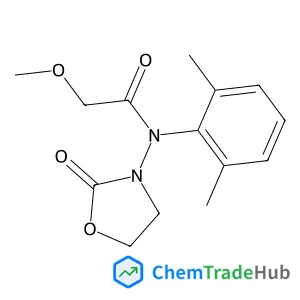
N-(2,6-Dimethylphenyl)-2-methoxy-N-(2-oxo-1,3-oxazolidin-3-yl)acetamide
CAS Number:
77732-09-3
Molecular Formula:
C14H18N2O4
Recommended Suppliers





Disclaimer
This page provides academic journal information for reference and research purposes only. We are not affiliated with any journal publishers and do not handle publication submissions. For publication-related inquiries, please contact the respective journal publishers directly.
If you notice any inaccuracies in the information displayed, please contact us at support@chemtradehub.com. We will promptly review and address your concerns.