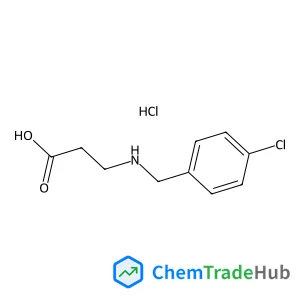
N-(4-Chlorobenzyl)-beta-alanine hydrochloride (1:1)
CAS Number:
1172479-10-5
Molecular Formula:
C10H13Cl2NO2
We have studied the theoretical hydration effect on the optical property of a deoxyribonucleic acid (DNA) double helix fiber. First-principles electronic structure and molecular dynamics simulations reveal that the electronic structure of the DNA fiber varies according to the amount of hydration or the relative humidity. We show that ultraviolet optical conductivity is influenced by hydration structure and DNA deformation, and our findings agree with other theoretical results and experimental observations. Infrared (IR) optical conductivity is estimated by the molecular dynamics approach. The humidity dependence of optical conductivity due to dipole relaxation of water is in close agreement with experimental observations. The theoretical IR absorption spectrum due to DNA vibrations agrees with the experimental spectrum. We discuss deformation and screening effects of the DNA fiber on humidity dependence of the optical spectra.
Anjum Qureshi, Yasar Gurbuz, Saravan Kallempudi, Javed H. Niazi
DOI: 10.1039/C004133E
Tangui Le Bahers, Frédéric Labat, Thierry Pauporté, Ilaria Ciofini
DOI: 10.1039/C004358C
DOI: 10.1039/B927432D
Masataka Nagaoka
DOI: 10.1039/C0CP01077D
Luigi Genovese, Guillaume Krosnicki, Olivier Lemaire, Thierry Deutsch, Alejandro A. Franco
DOI: 10.1039/B927111B
Jiehua Liu, Xiangfeng Wei, Yaolun Yu, Xin Wang, Wei-Qiao Deng, Xue-Wei Liu
DOI: 10.1039/C0CP01396J
Manidipa Paul, Nabanita Pal, P. R. Rajamohanan, Bharat S. Rana, Anil K. Sinha, Asim Bhaumik
DOI: 10.1039/B925619A
Tomás Rocha-Rinza, Kristian Sneskov, Ove Christiansen, Ulf Ryde, Jacob Kongsted
DOI: 10.1039/C0CP01075H
DOI: 10.1039/C0CP00917B
Sarah Couck, Tom Rémy, Gino V. Baron, Jorge Gascon, Freek Kapteijn, Joeri F. M. Denayer
DOI: 10.1039/B927115E
Waste containing N-Methoxy-N-methyl-1,3-thiazole-5-carboxamide (CAS: 898825-89-3...
N-(4-Biphenylyl)dibenzo[b,d]furan-4-amine should be stored in a tightly sealed c...
The market for 3-Acetamido-5-amino-2,4,6-triiodobenzoic acid (CAS: 1713-07-1) is...
Benzyl 2-O-acetyl-3,4,6-tri-O-benzyl-beta-D-galactopyranoside (CAS: 61820-03-9) ...
2-Ethylpiperazine dihydrochloride (CAS: 438050-52-3) is regulated under the Glob...
1,1'-[1,3-Phenylenebis(methylene)]bis(3-methyl-1H-pyrrole-2,5-dione) (CAS: 11946...
Several alternatives can be used in the synthesis of 5-Fluoro-2-(1-pyrrolidinyl)...
Proper personal protective equipment (PPE) must be worn when handling this compo...
When handling 6-Bromoimidazo[1,2-a]pyridin-8-amine, it is important to wear appr...
Alternatives to (2S,4R)-4-(4-Nitrobenzyl)pyrrolidine-2-carboxylic acid hydrochlo...

Physical Chemistry Chemical Physics (PCCP) is an international journal co-owned by 19 physical chemistry and physics societies from around the world. This journal publishes original, cutting-edge research in physical chemistry, chemical physics and biophysical chemistry. To be suitable for publication in PCCP, articles must include significant innovation and/or insight into physical chemistry; this is the most important criterion that reviewers and Editors will judge against when evaluating submissions. The journal has a broad scope and welcomes contributions spanning experiment, theory, computation and data science. Topical coverage includes spectroscopy, dynamics, kinetics, statistical mechanics, thermodynamics, electrochemistry, catalysis, surface science, quantum mechanics, quantum computing and machine learning. Interdisciplinary research areas such as polymers and soft matter, materials, nanoscience, energy, surfaces/interfaces, and biophysical chemistry are welcomed if they demonstrate significant innovation and/or insight into physical chemistry. Joined experimental/theoretical studies are particularly appreciated when complementary and based on up-to-date approaches.

![4-Chloro-2-{[(2-chlorophenoxy)acetyl]amino}benzoic acid structure](https://static.chemtradehub.com/structs/351/351424-20-9-9467.webp "4-Chloro-2-{[(2-chlorophenoxy)acetyl]amino}benzoic acid structure")