












Fluorescence resonance energy transfer between phenanthrene and PAMAM dendrimers
Literature Information
Publication Date
2010-06-23
DOI
10.1039/B924522G
Impact Factor
3.676
Authors
Mercy Lard, Seung Ha Kim, Sijie Lin, Priyanka Bhattacharya, Pu Chun Ke, Monica H. Lamm
View Original
Abstract
We describe herein an adsorption-induced energy transfer between phenanthrene, a major environmental pollutant, and a fluorescently labeled dendrimer acting as a host molecule. We find experimentally that such energy transfer is the most efficient at a solvent pH of 8 and for a phenanthrene ∶ dendrimer molar ratio of 1 ∶ 2. Using molecular dynamics simulations we show that the strongest binding interactions occur between phenanthrene and the primary amines of the dendrimer. The simulations provide evidence that at low pH, phenanthrene–phenanthrene interactions are favorable and compete with phenanthrene–dendrimer binding. This study offers a new scheme for detecting dendrimer molecular assembly and a physical basis for exploiting dendrimer nanotechnologies for water purification and environmental remediation.
Related Literature
Polymer vesicles formed by amphiphilic diblock copolymers containing a thermotropic liquid crystalline polymer block
Jing Yang, Daniel Lévy, Wei Deng, Patrick Keller, Min-Hui Li
2005-08-01
Communication
DOI: 10.1039/B508034G
Structure elucidation of a novel family of mycolactonetoxins from the frog pathogen Mycobacterium sp. MU128FXT by mass spectrometry
Hui Hong, Tim Stinear, Paul Skelton, Jonathan B. Spencer, Peter F. Leadlay
2005-08-05
Communication
DOI: 10.1039/B506835E
Dendritic supramolecular assemblies for drug delivery
Meredith T. Morgan, Michael A. Carnahan, Stella Finkelstein, Carla A. H. Prata, Lovorka Degoricija, Stephen J. Lee, Mark W. Grinstaff
2005-07-14
Communication
DOI: 10.1039/B502411K
Water-soluble organic dppz analogues—tuning DNA binding affinities, luminescence, and photo-redox properties
Tim Phillips, Chatna Rajput, Lance Twyman, Ihtshamul Haq, Jim A. Thomas
2005-07-27
Communication
DOI: 10.1039/B506946G
Dynamic helicity inversion in an octahedral cobalt(ii) complex system via solvato-diastereomerism
Hiroyuki Miyake, Hideki Sugimoto, Hitoshi Tamiaki, Hiroshi Tsukube
2005-08-02
Communication
DOI: 10.1039/B506130J
Palladium(0) alkyne complexes as active species: a DFT investigation
Mårten Ahlquist, Giancarlo Fabrizi, Sandro Cacchi, Per-Ola Norrby
2005-07-20
Communication
DOI: 10.1039/B507784B
Zirconium mediated total synthesis of crinitol, 9-hydroxyfarnesoic acid, 9-hydroxyfarnesol, 9-hydroxysargaquinone and the selectively-protected aglycone of moritoside and euplexide A
Sally Dixon, George J. Gordon, Richard J. Whitby
2005-08-05
Communication
DOI: 10.1039/B508524A
A simple synthesis of mesoporous carbons with tunable mesopores using a colloidal template-mediated vapor deposition polymerization
Jyongsik Jang, Byungkwon Lim, Moonjung Choi
2005-07-22
Communication
DOI: 10.1039/B506265A
First snapshot of a nonpolymeric hydrogelator interacting with its gelling solvents
D. Krishna Kumar, D. Amilan Jose, Amitava Das, Parthasarathi Dastidar
2005-07-13
Communication
DOI: 10.1039/B506941F
You might also like
Compound Q&A
How should waste containing N-Methoxy-N-methyl-1,3-thiazole-5-carboxamide (CAS: 898825-89-3) be handled?
Waste containing N-Methoxy-N-methyl-1,3-thiazole-5-carboxamide (CAS: 898825-89-3...
898825-89-3N-Methoxy-N-methyl-1...
Compound Q&A
How should N-(4-Biphenylyl)dibenzo[b,d]furan-4-amine (CAS: 1318338-47-4) be stored?
N-(4-Biphenylyl)dibenzo[b,d]furan-4-amine should be stored in a tightly sealed c...
1318338-47-4N-(4-Biphenylyl)dibe...
Compound Q&A
What is the market or research trend for 3-Acetamido-5-amino-2,4,6-triiodobenzoic acid (CAS: 1713-07-1)?
The market for 3-Acetamido-5-amino-2,4,6-triiodobenzoic acid (CAS: 1713-07-1) is...
1713-07-13-Acetamido-5-amino-...
Compound Q&A
How should Benzyl 2-O-acetyl-3,4,6-tri-O-benzyl-beta-D-galactopyranoside (CAS: 61820-03-9) be stored?
Benzyl 2-O-acetyl-3,4,6-tri-O-benzyl-beta-D-galactopyranoside (CAS: 61820-03-9) ...
61820-03-9Benzyl 2-O-acetyl-3,...
Compound Q&A
What regulatory guidelines apply to 2-Ethylpiperazine dihydrochloride (CAS: 438050-52-3)?
2-Ethylpiperazine dihydrochloride (CAS: 438050-52-3) is regulated under the Glob...
438050-52-32-Ethylpiperazine di...
Compound Q&A
What regulatory guidelines apply to 1,1'-[1,3-Phenylenebis(methylene)]bis(3-methyl-1H-pyrrole-2,5-dione) (CAS: 119462-56-5)?
1,1'-[1,3-Phenylenebis(methylene)]bis(3-methyl-1H-pyrrole-2,5-dione) (CAS: 11946...
119462-56-51,1'-[1,3-Phenyleneb...
Compound Q&A
Are there alternatives to 5-Fluoro-2-(1-pyrrolidinyl)pyridine (CAS: 1287217-79-1) in synthesis?
Several alternatives can be used in the synthesis of 5-Fluoro-2-(1-pyrrolidinyl)...
1287217-79-15-Fluoro-2-(1-pyrrol...
Compound Q&A
What precautions should be taken when handling 1-((2R,3R,4R,5R)-5-((bis(4-methoxyphenyl)(phenyl)methoxy)methyl)-4-hydroxy-3-methoxytetrahydrofuran-2-yl)-5-methylpyrimidine-2,4(1H,3H)-dione (CAS: 153631-19-7)?
Proper personal protective equipment (PPE) must be worn when handling this compo...
153631-19-71-((2R,3R,4R,5R)-5-(...
Compound Q&A
What precautions should be taken when handling 6-Bromoimidazo[1,2-a]pyridin-8-amine (CAS: 676371-00-9)?
When handling 6-Bromoimidazo[1,2-a]pyridin-8-amine, it is important to wear appr...
676371-00-96-Bromoimidazo[1,2-a...
Compound Q&A
Are there alternatives to (2S,4R)-4-(4-Nitrobenzyl)pyrrolidine-2-carboxylic acid hydrochloride (CAS: 1049740-22-8) in synthesis?
Alternatives to (2S,4R)-4-(4-Nitrobenzyl)pyrrolidine-2-carboxylic acid hydrochlo...
1049740-22-8(2S,4R)-4-(4-Nitrobe...
Source Journal
Physical Chemistry Chemical Physics

CiteScore:
5.5
Self-citation Rate:
10.3%
Articles per Year:
3036
Physical Chemistry Chemical Physics (PCCP) is an international journal co-owned by 19 physical chemistry and physics societies from around the world. This journal publishes original, cutting-edge research in physical chemistry, chemical physics and biophysical chemistry. To be suitable for publication in PCCP, articles must include significant innovation and/or insight into physical chemistry; this is the most important criterion that reviewers and Editors will judge against when evaluating submissions. The journal has a broad scope and welcomes contributions spanning experiment, theory, computation and data science. Topical coverage includes spectroscopy, dynamics, kinetics, statistical mechanics, thermodynamics, electrochemistry, catalysis, surface science, quantum mechanics, quantum computing and machine learning. Interdisciplinary research areas such as polymers and soft matter, materials, nanoscience, energy, surfaces/interfaces, and biophysical chemistry are welcomed if they demonstrate significant innovation and/or insight into physical chemistry. Joined experimental/theoretical studies are particularly appreciated when complementary and based on up-to-date approaches.
Recommended Compounds

![2-Methyl-2-propanyl {3-[4-(4,4,5,5-tetramethyl-1,3,2-dioxaborolan-2-yl)phenyl]-3-oxetanyl}carbamate structure](https://static.chemtradehub.com/structs/127/1279090-25-3-1b84.webp "2-Methyl-2-propanyl {3-[4-(4,4,5,5-tetramethyl-1,3,2-dioxaborolan-2-yl)phenyl]-3-oxetanyl}carbamate structure")
2-Methyl-2-propanyl {3-[4-(4,4,5,5-tetramethyl-1,3,2-dioxaborolan-2-yl)phenyl]-3-oxetanyl}carbamate
CAS Number:
1279090-25-3
Molecular Formula:
C20H30BNO5
![4-Chloro-2-{[(2-chlorophenoxy)acetyl]amino}benzoic acid structure](https://static.chemtradehub.com/structs/351/351424-20-9-9467.webp "4-Chloro-2-{[(2-chlorophenoxy)acetyl]amino}benzoic acid structure")
4-Chloro-2-{[(2-chlorophenoxy)acetyl]amino}benzoic acid
CAS Number:
351424-20-9
Molecular Formula:
C15H11Cl2NO4
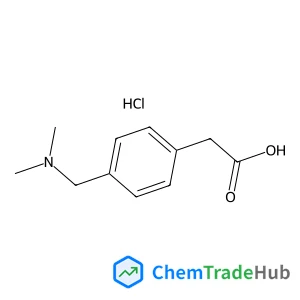
4-(Dimethylaminomethyl)phenylacetic acid hydrochloride
CAS Number:
99985-52-1
Molecular Formula:
C11H16ClNO2
Recommended Suppliers





Disclaimer
This page provides academic journal information for reference and research purposes only. We are not affiliated with any journal publishers and do not handle publication submissions. For publication-related inquiries, please contact the respective journal publishers directly.
If you notice any inaccuracies in the information displayed, please contact us at support@chemtradehub.com. We will promptly review and address your concerns.