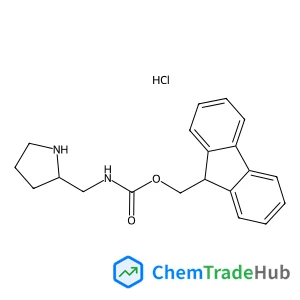
(S)-(9H-Fluoren-9-yl)methyl (pyrrolidin-2-ylmethyl)carbamate hydrochloride
CAS Number:
1217813-15-4
Molecular Formula:
C20H23ClN2O2
Lawrence Wright, Marc W. Sanders, Lauren Tate, Gayle Fairless, Lorna Crowhurst, Neil C. Bruce, Adam J. Walker, Guy A. Hembury, Seishi Shimizu
The study of solubility of 4-nitroaniline and its N,N-diethyl derivative in ionic liquids (ILs) of varying water content has shown that it is the interaction between water and the ILs’ ions, and not with the solute, that is the most important factor determining the solute's preferential hydration parameter and thus the solvation shell structure.
Christina Braun, Lukas Martin Wingen, Dirk Menche
DOI: 10.1039/D3NP00018D
Min Liu, Qi Liu, Xue-Ting Jin, Ya-Chen Zou, Di-Ning Li, Pan Feng, Yang-Hui Luo
DOI: 10.1039/D3TA05384A
Lili Song
DOI: 10.1039/D3NP00029J
Gustavo C. Rodrigues, Manoel V. F. Barrionuevo, Miguel A. San-Miguel, Camilla Abbehausen
DOI: 10.1039/D3NJ04945K
Evan T. Miller, Oleg V. Tsodikov, Sylvie Garneau-Tsodikova
DOI: 10.1039/D3NP00036B
P. Rosaiah, S. Vadivel, Kalaivani Dayanidhi, Mohammad Rezaul Karim, Ibrahim A. Alnaser, Sambasivam Sangaraju, M. Dhananjaya, Sang Woo Joo
DOI: 10.1039/D3NJ05321K
Waste containing N-Methoxy-N-methyl-1,3-thiazole-5-carboxamide (CAS: 898825-89-3...
N-(4-Biphenylyl)dibenzo[b,d]furan-4-amine should be stored in a tightly sealed c...
The market for 3-Acetamido-5-amino-2,4,6-triiodobenzoic acid (CAS: 1713-07-1) is...
Benzyl 2-O-acetyl-3,4,6-tri-O-benzyl-beta-D-galactopyranoside (CAS: 61820-03-9) ...
2-Ethylpiperazine dihydrochloride (CAS: 438050-52-3) is regulated under the Glob...
1,1'-[1,3-Phenylenebis(methylene)]bis(3-methyl-1H-pyrrole-2,5-dione) (CAS: 11946...
Several alternatives can be used in the synthesis of 5-Fluoro-2-(1-pyrrolidinyl)...
Proper personal protective equipment (PPE) must be worn when handling this compo...
When handling 6-Bromoimidazo[1,2-a]pyridin-8-amine, it is important to wear appr...
Alternatives to (2S,4R)-4-(4-Nitrobenzyl)pyrrolidine-2-carboxylic acid hydrochlo...

Physical Chemistry Chemical Physics (PCCP) is an international journal co-owned by 19 physical chemistry and physics societies from around the world. This journal publishes original, cutting-edge research in physical chemistry, chemical physics and biophysical chemistry. To be suitable for publication in PCCP, articles must include significant innovation and/or insight into physical chemistry; this is the most important criterion that reviewers and Editors will judge against when evaluating submissions. The journal has a broad scope and welcomes contributions spanning experiment, theory, computation and data science. Topical coverage includes spectroscopy, dynamics, kinetics, statistical mechanics, thermodynamics, electrochemistry, catalysis, surface science, quantum mechanics, quantum computing and machine learning. Interdisciplinary research areas such as polymers and soft matter, materials, nanoscience, energy, surfaces/interfaces, and biophysical chemistry are welcomed if they demonstrate significant innovation and/or insight into physical chemistry. Joined experimental/theoretical studies are particularly appreciated when complementary and based on up-to-date approaches.