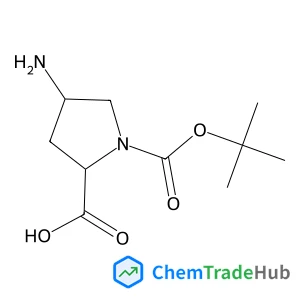
(2R,4R)-1-Boc-4-Aminopyrrolidine-2-carboxylic acid
CAS Number:
132622-98-1
Molecular Formula:
C10H18N2O4
Stepan Sklenak, Jiří Dědeček, Chengbin Li, Blanka Wichterlová, Vendula Gábová, Marek Sierka, Joachim Sauer
The Al siting in the ZSM-5 zeolite was investigated by 27Al 3Q MAS NMR spectroscopy and QM/MM calculations. It was found that the occupation of the framework T-sites by Al and the concentration of Al in these T-sites are neither random nor controlled by a simple rule. They both depend on the conditions of the zeolite synthesis. At least 12 out of the 24 distinguishable framework T-sites of ZSM-5 are occupied by Al in the set of the investigated zeolite samples. A partial identification of the Al sites is possible. The calculated 27Al NMR shielding values were converted to 27Al isotropic chemical shifts using the experimental isotropic chemical shift of 60.0 ppm referenced to the aqueous solution of Al(NO3)3 and the corresponding calculated NMR shielding of 490.0 ppm of a silicon rich (Si/Al 38) chabazite structure zeolite as a secondary internal standard. The observed 27Al isotropic chemical shifts of 50.0 and 54.7 ppm correspond to Al atoms in the T20 and T6 sites, respectively. The pair of measured isotropic chemical shifts of 52.9 and 53.7 ppm can be assigned to the T4, T8 pair. At the low-shielding end, two assignments are plausible. The smallest deviations between the calculated and observed isotropic chemical shifts are reached for the assignment as follows: T24 (64.8 ppm) is not occupied in the samples and that the observed isotropic chemical shifts 63.6, 62.8, and 60.0 ppm belong to T1, T17, and T7, respectively. It follows then that T-sites T12 (60.8 ppm), T3 (61.7 ppm), and T18 (62.0 ppm) are most likely not occupied by Al in our ZSM-5 samples. If we assume that the calculated isotropic chemical shifts are systematically larger than the observed ones then we can assign the largest observed isotropic chemical shifts of 63.6 and 62.8 ppm to the least shielded T24 and T1 sites, respectively, and 60.0 ppm to T12. Then the sites T3 (61.7 ppm), T18 (62.0 ppm), and T17 (62.5 ppm) would be unoccupied by Al in our ZSM-5 samples. It was further shown that there is no simple linear relationship between the observed 27Al isotropic chemical shifts and the average Al–O–Si angles.
Saswati Ghosh Roy, Priyadarsi De
DOI: 10.1039/C4PY00766B
M. Williams, N. J. W. Penfold, J. R. Lovett, N. J. Warren, C. W. I. Douglas, N. Doroshenko, P. Verstraete, J. Smets, S. P. Armes
DOI: 10.1039/C6PY00696E
Shotaro Ito, Raita Goseki, Takashi Ishizone
DOI: 10.1039/C4PY00584H
Robert H. Utama, Hongxu Lu, Martina H. Stenzel
DOI: 10.1039/C4PY00802B
Zhanwen Xu, Jiaping Lin, Qian Zhang, Liquan Wang, Xiaohui Tian
DOI: 10.1039/C6PY00535G
Kathiresan Murugavel
DOI: 10.1039/C4PY00718B
When considering alternatives to 1-(4-Chlorophenyl)-N-hydroxymethanimine (CAS: 3...
This compound should be stored in a cool, dry place away from direct sunlight. I...
3-(4-Bromophenyl)-5-(2-fluorophenyl)-1,2,4-oxadiazole is synthesized through a m...
5-Chloro-2-(4-chlorophenyl)-4-methyl-6-[3-(1-piperidinyl)propoxy]pyrimidine (CAS...
2-Chloro-4-(difluoromethoxy)pyridine is used in the pharmaceutical industry for ...
3-Chloro-6-methylpyridazine (CAS: 1121-79-5) is classified under the Globally Ha...
Several alternatives can be used in the synthesis of Methyl 4,5-dimethyl-2-nitro...
Alternatives to (2E,2'E)-3,3'-(1,4-Phenylene)bisacrylaldehyde include other acry...
3-Amino-5-chloropyridin-2-ol hydrochloride is an organic compound with the CAS n...
When handling 6,7-Difluoro-2,3-dihydro-4H-chromen-4-one, it is essential to wear...

Physical Chemistry Chemical Physics (PCCP) is an international journal co-owned by 19 physical chemistry and physics societies from around the world. This journal publishes original, cutting-edge research in physical chemistry, chemical physics and biophysical chemistry. To be suitable for publication in PCCP, articles must include significant innovation and/or insight into physical chemistry; this is the most important criterion that reviewers and Editors will judge against when evaluating submissions. The journal has a broad scope and welcomes contributions spanning experiment, theory, computation and data science. Topical coverage includes spectroscopy, dynamics, kinetics, statistical mechanics, thermodynamics, electrochemistry, catalysis, surface science, quantum mechanics, quantum computing and machine learning. Interdisciplinary research areas such as polymers and soft matter, materials, nanoscience, energy, surfaces/interfaces, and biophysical chemistry are welcomed if they demonstrate significant innovation and/or insight into physical chemistry. Joined experimental/theoretical studies are particularly appreciated when complementary and based on up-to-date approaches.
![[4-(Isobutyrylamino)phenyl]boronic acid structure](https://static.chemtradehub.com/structs/874/874219-50-8-6ab5.webp "[4-(Isobutyrylamino)phenyl]boronic acid structure")