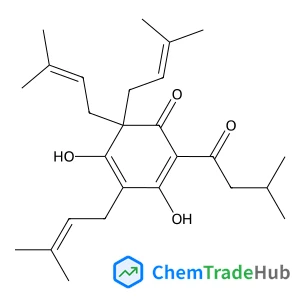
3,5-Dihydroxy-4-(3-methylbutanoyl)-2,6,6-tris(3-methyl-2-buten-1-yl)-2,4-cyclohexadien-1-one
CAS Number:
468-28-0
Molecular Formula:
C26H38O4
Boyong Wan, Gary W. Small
Passive Fourier transform infrared (FT-IR) remote sensing measurements are applied to the detection of methanol vapor plumes released from a chemical manufacturing facility. With the spectrometer mounted in a downward-looking mode on a fixed-wing aircraft, overflights of the facility are made during the methanol release. Signal processing and pattern recognition methods are applied to the acquired data for the purpose of constructing an automated classification algorithm for the methanol detection. The analysis is based on the use of short, digitally filtered segments of the raw interferogram data collected by the spectrometer. The classifiers are trained with data collected on the ground by use of an experimental protocol designed to simulate background conditions observed from the air. Optimization of the digital filtering and interferogram segment parameters leads to successful classifiers based on 100 or 120 interferogram points. The optimal interferogram segment location is found to be 95-points displaced from the centerburst, and the best performing digital filters are centered on the methanol C–O stretching band at 1036 cm−1 and have a passband full-width at half-maximum of 100 to 160 cm−1. The best classifiers achieve classification errors of less than 1% and are observed to be resistant to possible interference effects from species such as ethanol and ozone. This work demonstrates the utility of airborne passive FT-IR remote sensing measurements of volatile organic compounds under complex background conditions such as those encountered while monitoring an operating industrial facility.
Srikanth Revoju, Subhayan Biswas, Bertil Eliasson, Ganesh D. Sharma
DOI: 10.1039/C7CP08653A
Bin Tu, Guo-jun Hu, Qiao-jun Fang, Jun-jie Qi, Xun-wen Xiao, Yan-fang Geng, Qing-dao Zeng
DOI: 10.1039/C7CP08201K
Mateusz Rebarz, Martin Rohrmüller, Shirly Espinoza, Miroslav Kloz, Norman Kretzschmar, Adam Neuba, Jochen Ortmeyer, Roland Schoch, Matthias Bauer, Wolf Gero Schmidt, Gerald Henkel
DOI: 10.1039/C7CP04880G
Xuedan Liu, Aisen Li, Weiqing Xu, Zhiyong Ma, Xinru Jia
DOI: 10.1039/C8CP02096E
Christoph Nançoz, Giuseppe Licari, Joseph S. Beckwith, Magnus Soederberg, Bogdan Dereka, Arnulf Rosspeintner, Oleksandr Yushchenko, Romain Letrun, Sabine Richert, Bernhard Lang, Eric Vauthey
DOI: 10.1039/C7CP08390D
Xiqian Wang, Chenxi Liu, Yuying Jiang, Chiming Wang, Tianyu Wang, Ming Bai, Jianzhuang Jiang
DOI: 10.1039/C7CP08647D
Marie-Aline Martin-Drumel, Kin Long Kelvin Lee, John F. Stanton, Carl A. Gottlieb
DOI: 10.1039/C8CP01102H
Santhia Carmel, Adhithan Pon, N. Meenakshisundaram, R. Ramesh, Arkaprava Bhattacharyya
DOI: 10.1039/C8CP01435C
David Muñoz Ramo, Stephen J. Jenkins
DOI: 10.1039/C8CP01028E
When handling 2-Chloro-1,2-bis(4-methylphenyl)ethanone (CAS: 71193-32-3), it is ...
4-Ethoxy-3-(5-methyl-4-oxo-7-propyl-1,4-dihydroimidazo[5,1-f][1,2,4]triazin-2-yl...
Methyl 3-Oxo-4-Androsten-17-Carboxylate (CAS: 2681-55-2) should be stored in a c...
(R)-3-Amino-4-(3-hexylphenylamino)-4-oxobutylphosphonic acid is primarily used i...
2-Methyl-2-propanyl 3-amino-3-carbamoyl-1-azetidinecarboxylate (CAS: 1254120-14-...
There are alternative reagents that can be used in synthesis instead of (E)-4-(t...
[2-(3-Chlorophenyl)-1,3-thiazol-4-yl]methanol (CAS: 121202-20-8) is a crystallin...
The market and research trends for Methyl (2S)-[(4S)-2,2-dimethyl-1,3-dioxolan-4...
The market for 1-Bromo-2-isocyanatoethane (CAS: 42865-19-0) is driven by its use...
4-Nitro-D-phenylalanine hydrochloride (CAS: 147065-06-3) is primarily used in re...

Analyst publishes analytical and bioanalytical research that reports premier fundamental discoveries and inventions, and the applications of those discoveries, unconfined by traditional discipline barriers.
![4-[2-(Trichlorosilyl)ethyl]benzenesulfonyl chloride structure](https://static.chemtradehub.com/structs/797/79793-00-3-de16.webp "4-[2-(Trichlorosilyl)ethyl]benzenesulfonyl chloride structure")