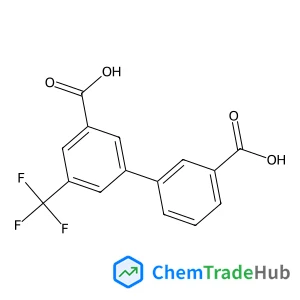
3-(3-Carboxyphenyl)-5-(trifluoromethyl)benzoic acid
CAS Number:
1261930-96-4
Molecular Formula:
C15H9F3O4
Marcelo Puiatti, D. Mariano A. Vera, Adriana B. Pierini
Recently, we have shown that traditional bound-electron DFT models are reliable enough to reproduce negative electron affinities (EA) within a few meV, as long as the valence anion state is found, but they seem to fail in predicting the lowest EA when the ground anion state obtained is non-valence, which holds the extra electron in a diffuse orbital around the molecule; here we propose an alternative approach for finding the valence anion state, based on the stabilization exerted by a polar solvent; the methodology yields correct EA values (i.e. beyond the Koopman′s theorem approximation) by gradually decreasing the dielectric constant of the medium.
DOI: 10.1039/JA994090033N
DOI: 10.1039/B301773G
4-Amino-3-bromophenol (CAS: 74440-80-5) falls under the classification of a haza...
(17beta)-3-Oxoestr-4-en-17-yl acetate should be stored in a cool, dry place away...
2-[(2,2-Diethoxyethyl)disulfanyl]-1,1-diethoxyethane (CAS: 76505-71-0) is a colo...
The market and research for 1-(β-D-ribofuranosyl)-1H-imidazo[4,5-c]pyridin-4-ami...
Waste containing Conjugated Estrogen (CAS: 12126-59-9) should be collected and d...
The market for Bis(2,2,2-trifluoroethyl) (methoxycarbonylmethyl)phosphonate (CAS...
There are several alternatives to 3,4'-Di-O-methylellagic acid (CAS: 57499-59-9)...
2-Chloro-N,N-dimethylpyridin-4-amine (CAS: 59047-70-0) is regulated under the Gl...
Cerium(3+);oxygen(2-);vanadium(5+) (CAS: 13597-19-8) is a complex inorganic comp...
7-Chloro-1-iodoisoquinoline (CAS: 1203579-27-4) is generally considered safe whe...

Physical Chemistry Chemical Physics (PCCP) is an international journal co-owned by 19 physical chemistry and physics societies from around the world. This journal publishes original, cutting-edge research in physical chemistry, chemical physics and biophysical chemistry. To be suitable for publication in PCCP, articles must include significant innovation and/or insight into physical chemistry; this is the most important criterion that reviewers and Editors will judge against when evaluating submissions. The journal has a broad scope and welcomes contributions spanning experiment, theory, computation and data science. Topical coverage includes spectroscopy, dynamics, kinetics, statistical mechanics, thermodynamics, electrochemistry, catalysis, surface science, quantum mechanics, quantum computing and machine learning. Interdisciplinary research areas such as polymers and soft matter, materials, nanoscience, energy, surfaces/interfaces, and biophysical chemistry are welcomed if they demonstrate significant innovation and/or insight into physical chemistry. Joined experimental/theoretical studies are particularly appreciated when complementary and based on up-to-date approaches.
![(2S)-2-({N-[(2S)-2-Ammonio-4-methylpentanoyl]glycyl}amino)-3-phenylpropanoate structure](https://static.chemtradehub.com/structs/429/4294-25-1-0842.webp "(2S)-2-({N-[(2S)-2-Ammonio-4-methylpentanoyl]glycyl}amino)-3-phenylpropanoate structure")