












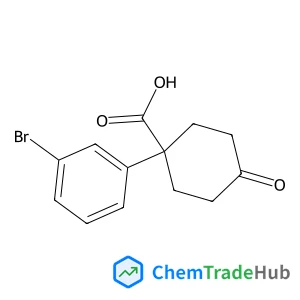
1-(3-Bromophenyl)-4-oxocyclohexanecarboxylic acid
CAS Number:
1385694-53-0
Molecular Formula:
C13H13BrO3
Atichat Wongkoblap, Duong D. Do, David Nicholson
Heats of adsorption and adsorption isotherms of argon, nitrogen and methane on a perfect graphitic surface and a defective graphitic surface are studied with a Grand Canonical Monte Carlo Simulation (GCMC). For the perfect surface, the isosteric heat versus loading shows a typical pattern of adsorption of simple fluids on graphite. Depending on adsorbate, degree of graphitization and temperature, a spike in the heat curve versus loading is observed when the first layer is mostly covered with adsorbate molecules. The heat spike is observed for argon and nitrogen at 77 K while for argon at 87.3 K it is no longer present. These simulation results are consistent with the experimental data of J. Rouquerol, S. Partyka and F. Rouquerol, J. Chem. Soc., Faraday Trans. 1, 1977, 73, 306. In the case of methane we observe heat spikes at low temperatures, 84.5, 92.5 and 104 K. The heat spike shifts to higher loading with temperature and it then disappears at high temperatures. These observations are in qualitative agreement with the experimental data of A. Inaba, Y. Koga and J. A. Morrison, J. Chem. Soc., Faraday Trans. 2, 1986, 82, 1635. In all cases where heat spikes are observed, the GCMC simulation results indicate that the heat spike is associated with the squeezing of molecules into the already dense first layer, and the rearrangement of molecules to form a highly structured fluid of this layer. While this squeezing into the first layer is happening, molecules continue to adsorb onto the relatively sparse second layer.
DOI: 10.1039/B405895J
Norbert Jakubowski
DOI: 10.1039/B211958G
4-Amino-3-bromophenol (CAS: 74440-80-5) falls under the classification of a haza...
(17beta)-3-Oxoestr-4-en-17-yl acetate should be stored in a cool, dry place away...
2-[(2,2-Diethoxyethyl)disulfanyl]-1,1-diethoxyethane (CAS: 76505-71-0) is a colo...
The market and research for 1-(β-D-ribofuranosyl)-1H-imidazo[4,5-c]pyridin-4-ami...
Waste containing Conjugated Estrogen (CAS: 12126-59-9) should be collected and d...
The market for Bis(2,2,2-trifluoroethyl) (methoxycarbonylmethyl)phosphonate (CAS...
There are several alternatives to 3,4'-Di-O-methylellagic acid (CAS: 57499-59-9)...
2-Chloro-N,N-dimethylpyridin-4-amine (CAS: 59047-70-0) is regulated under the Gl...
Cerium(3+);oxygen(2-);vanadium(5+) (CAS: 13597-19-8) is a complex inorganic comp...
7-Chloro-1-iodoisoquinoline (CAS: 1203579-27-4) is generally considered safe whe...

Physical Chemistry Chemical Physics (PCCP) is an international journal co-owned by 19 physical chemistry and physics societies from around the world. This journal publishes original, cutting-edge research in physical chemistry, chemical physics and biophysical chemistry. To be suitable for publication in PCCP, articles must include significant innovation and/or insight into physical chemistry; this is the most important criterion that reviewers and Editors will judge against when evaluating submissions. The journal has a broad scope and welcomes contributions spanning experiment, theory, computation and data science. Topical coverage includes spectroscopy, dynamics, kinetics, statistical mechanics, thermodynamics, electrochemistry, catalysis, surface science, quantum mechanics, quantum computing and machine learning. Interdisciplinary research areas such as polymers and soft matter, materials, nanoscience, energy, surfaces/interfaces, and biophysical chemistry are welcomed if they demonstrate significant innovation and/or insight into physical chemistry. Joined experimental/theoretical studies are particularly appreciated when complementary and based on up-to-date approaches.
![2-[1-(4-Chlorobenzyl)-1H-indol-3-yl]-2-oxo-N-(6-quinolinyl)acetamide structure](https://static.chemtradehub.com/structs/501/501921-61-5-756a.webp "2-[1-(4-Chlorobenzyl)-1H-indol-3-yl]-2-oxo-N-(6-quinolinyl)acetamide structure")
![4-{2-[(9H-Fluoren-9-ylmethoxy)carbonyl]hydrazino}benzoic acid structure](https://static.chemtradehub.com/structs/214/214475-53-3-bf36.webp "4-{2-[(9H-Fluoren-9-ylmethoxy)carbonyl]hydrazino}benzoic acid structure")



