













Metal-catalyzed radical polyaddition as a novel polymer synthetic route
Literature Information
Publication Date
2007-01-11
DOI
10.1039/B616598B
Impact Factor
6.222
Authors
Kotaro Satoh, Masato Mizutani, Masami Kamigaito
View Original
Abstract
A new class of polymerizations was developed via metal-catalyzed C–C bond forming radical polyaddition; the monomers were designed to have a reactive C–Cl bond, which can be activated by the metal catalysts to generate a carbon radical species, along with a CC double bond, to which the carbon radical generated from another molecule adds to form a C–C backbone polymer with an inactive C–Cl pendant.
Recommended Journals
Related Literature
Interdiffusion and surface-sandwich ordering in initial Ni-core–Pd-shell nanoparticle
Alexander V. Evteev, Elena V. Levchenko, Irina V. Belova, Graeme E. Murch
2009-03-16
Paper
DOI: 10.1039/B822112J
Supported vanadium oxide in heterogeneous catalysis: elucidating the structure–activity relationship with spectroscopy
Ilke Muylaert, Pascal Van Der Voort
2009-03-05
Perspective
DOI: 10.1039/B819808J
Parameterizations for ice nucleation in biological and atmospheric systems
Thomas Koop
2009-09-30
Paper
DOI: 10.1039/B914289D
Mixed LiCo0.6M0.4PO4 (M = Mn, Fe, Ni) phosphates: cycling mechanism and thermal stability
Dmytro M. Trots, Heiko J. Hofmann, Helmut Ehrenberg
2009-03-09
Paper
DOI: 10.1039/B901319A
Molecular dynamics simulation of nanoconfined glycerol
R. Busselez, R. Lefort, Q. Ji, F. Affouard, D. Morineau
2009-11-05
Paper
DOI: 10.1039/B911859D
Enhancing the fluorescence of tyr-59 in ubiquitin by blocking proton transfer
Hana Gerbelová, Tiago Q. Faria, Maria Manuel Sampaio, Rainer Rudolph, António L. Maçanita, Helena Santos
2009-03-03
Paper
DOI: 10.1039/B819365G
Theoretical analysis of carbon nanotube wetting in polystyrene nanocomposites
Gregory Van Lier, Guy Van Assche, Hans E. Miltner, Nadia Grossiord, Cor E. Koning, Paul Geerlings, Bruno Van Mele
2009-10-16
Paper
DOI: 10.1039/B912991J
Dynamics on the microsecond timescale in hydrous silicates studied by solid-state 2H NMR spectroscopy
John M. Griffin, Andrew J. Miller, Andrew J. Berry, Stephen Wimperis, Sharon E. Ashbrook
2010-02-03
Paper
DOI: 10.1039/B924666E
Carbon and proton shielding tensors in methyl halides
Anu M. Kantola, Perttu Lantto, Jukka Jokisaari
2010-01-27
Paper
DOI: 10.1039/B923506J
Impact of vibrational excitation on the kinetics of a nascent ketene
Thomas Schmierer, Wolfgang J. Schreier, Florian O. Koller, Tobias E. Schrader
2009-11-05
Paper
DOI: 10.1039/B915451E
You might also like
Compound Q&A
What precautions should be taken when handling 2-Chloro-1,2-bis(4-methylphenyl)ethanone (CAS: 71193-32-3)?
When handling 2-Chloro-1,2-bis(4-methylphenyl)ethanone (CAS: 71193-32-3), it is ...
71193-32-32-Chloro-1,2-bis(4-m...
Compound Q&A
What industries use 4-Ethoxy-3-(5-methyl-4-oxo-7-propyl-1,4-dihydroimidazo[5,1-f][1,2,4]triazin-2-yl)benzenesulfonyl chloride (CAS: 224789-26-8)?
4-Ethoxy-3-(5-methyl-4-oxo-7-propyl-1,4-dihydroimidazo[5,1-f][1,2,4]triazin-2-yl...
224789-26-84-Ethoxy-3-(5-methyl...
Compound Q&A
How should Methyl 3-Oxo-4-Androsten-17-Carboxylate (CAS: 2681-55-2) be stored?
Methyl 3-Oxo-4-Androsten-17-Carboxylate (CAS: 2681-55-2) should be stored in a c...
2681-55-2Methyl 3-Oxo-4-Andro...
Compound Q&A
What are the main uses of (R)-3-Amino-4-(3-hexylphenylamino)-4-oxobutylphosphonic acid (CAS: 909725-61-7)?
(R)-3-Amino-4-(3-hexylphenylamino)-4-oxobutylphosphonic acid is primarily used i...
909725-61-7(R)-3-Amino-4-(3-hex...
Compound Q&A
What regulatory guidelines apply to 2-Methyl-2-propanyl 3-amino-3-carbamoyl-1-azetidinecarboxylate (CAS: 1254120-14-3)?
2-Methyl-2-propanyl 3-amino-3-carbamoyl-1-azetidinecarboxylate (CAS: 1254120-14-...
1254120-14-32-Methyl-2-propanyl ...
Compound Q&A
Are there alternatives to (E)-4-(tert-Butoxy)-4-oxobut-2-enoic acid (CAS: 135355-96-3) in synthesis?
There are alternative reagents that can be used in synthesis instead of (E)-4-(t...
135355-96-3(E)-4-(tert-Butoxy)-...
Compound Q&A
What are the physical and chemical properties of [2-(3-Chlorophenyl)-1,3-thiazol-4-yl]methanol (CAS: 121202-20-8)?
[2-(3-Chlorophenyl)-1,3-thiazol-4-yl]methanol (CAS: 121202-20-8) is a crystallin...
121202-20-8[2-(3-Chlorophenyl)-...
Compound Q&A
What is the market or research trend for Methyl (2S)-[(4S)-2,2-dimethyl-1,3-dioxolan-4-yl]{[(4-methylphenyl)sulfonyl]oxy}acetate (CAS: 166249-17-8)?
The market and research trends for Methyl (2S)-[(4S)-2,2-dimethyl-1,3-dioxolan-4...
166249-17-8Methyl (2S)-[(4S)-2,...
Compound Q&A
What is the market or research trend for 1-Bromo-2-isocyanatoethane (CAS: 42865-19-0)?
The market for 1-Bromo-2-isocyanatoethane (CAS: 42865-19-0) is driven by its use...
42865-19-01-Bromo-2-isocyanato...
Compound Q&A
What are the main uses of 4-Nitro-D-phenylalanine hydrochloride (CAS: 147065-06-3)?
4-Nitro-D-phenylalanine hydrochloride (CAS: 147065-06-3) is primarily used in re...
147065-06-34-Nitro-D-phenylalan...
Source Journal
Chemical Communications

CiteScore:
8.6
Self-citation Rate:
4.7%
Articles per Year:
2458
ChemComm publishes urgent research which is of outstanding significance and interest to experts in the field, while also appealing to the journal’s broad chemistry readership. Our communication format is ideally suited to short, urgent studies that are of such importance that they require accelerated publication. Our scope covers all topics in chemistry, and research at the interface of chemistry and other disciplines (such as materials science, nanoscience, physics, engineering and biology) where there is a significant novelty in the chemistry aspects. Major topic areas covered include: Analytical Chemistry Catalysis Chemical Biology and medicinal chemistry Computational Chemistry and Machine Learning Energy and sustainable chemistry Environmental Chemistry Green Chemistry Inorganic Chemistry Materials Chemistry Nanoscience Organic Chemistry Physical Chemistry Polymer Chemistry Supramolecular Chemistry
Recommended Compounds
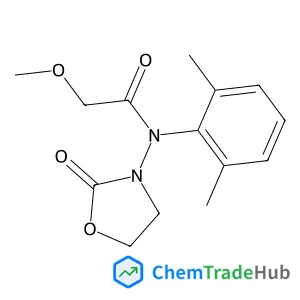
N-(2,6-Dimethylphenyl)-2-methoxy-N-(2-oxo-1,3-oxazolidin-3-yl)acetamide
CAS Number:
77732-09-3
Molecular Formula:
C14H18N2O4
Recommended Suppliers





Disclaimer
This page provides academic journal information for reference and research purposes only. We are not affiliated with any journal publishers and do not handle publication submissions. For publication-related inquiries, please contact the respective journal publishers directly.
If you notice any inaccuracies in the information displayed, please contact us at support@chemtradehub.com. We will promptly review and address your concerns.