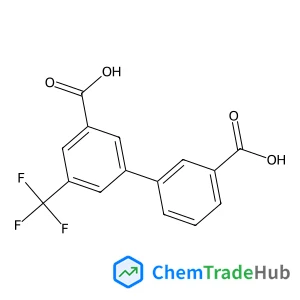
3-(3-Carboxyphenyl)-5-(trifluoromethyl)benzoic acid
CAS Number:
1261930-96-4
Molecular Formula:
C15H9F3O4
Eduardo J. Fernández, Antonio Laguna, José M. López-de-Luzuriaga, Miguel Monge, M. Elena Olmos, Javier Pérez, Cristian Silvestru
Complex [Au(C6F5)2][Bi(C6H4CH2NMe2-2)2] 1 displays the first example of an interaction between Au(I) and Bi(III), the nature of which is shown to be consistent with the presence of a high ionic contribution (79%) and a dispersion type (van der Waals) interaction (21%).
A. R. W. McKellar
DOI: 10.1039/B718509J
Max R. McGillen, Trevor J. Carey, Alex T. Archibald, John C. Wenger, Dudley E. Shallcross, Carl J. Percival
DOI: 10.1039/B715394E
Nikolaus P. Ernsting, Jens Breffke, Dmitry Yu. Vorobyev, David A. Duncan, Inga Pfeffer
DOI: 10.1039/B717541H
Tian Wu, Wei Xiao, Xianbo Jin, Chao Liu, Dihua Wang
DOI: 10.1039/B719369F
A. Borgoo, D. J. Tozer, P. Geerlings, F. De Proft
DOI: 10.1039/B716727J
Qadir K. Timerghazin, Gilles H. Peslherbe, Ann M. English
DOI: 10.1039/B715025C
Prabha Jayapal, David Robinson, Mahesh Sundararajan, Ian H. Hillier, Joseph J. W. McDouall
DOI: 10.1039/B719980E
4-Amino-3-bromophenol (CAS: 74440-80-5) falls under the classification of a haza...
(17beta)-3-Oxoestr-4-en-17-yl acetate should be stored in a cool, dry place away...
2-[(2,2-Diethoxyethyl)disulfanyl]-1,1-diethoxyethane (CAS: 76505-71-0) is a colo...
The market and research for 1-(β-D-ribofuranosyl)-1H-imidazo[4,5-c]pyridin-4-ami...
Waste containing Conjugated Estrogen (CAS: 12126-59-9) should be collected and d...
The market for Bis(2,2,2-trifluoroethyl) (methoxycarbonylmethyl)phosphonate (CAS...
There are several alternatives to 3,4'-Di-O-methylellagic acid (CAS: 57499-59-9)...
2-Chloro-N,N-dimethylpyridin-4-amine (CAS: 59047-70-0) is regulated under the Gl...
Cerium(3+);oxygen(2-);vanadium(5+) (CAS: 13597-19-8) is a complex inorganic comp...
7-Chloro-1-iodoisoquinoline (CAS: 1203579-27-4) is generally considered safe whe...

ChemComm publishes urgent research which is of outstanding significance and interest to experts in the field, while also appealing to the journal’s broad chemistry readership. Our communication format is ideally suited to short, urgent studies that are of such importance that they require accelerated publication. Our scope covers all topics in chemistry, and research at the interface of chemistry and other disciplines (such as materials science, nanoscience, physics, engineering and biology) where there is a significant novelty in the chemistry aspects. Major topic areas covered include: Analytical Chemistry Catalysis Chemical Biology and medicinal chemistry Computational Chemistry and Machine Learning Energy and sustainable chemistry Environmental Chemistry Green Chemistry Inorganic Chemistry Materials Chemistry Nanoscience Organic Chemistry Physical Chemistry Polymer Chemistry Supramolecular Chemistry
![Ethyl 5-[({[(2-methyl-2-propanyl)oxy]carbonyl}amino)methyl]-1,2-oxazole-3-carboxylate structure](https://static.chemtradehub.com/structs/253/253196-37-1-8450.webp "Ethyl 5-[({[(2-methyl-2-propanyl)oxy]carbonyl}amino)methyl]-1,2-oxazole-3-carboxylate structure")