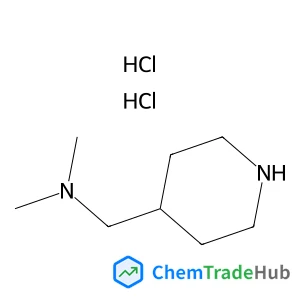
N,N-dimethyl(piperidin-4-yl)methanamine hydrochloride
CAS Number:
172281-72-0
Molecular Formula:
C8H20Cl2N2
Clélia Canuel, Mohamed Elhanine, Michel Mons, François Piuzzi, Benjamin Tardivel, Iliana Dimicoli
The excited state dynamics of the purine base 9-methyladenine (9Me-Ade) has been investigated by time- and energy-resolved photoelectron imaging spectroscopy and mass-selected ion spectroscopy, in both vacuum and water-cluster environments. The specific probe processes used, namely a careful monitoring of time-resolved photoelectron energy distributions and of photoion fragmentation, together with the excellent temporal resolution achieved, enable us to derive additional information on the nature of the excited states (ππ*, nπ*, πσ*, triplet) involved in the electronic relaxation of adenine. The two-step pathway we propose to account for the double exponential decay observed agrees well with recent theoretical calculations. The near-UV photophysics of 9Me-Ade is dominated by the direct excitation of the ππ* (1Lb) state (lifetime of 100 fs), followed by internal conversion to the nπ* state (lifetime in the ps range) via conical intersection. No evidence for the involvement of a πσ* or a triplet state was found. 9Me-Ade–(H2O)n clusters have been studied, focusing on the fragmentation of these species after the probe process. A careful analysis of the fragments allowed us to provide evidence for a double exponential decay profile for the hydrates. The very weak second component observed, however, led us to conclude that the photophysics were very different compared with the isolated base, assigned to a competition between (i) a direct one-step decay of the initially excited state (ππ* La and/or Lb, stabilised by hydration) to the ground state and (ii) a modified two-step decay scheme, qualitatively comparable to that occurring in the isolated molecule.
Bingbing Suo, Daiqian Xie, Yibo Lei, Yubin Wang
DOI: 10.1039/C0CP01300E
Zhi Li, Cristian V. Ciobanu, Juncheng Hu, Juan-Pedro Palomares-Báez, José-Luis Rodríguez-López, Ryan Richards
DOI: 10.1039/C0CP01820A
Ilkeun Lee, Manuel A. Albiter, Qiao Zhang, Jianping Ge, Yadong Yin, Francisco Zaera
DOI: 10.1039/C0CP01688H
Álvaro Valdés, Geert-Jan Kroes
DOI: 10.1039/C0CP01804J
Uwe Hahn, Francesca Setaro, Xavier Ragàs, Angus Gray-Weale, Santi Nonell, Tomas Torres
DOI: 10.1039/C0CP01015D
D. L. Thomsen, V. F. Andersen, O. J. Nielsen, T. J. Wallington
DOI: 10.1039/C0CP01609H
Cui Yu, Hongmei Liu, Wenbin Ni, Nengyue Gao, Jianwei Zhao, Haoli Zhang
DOI: 10.1039/C0CP01026J
Ferdi Schüth
DOI: 10.1039/C1CP90005F
Joshua W. Hollett, Peter M. W. Gill
DOI: 10.1039/C0CP02154G
Ethyl 4-chlorothieno[2,3-b]pyridine-5-carboxylate (CAS: 59713-58-5) can be synth...
5-Methyl-1H-indole-3-carbaldehyde (CAS: 52562-50-2) is subject to various regula...
(1,3-Dimethyl-2,4-dioxo-1,2,3,4-tetrahydro-5-pyrimidinyl)boronic acid is a white...
Waste containing Sulfocostunolide A (CAS: 1016983-51-9) should be handled with c...
When handling Murraxocin (CAS: 88478-44-8), ensure proper personal protective eq...
Formvar (CAS: 63148-64-1) is an alkyd resin characterized by a high molecular we...
(S)-4-benzyl-2-((benzyloxy)methyl)morpholine is generally safe when handled with...
Methyl 1-(5-bromo-2-pyrimidinyl)cyclopropanecarboxylate (CAS: 1447607-69-3) is p...
2-Methyl-1-phenyl-1-propanamine hydrochloride (CAS: 24290-47-9) is generally con...
3-(4-Bromophenyl)-2-methylpropanoic acid is synthesized through a multi-step pro...

Physical Chemistry Chemical Physics (PCCP) is an international journal co-owned by 19 physical chemistry and physics societies from around the world. This journal publishes original, cutting-edge research in physical chemistry, chemical physics and biophysical chemistry. To be suitable for publication in PCCP, articles must include significant innovation and/or insight into physical chemistry; this is the most important criterion that reviewers and Editors will judge against when evaluating submissions. The journal has a broad scope and welcomes contributions spanning experiment, theory, computation and data science. Topical coverage includes spectroscopy, dynamics, kinetics, statistical mechanics, thermodynamics, electrochemistry, catalysis, surface science, quantum mechanics, quantum computing and machine learning. Interdisciplinary research areas such as polymers and soft matter, materials, nanoscience, energy, surfaces/interfaces, and biophysical chemistry are welcomed if they demonstrate significant innovation and/or insight into physical chemistry. Joined experimental/theoretical studies are particularly appreciated when complementary and based on up-to-date approaches.