


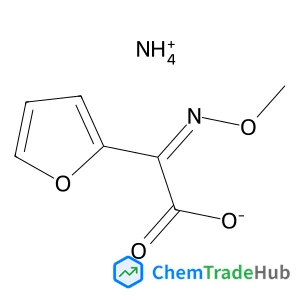
Ammonium (Z)-2-(furan-2-yl)-2-(methoxyimino)acetate
CAS Number:
97148-39-5
Molecular Formula:
C7H10N2O4
Ruth E. Lindley, Manik Pradhan, Andrew J. Orr-Ewing
Two frequency chirped continuous wave diode lasers operating in the near infrared (IR) at wavelengths of λ ∼ 1.535 µm and λ ∼ 1.520 µm have been used to measure acetylene concentrations using the P(17) and R(9) rotational lines of the (ν1 + ν3) vibrational combination band. The diode lasers were frequency chirped by applying an electrical current pulse to the laser driver at a repetition rate of greater than 1 kHz. As the laser is operated at high repetition rates, more than 1000 spectra per second can, in principle, be acquired and summed, allowing fast accumulation of data, rapid averaging and consequent improvement of the signal to noise ratio and detection limit. Experiments were performed using a single-pass cell with a path length of 16.4 cm, and also an astigmatic multi-pass absorption cell aligned to give a path length of 56 m. Detection limits corresponding to minimum detectable absorption coefficients, αmin, of 5.6 × 10⁻⁵ and 7.8 × 10⁻⁸ cm−1, respectively, were obtained over a 4 s detection bandwidth. These detection limits would correspond to mixing ratios of 21 parts per million by volume (ppmv) and 59 parts per billion by volume (ppbv) of acetylene at 1 atm in air, with the deleterious effects of pressure broadening accounted for. The single-pass cell was used to perform breakthrough volume (BTV) experiments for the low volume adsorbent traps used to pre-concentrate organic compounds in air, taking advantage of the capability of the system to measure concentrations in real time.

Atomization and Sprays

Journal of Chemical Sciences

Herald of the Russian Academy of Sciences

Biocatalysis and Biotransformation

Colloid Journal

Critical Reviews in Solid State and Materials Sciences

Journal of Asian Natural Products Research

Medicinal Chemistry Research

Chinese Journal of Chemistry

Polycyclic Aromatic Compounds
Baoshun Liu, Jingjing Yang, Xiujian Zhao, Jiaguo Yu
DOI: 10.1039/C6CP07328J
Jamie C. Wang, Kyle Violette, Omotola O. Ogunsolu
DOI: 10.1039/C6CP07939C
Yang-Jin Cho, So-Yoen Kim, Ho-Jin Son, Sang Ook Kang
DOI: 10.1039/C7CP00500H
Tim Kohlmann, Robert Naumann, Christoph Kerzig, Martin Goez
DOI: 10.1039/C6CP08491E
Rongzheng Wan, Guosheng Shi
DOI: 10.1039/C7CP00553A
Zhi-Xiang Zhang, Pi-Xia Wang, Fu-Quan Bai, Chui-Peng Kong, Hong-Xing Zhang
DOI: 10.1039/C7CP00262A
Robert A. Lazenby, Kiran Bano, Jie Zhang, Alan M. Bond, Julie V. Macpherson, Patrick R. Unwin
DOI: 10.1039/C7CP00968B
Giorgia Olivieri, Krista M. Parry, Cedric J. Powell, Douglas J. Tobias, Matthew A. Brown
DOI: 10.1039/C6CP07539H
K. McCluskey
DOI: 10.1039/C6CP08798A
Martin Kroupa, Miroslav Soos, Juraj Kosek
DOI: 10.1039/C6CP07666A
1H-Indazole-6-carbonitrile finds applications in pharmaceuticals, where it serve...
Waste containing Dioctyl (2E)-2-butenedioate (CAS: 2997-85-5) should be collecte...
Sodium [(1,2-benzoxazol-3-ylmethyl)sulfonyl]azanide is primarily used in pharmac...
Dimethyl 4-(4,4,5,5-tetramethyl-1,3,2-dioxaborolan-2-yl)-2,6-pyridinedicarboxyla...
Waste containing 2-Fluoro-6-hydrazinopyridine (CAS: 80714-39-2) should be manage...
6-Formyl-2-pyridinecarboxylic acid is an organic compound with the molecular for...
Research trends for this compound indicate a focus on its potential applications...
9H-Tribenzo[b,d,f]azepine is typically synthesized via a multi-step process invo...
1-Cyclopropyl-7-ethoxy-6-fluoro-8-methoxy-4-oxo-1,4-dihydro-3-quinolinecarboxyli...
Waste containing Methyl 3-oxo-1,2,3,4-tetrahydro-6-quinoxalinecarboxylate (CAS: ...

Analyst publishes analytical and bioanalytical research that reports premier fundamental discoveries and inventions, and the applications of those discoveries, unconfined by traditional discipline barriers.

![N-[(9H-Fluoren-9-ylmethoxy)carbonyl]serine structure](https://static.chemtradehub.com/structs/737/73724-45-5-b0dc.webp "N-[(9H-Fluoren-9-ylmethoxy)carbonyl]serine structure")







