













ATR-FTIR membrane-based sensor for the simultaneous determination of surfactant and oil total indices in industrial degreasing baths
Literature Information
Publication Date
2005-12-14
DOI
10.1039/B515163E
Impact Factor
4.616
Authors
Rafael Lucena, Soledad Cárdenas, Mercedes Gallego, Miguel Valcárcel
View Original
Abstract
Monitoring the exhaustion of alkaline degreasing baths is one of the main aspects in metal mechanizing industrial process control. The global level of surfactant, and mainly grease, can be used as ageing indicators. In this paper, an attenuated total reflection-Fourier transform infrared (ATR-FTIR) membrane-based sensor is presented for the determination of these parameters. The system is based on a μ-liquid–liquid extraction of the analytes through a polymeric membrane from the aqueous to the organic solvent layer which is in close contact with the internal reflection element and continuously monitored. Samples are automatically processed using a simple, robust sequential injection analysis (SIA) configuration, on-line coupled to the instrument. The global signal obtained for both families of compounds are processed via a multivariate calibration technique (partial least squares, PLS). Excellent correlation was obtained for the values given by the proposed method compared to those of the gravimetric reference one with very low error values for both calibration and validation.
Recommended Journals
Related Literature
Ionic conductivity and mixed-ion effect in mixed alkali metaphosphate glasses
Jefferson Esquina Tsuchida, Fabio Aparecido Ferri
2017-02-16
Paper
DOI: 10.1039/C6CP07876A
Tuning calcium biosensors with a single-site mutation: structural dynamics insights from femtosecond Raman spectroscopy
Sean R. Tachibana, Longteng Tang, Yanli Wang, Weimin Liu
2017-02-13
Paper
DOI: 10.1039/C6CP08821J
Dense ionization and subsequent non-homogeneous radical-mediated chemistry of femtosecond laser-induced low density plasma in aqueous solutions: synthesis of colloidal gold
Hakim Belmouaddine, Minghan Shi, Paul-Ludovic Karsenti, Ridthee Meesat, Léon Sanche, Daniel Houde
2017-02-15
Paper
DOI: 10.1039/C6CP08080D
The effect of interligand energy transfer on the emission spectra of heteroleptic Ir complexes
Yang-Jin Cho, So-Yoen Kim, Ho-Jin Son, Sang Ook Kang
2017-03-02
Paper
DOI: 10.1039/C7CP00500H
Strong current polarization and perfect negative differential resistance in few-FeN4-embedded zigzag graphene nanoribbons
Xiao-Fei Li, Lingling Liu, Qing Yan, Qin-Kun Li, Yunxiang Wang, Mingsen Deng, Qi Qiu
2016-12-21
Communication
DOI: 10.1039/C6CP08357A
Successive lithiation of acetylene, ethylene and benzene: a comprehensive computational study of large static second hyperpolarizability
Avijit Mondal, Kaushik Hatua, Ria Sinha Roy, Prasanta K. Nandi
2017-01-16
Paper
DOI: 10.1039/C6CP07845A
Comparison of fast electron transfer kinetics at platinum, gold, glassy carbon and diamond electrodes using Fourier-transformed AC voltammetry and scanning electrochemical microscopy
Robert A. Lazenby, Kiran Bano, Jie Zhang, Alan M. Bond, Julie V. Macpherson, Patrick R. Unwin
2017-03-06
Paper
DOI: 10.1039/C7CP00968B
Facile synthesis of nanoporous Li1+xV1−xO2@C composites as promising anode materials for lithium-ion batteries
Malay Pramanik, Jaewoo Lee, Toshiaki Takei, Yusuke Ide, Md. Shahriar A. Hossain, Jung Ho Kim
2017-03-20
Paper
DOI: 10.1039/C6CP08827A
Infrared spectra of HSCS+, c-HSCS, and HCS2− produced on electron bombardment of CS2 in solid para-hydrogen
Masashi Tsuge
2017-03-13
Paper
DOI: 10.1039/C7CP00988G
Dynamical descriptors of bioactivity: a correlation between chemical durability and ion migration in biodegradable glasses
2017-02-21
Communication
DOI: 10.1039/C6CP07203H
You might also like
Compound Q&A
What are the main uses of 1H-Indazole-6-carbonitrile (CAS: 141290-59-7)?
1H-Indazole-6-carbonitrile finds applications in pharmaceuticals, where it serve...
141290-59-71H-Indazole-6-carbon...
Compound Q&A
How should waste containing Dioctyl (2E)-2-butenedioate (CAS: 2997-85-5) be handled?
Waste containing Dioctyl (2E)-2-butenedioate (CAS: 2997-85-5) should be collecte...
2997-85-5Dioctyl (2E)-2-buten...
Compound Q&A
What industries use Sodium [(1,2-benzoxazol-3-ylmethyl)sulfonyl]azanide (CAS: 68291-98-5)?
Sodium [(1,2-benzoxazol-3-ylmethyl)sulfonyl]azanide is primarily used in pharmac...
68291-98-5Sodium [(1,2-benzoxa...
Compound Q&A
Are there alternatives to Dimethyl 4-(4,4,5,5-tetramethyl-1,3,2-dioxaborolan-2-yl)-2,6-pyridinedicarboxylate (CAS: 741709-66-0) in synthesis?
Dimethyl 4-(4,4,5,5-tetramethyl-1,3,2-dioxaborolan-2-yl)-2,6-pyridinedicarboxyla...
741709-66-0Dimethyl 4-(4,4,5,5-...
Compound Q&A
How should waste containing 2-Fluoro-6-hydrazinopyridine (CAS: 80714-39-2) be handled?
Waste containing 2-Fluoro-6-hydrazinopyridine (CAS: 80714-39-2) should be manage...
80714-39-22-Fluoro-6-hydrazino...
Compound Q&A
What is 6-Formyl-2-pyridinecarboxylic acid (CAS: 499214-11-8)?
6-Formyl-2-pyridinecarboxylic acid is an organic compound with the molecular for...
499214-11-86-Formyl-2-pyridinec...
Compound Q&A
What is the market or research trend for 3-(3,4-dimethoxyphenyl)-2,5-dimethyl-N-(2-morpholin-4-ylethyl)pyrazolo[1,5-a]pyrimidin-7-amine (CAS: 900874-91-1)?
Research trends for this compound indicate a focus on its potential applications...
900874-91-13-(3,4-dimethoxyphen...
Compound Q&A
How is 9H-Tribenzo[b,d,f]azepine (CAS: 29875-73-8) typically synthesized?
9H-Tribenzo[b,d,f]azepine is typically synthesized via a multi-step process invo...
29875-73-89H-Tribenzo[b,d,f]az...
Compound Q&A
How is 1-Cyclopropyl-7-ethoxy-6-fluoro-8-methoxy-4-oxo-1,4-dihydro-3-quinolinecarboxylic acid (CAS: 1797982-51-4) typically synthesized?
1-Cyclopropyl-7-ethoxy-6-fluoro-8-methoxy-4-oxo-1,4-dihydro-3-quinolinecarboxyli...
1797982-51-41-Cyclopropyl-7-etho...
Compound Q&A
How should waste containing Methyl 3-oxo-1,2,3,4-tetrahydro-6-quinoxalinecarboxylate (CAS: 671820-52-3) be handled?
Waste containing Methyl 3-oxo-1,2,3,4-tetrahydro-6-quinoxalinecarboxylate (CAS: ...
671820-52-3Methyl 3-oxo-1,2,3,4...
Source Journal
Analyst

CiteScore:
7.8
Self-citation Rate:
5.6%
Articles per Year:
653
Analyst publishes analytical and bioanalytical research that reports premier fundamental discoveries and inventions, and the applications of those discoveries, unconfined by traditional discipline barriers.
Recommended Compounds
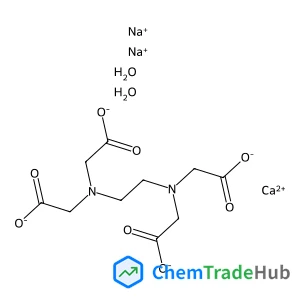
EthylenediaminetetraaceticacidcalciumDisodiumsalthydrate
CAS Number:
23411-34-9
Molecular Formula:
C10H16CaN2Na2O10


![(1S)-1,5-Anhydro-1-[3-(1-benzothiophen-2-ylmethyl)-4-fluorophenyl]-D-glucitol structure](https://static.chemtradehub.com/structs/761/761423-87-4-dbeb.webp "(1S)-1,5-Anhydro-1-[3-(1-benzothiophen-2-ylmethyl)-4-fluorophenyl]-D-glucitol structure")
(1S)-1,5-Anhydro-1-[3-(1-benzothiophen-2-ylmethyl)-4-fluorophenyl]-D-glucitol
CAS Number:
761423-87-4
Molecular Formula:
C21H21FO5S
Recommended Suppliers






Disclaimer
This page provides academic journal information for reference and research purposes only. We are not affiliated with any journal publishers and do not handle publication submissions. For publication-related inquiries, please contact the respective journal publishers directly.
If you notice any inaccuracies in the information displayed, please contact us at support@chemtradehub.com. We will promptly review and address your concerns.