












In situ determination of sulfur isotopes in sulfur-rich materials by laser ablation multiple-collector inductively coupled plasma mass spectrometry (LA-MC-ICP-MS)
Literature Information
Publication Date
2005-12-20
DOI
10.1039/B510883G
Impact Factor
4.023
Authors
Paul R. D. Mason, Jan Košler, Paul J. Sylvester, Simon Meffan-Main
View Original
Abstract
A new method has been developed for the accurate and precise measurement of sulfur isotopes (32S, 33S, 34S) in solids on a scale down to 80–100 μm by laser ablation multiple collector inductively coupled plasma mass spectrometry (LA-MC-ICP-MS). The method was developed independently on two different sets of instrumentation, both of which give equivalent results with comparable accuracy and precision. The first instrumental set-up utilizes Xe gas in a hexapole collision and reaction cell for interference attenuation coupled with a mass discrimination correction by external normalization using a nebulised vapour of 37Cl/35Cl standard solution. The second employs high mass resolution by sector field mass spectrometry to avoid the interfering O2+ isobars with a 30Si/29Si standard aerosol for external normalization. The external isotope mass discrimination correction was applied using the exponential law and was further calibrated for both sets of instrumentation by linear interpolation in a sample–standard bracketing method. Mean δ34SV-CDT and δ33SV-CDT show excellent agreement (within analytical error, typically 0.6 and 1.5‰, respectively) with compiled data for IAEA-S series AgS standard reference materials. Results for NIST SRM 127 (sulfate) were less accurate when calibrated against the IAEA-S series sulfides, whilst significant and consistent deviations in accuracy of up to 3‰ were observed in both sets of instrumentation for Soufre de Lacq SRM sulfur. Such generic matrix effects may be widespread in LA-ICP-MS due to differential ablation rates, particle formation, particle transport efficiency and ionization efficiency in an argon plasma.
Related Literature
A C20-based 3D carbon allotrope with high thermal conductivity
Yupeng Shen, Fancy Qian Wang, Jie Liu, Qian Wang
2019-06-04
Paper
DOI: 10.1039/C9CP02202C
Mechanism and theory of d-glucopyranose homogeneous acid catalysis in the aqueous solution phase
Karla Dussan
2019-07-15
Paper
DOI: 10.1039/C8CP07224H
Graphene coated gold nanoparticles: an emerging class of nanoagents for photothermal therapy applications
Mohsen Farokhnezhad, Mahdi Esmaeilzadeh
2019-08-01
Paper
DOI: 10.1039/C9CP03126J
Studies on the internal medium-range ordering and high pressure dynamics in modified ibuprofens
Aldona Minecka, Ewa Kamińska, Dawid Heczko, Barbara Hachuła, Wojciech Pisarski
2019-11-21
Paper
DOI: 10.1039/C9CP04886C
Sublimation thermodynamics of nucleobases derived from fast scanning calorimetry
A. V. Buzyurov
2019-12-10
Paper
DOI: 10.1039/C9CP04761A
Rate coefficient of the reaction CH2OO + NO2 probed with a quantum-cascade laser near 11 μm
Pei-Ling Luo, Chen-An Chung
2019-07-26
Paper
DOI: 10.1039/C9CP03333E
First-principles prediction of large thermoelectric efficiency in superionic Li2SnX3 (X = S, Se)
Enamul Haque, Claudio Cazorla, M. Anwar Hossain
2019-11-22
Paper
DOI: 10.1039/C9CP05939C
ReacNetGenerator: an automatic reaction network generator for reactive molecular dynamics simulations
Jinzhe Zeng, Liqun Cao, Haisheng Ren
2019-11-26
Paper
DOI: 10.1039/C9CP05091D
You might also like
Compound Q&A
What precautions should be taken when handling 4-Methyl-6-(trifluoromethyl)quinoline (CAS: 40716-16-3)?
When handling 4-Methyl-6-(trifluoromethyl)quinoline (CAS: 40716-16-3), safety go...
40716-16-34-Methyl-6-(trifluor...
Compound Q&A
What is 4-(3,5-Difluorophenyl)aniline (CAS: 405058-00-6)?
4-(3,5-Difluorophenyl)aniline is an aromatic organic compound with the CAS numbe...
405058-00-64-(3,5-Difluoropheny...
Compound Q&A
How is 5-{[4-(Trifluoromethyl)phenyl]sulfanyl}-1,2,3-thiadiazole-4-carboxylic acid (CAS: 338982-07-3) typically synthesized?
5-{[4-(Trifluoromethyl)phenyl]sulfanyl}-1,2,3-thiadiazole-4-carboxylic acid can ...
338982-07-35-{[4-(Trifluorometh...
Compound Q&A
What is the market or research trend for 4-Benzylaniline hydrochloride (CAS: 6317-57-3)?
The market for 4-Benzylaniline hydrochloride (CAS: 6317-57-3) is steadily growin...
6317-57-34-Benzylaniline hydr...
Compound Q&A
Is [3-(Diethylsulfamoyl)phenyl]boronic acid (CAS: 871329-58-7) safe?
[3-(Diethylsulfamoyl)phenyl]boronic acid is generally considered safe when handl...
871329-58-7[3-(Diethylsulfamoyl...
Compound Q&A
What are the main uses of 3-Bromo-2,5-dimethoxyaniline (CAS: 115929-62-9)?
3-Bromo-2,5-dimethoxyaniline is mainly used in the pharmaceutical and chemical i...
115929-62-93-Bromo-2,5-dimethox...
Compound Q&A
What regulatory guidelines apply to N-Methyl-1-(5-methyl-1H-indol-3-yl)methanamine (CAS: 915922-67-7)?
N-Methyl-1-(5-methyl-1H-indol-3-yl)methanamine (CAS: 915922-67-7) is subject to ...
915922-67-7N-Methyl-1-(5-methyl...
Compound Q&A
What industries use Carbamic acid, N-[(5S)-5,6-diamino-6-oxohexyl]-, 1,1-dimethylethyl ester (CAS: 24828-96-4)?
This compound is primarily used in the pharmaceutical industry for the synthesis...
24828-96-4Carbamic acid, N-[(5...
Compound Q&A
How should 2-Methyl-2-propanyl [(1S,3R)-3-aminocyclohexyl]carbamate (CAS: 1298101-47-9) be stored?
2-Methyl-2-propanyl [(1S,3R)-3-aminocyclohexyl]carbamate (CAS: 1298101-47-9) sho...
1298101-47-92-Methyl-2-propanyl ...
Compound Q&A
What industries use Ethyl 2-bromo-4,4,4-trifluorobutanoate (CAS: 367-33-9)?
Ethyl 2-bromo-4,4,4-trifluorobutanoate (CAS: 367-33-9) is utilized in the pharma...
367-33-9Ethyl 2-bromo-4,4,4-...
Source Journal
Journal of Analytical Atomic Spectrometry

CiteScore:
6.2
Self-citation Rate:
25.8%
Articles per Year:
254
The Journal of Analytical Atomic Spectrometry (JAAS) is the central journal for publishing innovative research on fundamentals, instrumentation, and methods in the determination, speciation and isotopic analysis of (trace) elements within all fields of application. This includes, but is not restricted to, the most recent progress, developments and achievements in all forms of atomic and elemental detection, isotope ratio determination, molecular analysis, plasma-based analysis and X-ray techniques. The journal welcomes full papers, communications, technical notes, critical and tutorial review articles, editorials, and comments, in addition to the Atomic Spectrometry Updates (ASU) literature reviews that are prepared by an expert panel. Submissions are welcome in the following areas, but note this list reflects the current scope and authors are strongly encouraged to contact the Editorial team if they believe that their work offers potentially new and emerging research relevant to the journal remit: Fundamental studies in the following. New and existing sources for atomic emission, absorption, fluorescence and mass spectrometry and those that provide both atomic and molecular information Sample introduction techniques for solids, liquids, gases Improvements in sensitivity, selectivity, precision, accuracy and/or robustness Isotope ratio measurements, including techniques for improving precision and mass bias correction Single channel and multichannel simultaneous detection systems Chemometrics, statistics, calibration techniques and internal standardisation Theoretical and numerical modelling of fundamental processes related to all of the above methodologies Novel or improved methodologies in areas of application including, but not limited to the following. Biosciences, including elemental, speciation and isotopic analysis in biological systems, immunoassays based on metal-labeled antibodies, bio-imaging, and nanoparticle toxicology Geochemistry Environmental science Materials science, including engineered nanoparticles and quantum dots Metrology, including reference materials Forensic analysis Food and agricultural sciences Energy Archaeometry Molecular analysis. Molecular sources for elemental and isotopic analysis Atomic sources for molecular analysis Atomic and molecular techniques simultaneously used for complementary chemical information All contributions are judged on originality and quality of scientific content, and appropriateness of length to content of new science.
Recommended Compounds
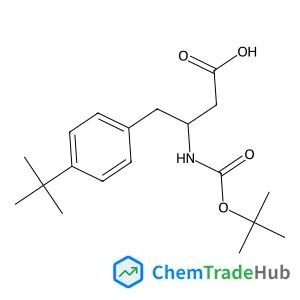
(S)-3-((tert-Butoxycarbonyl)amino)-4-(4-(tert-butyl)phenyl)butanoic acid
CAS Number:
403661-85-8
Molecular Formula:
C19H29NO4
Recommended Suppliers






Disclaimer
This page provides academic journal information for reference and research purposes only. We are not affiliated with any journal publishers and do not handle publication submissions. For publication-related inquiries, please contact the respective journal publishers directly.
If you notice any inaccuracies in the information displayed, please contact us at support@chemtradehub.com. We will promptly review and address your concerns.