













Two-dimensional (2D) correlation coefficient analyses of heavily overlapped near-infrared spectra
Literature Information
Publication Date
2005-03-21
DOI
10.1039/B418963A
Impact Factor
4.616
Authors
Slobodan Šašić, Harumi Sato, Masahiko Shimoyama, Yukihiro Ozaki
View Original
Abstract
Two-dimensional (2D) correlation coefficient analysis is employed to classify and characterize spectral variations among heavily overlapped near-infrared spectra of pellets and films of three kinds of polyethylene (PE), high-density (HD), low density (LD), and linear low-density (LLD) polyethylene, and five kinds of ivory signature seals. The sample–sample (SS) 2D correlation maps are used for classification while the wavenumber–wavenumber (WW) 2D correlation maps are used for determining spectral variation among the above materials. Both correlation maps are obtained by multiplying the original data with themselves. It is found that the NIR spectra of pellets and films of HD PE are clearly different from those of LD PE and LLD PE, while the NIR spectra of five kinds of ivory seals yield easily discernable squares in the SS correlation maps. The background variation is thought to be behind the differentiation of the PE samples because the WW correlation maps do not indicate appearance of new bands. The correlation results are compared with those of principal component analysis (PCA). This study is a novel application of 2D correlation coefficient analysis which reveals that a comprehensive description of demanding spectral systems is achievable by utterly simple mathematical means because 2D correlation maps are obtained via a single mathematical operation.
Recommended Journals
Related Literature
Spacer-controlled emission of randomly oriented fluorophores enhanced with surface plasmon-polaritons
Yu. Akimov
2017-03-06
Paper
DOI: 10.1039/C7CP00151G
Accelerated evaporation of water on graphene oxide
Rongzheng Wan, Guosheng Shi
2017-03-06
Paper
DOI: 10.1039/C7CP00553A
Slip on a particle surface as the possible origin of shear thinning in non-Brownian suspensions
Martin Kroupa, Miroslav Soos, Juraj Kosek
2017-01-25
Paper
DOI: 10.1039/C6CP07666A
Direct observation of the rise of delayed fluorescence in dithienylbenzothiadiazole and its role in the excited state dynamics of a donor–acceptor–donor molecule
Maneesha Esther Mohanty, Chakali Madhu, Vanammoole Lakshmi Reddy, Mahalingavelar Paramasivam, Prakriti Ranjan Bangal, Vaidya Jayathirtha Rao
2017-02-28
Paper
DOI: 10.1039/C7CP00261K
Thermodynamic stability of stoichiometric LaFeO3 and BiFeO3: a hybrid DFT study
Eugene Heifets, Joachim Maier
2016-12-20
Paper
DOI: 10.1039/C6CP07986E
Correlation of the structural information obtained for europium-chelate ensembles from gas-phase photoluminescence and ion-mobility spectroscopy with density-functional computations and ligand-field theory
Jean-François Greisch, Jiří Chmela, Michael E. Harding, Dirk Wunderlich, Bernhard Schäfer
2017-01-27
Paper
DOI: 10.1039/C6CP04656H
Dynamical descriptors of bioactivity: a correlation between chemical durability and ion migration in biodegradable glasses
2017-02-21
Communication
DOI: 10.1039/C6CP07203H
Energy decomposition analysis in an adiabatic picture
Yuezhi Mao, Paul R. Horn
2017-02-01
Paper
DOI: 10.1039/C6CP08039A
Drug–DNA complexation as the key factor in photosensitized thymine dimerization
M. Consuelo Cuquerella, Virginie Lhiaubet-Vallet, Miguel A. Miranda, Francisco Bosca
2017-01-20
Communication
DOI: 10.1039/C6CP08485K
You might also like
Compound Q&A
What are the main uses of 1H-Indazole-6-carbonitrile (CAS: 141290-59-7)?
1H-Indazole-6-carbonitrile finds applications in pharmaceuticals, where it serve...
141290-59-71H-Indazole-6-carbon...
Compound Q&A
How should waste containing Dioctyl (2E)-2-butenedioate (CAS: 2997-85-5) be handled?
Waste containing Dioctyl (2E)-2-butenedioate (CAS: 2997-85-5) should be collecte...
2997-85-5Dioctyl (2E)-2-buten...
Compound Q&A
What industries use Sodium [(1,2-benzoxazol-3-ylmethyl)sulfonyl]azanide (CAS: 68291-98-5)?
Sodium [(1,2-benzoxazol-3-ylmethyl)sulfonyl]azanide is primarily used in pharmac...
68291-98-5Sodium [(1,2-benzoxa...
Compound Q&A
Are there alternatives to Dimethyl 4-(4,4,5,5-tetramethyl-1,3,2-dioxaborolan-2-yl)-2,6-pyridinedicarboxylate (CAS: 741709-66-0) in synthesis?
Dimethyl 4-(4,4,5,5-tetramethyl-1,3,2-dioxaborolan-2-yl)-2,6-pyridinedicarboxyla...
741709-66-0Dimethyl 4-(4,4,5,5-...
Compound Q&A
How should waste containing 2-Fluoro-6-hydrazinopyridine (CAS: 80714-39-2) be handled?
Waste containing 2-Fluoro-6-hydrazinopyridine (CAS: 80714-39-2) should be manage...
80714-39-22-Fluoro-6-hydrazino...
Compound Q&A
What is 6-Formyl-2-pyridinecarboxylic acid (CAS: 499214-11-8)?
6-Formyl-2-pyridinecarboxylic acid is an organic compound with the molecular for...
499214-11-86-Formyl-2-pyridinec...
Compound Q&A
What is the market or research trend for 3-(3,4-dimethoxyphenyl)-2,5-dimethyl-N-(2-morpholin-4-ylethyl)pyrazolo[1,5-a]pyrimidin-7-amine (CAS: 900874-91-1)?
Research trends for this compound indicate a focus on its potential applications...
900874-91-13-(3,4-dimethoxyphen...
Compound Q&A
How is 9H-Tribenzo[b,d,f]azepine (CAS: 29875-73-8) typically synthesized?
9H-Tribenzo[b,d,f]azepine is typically synthesized via a multi-step process invo...
29875-73-89H-Tribenzo[b,d,f]az...
Compound Q&A
How is 1-Cyclopropyl-7-ethoxy-6-fluoro-8-methoxy-4-oxo-1,4-dihydro-3-quinolinecarboxylic acid (CAS: 1797982-51-4) typically synthesized?
1-Cyclopropyl-7-ethoxy-6-fluoro-8-methoxy-4-oxo-1,4-dihydro-3-quinolinecarboxyli...
1797982-51-41-Cyclopropyl-7-etho...
Compound Q&A
How should waste containing Methyl 3-oxo-1,2,3,4-tetrahydro-6-quinoxalinecarboxylate (CAS: 671820-52-3) be handled?
Waste containing Methyl 3-oxo-1,2,3,4-tetrahydro-6-quinoxalinecarboxylate (CAS: ...
671820-52-3Methyl 3-oxo-1,2,3,4...
Source Journal
Analyst

CiteScore:
7.8
Self-citation Rate:
5.6%
Articles per Year:
653
Analyst publishes analytical and bioanalytical research that reports premier fundamental discoveries and inventions, and the applications of those discoveries, unconfined by traditional discipline barriers.
Recommended Compounds
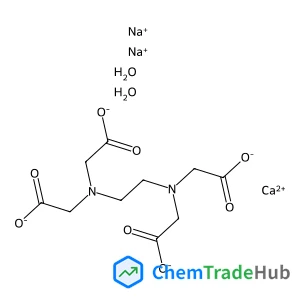
EthylenediaminetetraaceticacidcalciumDisodiumsalthydrate
CAS Number:
23411-34-9
Molecular Formula:
C10H16CaN2Na2O10


Recommended Suppliers




Disclaimer
This page provides academic journal information for reference and research purposes only. We are not affiliated with any journal publishers and do not handle publication submissions. For publication-related inquiries, please contact the respective journal publishers directly.
If you notice any inaccuracies in the information displayed, please contact us at support@chemtradehub.com. We will promptly review and address your concerns.