












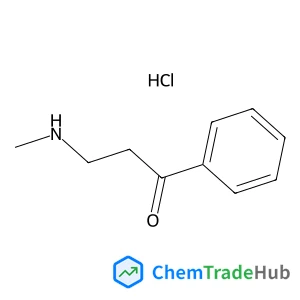
3-(Methylamino)-1-phenyl-1-propanone hydrochloride (1:1)
CAS Number:
2538-50-3
Molecular Formula:
C10H14ClNO
J. M. Bofill
Inelastic excitation and charge transfer excitation processes in collisions between neutral Mg atoms and Cs+ ions, both in their ground states, have been studied by means of a crossed molecular beam technique. Decay fluorescent emissions from Mg(3 1P1), Mg(3 3D3,2,1), Mg(4 3S1) and Cs(6 2P3/2) states have been detected as well as the phosphorescent emission due to Mg(3 3P1) decay. The corresponding absolute cross-sections vs. collision energy functions were determined in the laboratory 0.05–4.20 keV energy range. In order to interpret the experimental results, accurate ab initio calculations using pseudopotentials have been performed for the (Mg–Cs)+ system obtaining a manifold of adiabatic energy curves correlating with the different collision channels and allowing a qualitative interpretation of the emission excitation functions for the different processes studied.
Kees-Jan Weststrate, Ludo Juurlink
DOI: 10.1039/C3CP44503H
Arnošt Mládek, Miroslav Krepl, Michal Otyepka, Pavel Banáš, Marie Zgarbová, Petr Jurečka
DOI: 10.1039/C3CP44383C
Giuseppe Graziano
DOI: 10.1039/C3CP50616A
Andrew P. Ault, Defeng Zhao, Carlena J. Ebben, Michael J. Tauber, Franz M. Geiger, Vicki H. Grassian
DOI: 10.1039/C3CP43899F
Stephan Menzel, Stefan Tappertzhofen, Ilia Valov
DOI: 10.1039/C3CP50738F
Alexei Bagrets
DOI: 10.1039/C3CP44286A
Xiaowei Li, Shunhong Zhang, Qian Wang
DOI: 10.1039/C3CP44660C
Bethany R. Lettiere, Gareth Seward, Nisha Verma, Yichi Zhang
DOI: 10.1039/C3CP50918D
Marco Micciarelli, Carlo Altucci, Bartolomeo Della Ventura, Raffaele Velotta, Valer Toşa, Adán B. Gónzalez Pérez, Martin Pérez Rodríguez, Ángel R. de Lera, Attila Bende
DOI: 10.1039/C3CP50343G
When handling 4-(2-Furylmethyl)thiomorpholine 1,1-dioxide (CAS: 79206-94-3), it ...
When handling 4-Chloro-N-[2-(4-morpholinyl)ethyl]benzamide (CAS: 71320-77-9), it...
Waste containing this compound (CAS: 62921-74-8) should be handled according to ...
Waste containing (S)-Methyl 2-amino-3-cyclohexylpropanoate should be collected i...
This compound can be synthesized using a multi-step process involving the conjug...
There are several alternatives to (2E)-3-(3,4-Dichlorophenyl)acrylic acid in syn...
Ethyl 6-(2-nitrophenyl)imidazo[2,1-b][1,3]thiazole-3-carboxylate (CAS: 925437-84...
Waste containing 2-(1,3-Thiazol-2-yl)ethanamine (CAS: 18453-07-1) should be coll...
Methyl 5-iodo-2-methylbenzoate can be synthesized through the iodination of meth...
5-Chloro[1,2,4]triazolo[1,5-a]pyridine is commonly synthesized via the condensat...

Physical Chemistry Chemical Physics (PCCP) is an international journal co-owned by 19 physical chemistry and physics societies from around the world. This journal publishes original, cutting-edge research in physical chemistry, chemical physics and biophysical chemistry. To be suitable for publication in PCCP, articles must include significant innovation and/or insight into physical chemistry; this is the most important criterion that reviewers and Editors will judge against when evaluating submissions. The journal has a broad scope and welcomes contributions spanning experiment, theory, computation and data science. Topical coverage includes spectroscopy, dynamics, kinetics, statistical mechanics, thermodynamics, electrochemistry, catalysis, surface science, quantum mechanics, quantum computing and machine learning. Interdisciplinary research areas such as polymers and soft matter, materials, nanoscience, energy, surfaces/interfaces, and biophysical chemistry are welcomed if they demonstrate significant innovation and/or insight into physical chemistry. Joined experimental/theoretical studies are particularly appreciated when complementary and based on up-to-date approaches.

![1,2-Diphenyl-4-[2-(phenylsulfinyl)ethyl]-3,5-pyrazolidinedione structure](https://static.chemtradehub.com/structs/57-/57-96-5-efcc.webp "1,2-Diphenyl-4-[2-(phenylsulfinyl)ethyl]-3,5-pyrazolidinedione structure")




