












A method for rapid reaction optimisation in continuous-flow microfluidic reactors using online Raman spectroscopic detection
Literature Information
Publication Date
2004-11-22
DOI
10.1039/B412069H
Impact Factor
4.616
Authors
Shee-Ann Leung, Richard F. Winkle, Robert C. R. Wootton, Andrew J. deMello
View Original
Abstract
An extremely rapid tool for continuous flow synthetic process optimisation is described. A microfluidic reaction system operating in continuous flow is used in conjunction with confocal Raman microscopy to afford rapid molecule synthesis and product quantitation. Accordingly, the approach allows for rapid reaction optimisation within a continuous flow system. Specifically, the catalytic oxidation of isopropyl alcohol (IPA) to acetone using tetra-N-propylammonium perruthanate (TPAP)/N-methylmorpholine N-oxide (NMO) in a radial interdigitated micromixer is studied as a model reaction system. The composition of the reaction effluent can be determined with great facility and information relating to catalyst/co-oxidant ratios, catalyst turnovers and reaction endpoints extracted. Specifically, variation of catalyst and co-oxidant volumetric flow rates between 0 and 50 µL min−1 is used to vary reactant concentrations, define reaction residence times and control product conversions between 0 and 100%. The rapid nature of the system allows chemical information to be gathered and utilised on a sub-minute timescale.
Related Literature
The synergy between qualitative theory, quantitative calculations, and direct experiments in understanding, calculating, and measuring the energy differences between the lowest singlet and triplet states of organic diradicals
W. Carl Lineberger, Weston Thatcher Borden
2011-05-26
Perspective
DOI: 10.1039/C0CP02786C
Effects of the substituents on the reactivity of carbonyl oxides. A theoretical study on the reaction of substituted carbonyl oxides with water
J. M. Anglada, J. González, M. Torrent-Sucarrat
2011-06-20
Paper
DOI: 10.1039/C1CP20872A
The valence electronic structure and conformational flexibility of epichlorohydrin
M. Alagia, D. Toffoli, M. Speranza, D. Catone, S. Turchini, T. Prosperi, N. Zema, G. Contini, Y. Keheyan
2011-06-10
Paper
DOI: 10.1039/C0CP02730H
An infrared study of solid glycine in environments of astrophysical relevance
Belén Maté, Yamilet Rodriguez-Lazcano, Óscar Gálvez, Isabel Tanarro, Rafael Escribano
2011-06-01
Paper
DOI: 10.1039/C1CP20899C
Complementary and partially complementary DNA duplexes tethered to a functionalized substrate: a molecular dynamics approach to biosensing
Susanna Monti, Ivo Cacelli, Alessandro Ferretti, Giacomo Prampolini, Vincenzo Barone
2011-06-09
Paper
DOI: 10.1039/C1CP21115C
Recent advances and perspectives in four-component Dirac–Kohn–Sham calculations
Leonardo Belpassi, Loriano Storchi, Harry M. Quiney, Francesco Tarantelli
2011-06-13
Perspective
DOI: 10.1039/C1CP20569B
Locking of Turing patterns in the chlorine dioxide–iodine–malonic acid reaction with one-dimensional spatial periodic forcing
Milos Dolnik, Tamás Bánsági, Jr., Sama Ansari, Irving R. Epstein
2011-06-13
Paper
DOI: 10.1039/C1CP20949C
In situ infrared monitoring of the solid/liquid catalyst interface during the three-phase hydrogenation of nitrobenzene over nanosized Au on TiO2
Gilles Richner, Yorck-Michael Neuhold, Martin Makosch, Konrad Hungerbühler
2011-06-09
Paper
DOI: 10.1039/C1CP20238C
Hybrid density functional theory/molecular mechanics calculations of two-photon absorption of dimethylamino nitro stilbene in solution
N. Arul Murugan, Jacob Kongsted, Zilvinas Rinkevicius, Keęstutis Aidas, Kurt V. Mikkelsen, Hans Ågren
2011-06-09
Paper
DOI: 10.1039/C1CP20611G
You might also like
Compound Q&A
What are the main uses of 1H-Indazole-6-carbonitrile (CAS: 141290-59-7)?
1H-Indazole-6-carbonitrile finds applications in pharmaceuticals, where it serve...
141290-59-71H-Indazole-6-carbon...
Compound Q&A
How should waste containing Dioctyl (2E)-2-butenedioate (CAS: 2997-85-5) be handled?
Waste containing Dioctyl (2E)-2-butenedioate (CAS: 2997-85-5) should be collecte...
2997-85-5Dioctyl (2E)-2-buten...
Compound Q&A
What industries use Sodium [(1,2-benzoxazol-3-ylmethyl)sulfonyl]azanide (CAS: 68291-98-5)?
Sodium [(1,2-benzoxazol-3-ylmethyl)sulfonyl]azanide is primarily used in pharmac...
68291-98-5Sodium [(1,2-benzoxa...
Compound Q&A
Are there alternatives to Dimethyl 4-(4,4,5,5-tetramethyl-1,3,2-dioxaborolan-2-yl)-2,6-pyridinedicarboxylate (CAS: 741709-66-0) in synthesis?
Dimethyl 4-(4,4,5,5-tetramethyl-1,3,2-dioxaborolan-2-yl)-2,6-pyridinedicarboxyla...
741709-66-0Dimethyl 4-(4,4,5,5-...
Compound Q&A
How should waste containing 2-Fluoro-6-hydrazinopyridine (CAS: 80714-39-2) be handled?
Waste containing 2-Fluoro-6-hydrazinopyridine (CAS: 80714-39-2) should be manage...
80714-39-22-Fluoro-6-hydrazino...
Compound Q&A
What is 6-Formyl-2-pyridinecarboxylic acid (CAS: 499214-11-8)?
6-Formyl-2-pyridinecarboxylic acid is an organic compound with the molecular for...
499214-11-86-Formyl-2-pyridinec...
Compound Q&A
What is the market or research trend for 3-(3,4-dimethoxyphenyl)-2,5-dimethyl-N-(2-morpholin-4-ylethyl)pyrazolo[1,5-a]pyrimidin-7-amine (CAS: 900874-91-1)?
Research trends for this compound indicate a focus on its potential applications...
900874-91-13-(3,4-dimethoxyphen...
Compound Q&A
How is 9H-Tribenzo[b,d,f]azepine (CAS: 29875-73-8) typically synthesized?
9H-Tribenzo[b,d,f]azepine is typically synthesized via a multi-step process invo...
29875-73-89H-Tribenzo[b,d,f]az...
Compound Q&A
How is 1-Cyclopropyl-7-ethoxy-6-fluoro-8-methoxy-4-oxo-1,4-dihydro-3-quinolinecarboxylic acid (CAS: 1797982-51-4) typically synthesized?
1-Cyclopropyl-7-ethoxy-6-fluoro-8-methoxy-4-oxo-1,4-dihydro-3-quinolinecarboxyli...
1797982-51-41-Cyclopropyl-7-etho...
Compound Q&A
How should waste containing Methyl 3-oxo-1,2,3,4-tetrahydro-6-quinoxalinecarboxylate (CAS: 671820-52-3) be handled?
Waste containing Methyl 3-oxo-1,2,3,4-tetrahydro-6-quinoxalinecarboxylate (CAS: ...
671820-52-3Methyl 3-oxo-1,2,3,4...
Source Journal
Analyst

CiteScore:
7.8
Self-citation Rate:
5.6%
Articles per Year:
653
Analyst publishes analytical and bioanalytical research that reports premier fundamental discoveries and inventions, and the applications of those discoveries, unconfined by traditional discipline barriers.
Recommended Compounds
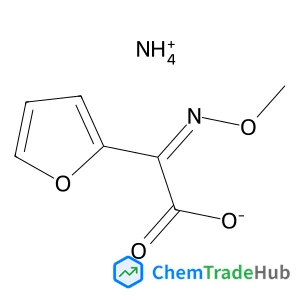
Ammonium (Z)-2-(furan-2-yl)-2-(methoxyimino)acetate
CAS Number:
97148-39-5
Molecular Formula:
C7H10N2O4
Recommended Suppliers



Disclaimer
This page provides academic journal information for reference and research purposes only. We are not affiliated with any journal publishers and do not handle publication submissions. For publication-related inquiries, please contact the respective journal publishers directly.
If you notice any inaccuracies in the information displayed, please contact us at support@chemtradehub.com. We will promptly review and address your concerns.