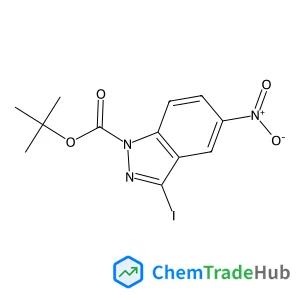
Tert-butyl 3-iodo-5-nitro-1H-indazole-1-carboxylate
CAS Number:
459133-69-8
Molecular Formula:
C12H12IN3O4
Nazlee F. Ghazali, Darrell A. Patterson, Andrew G. Livingston
Organic solvent nanofiltration (OSN) was used to investigate the mechanism of chiral selectivity in diastereomeric salt formation of α-phenylethylamine with D-tartaric acid and di-p-toluoyl-D-tartaric acid as resolving agents; results indicate that for these systems chiral selectivity occurs only upon crystallisation and chiral interactions in solution were negligible.
Dilek Yalcin, Calum J. Drummond, Tamar L. Greaves
DOI: 10.1039/C9CP05711K
Gregory S. Jackson, Ethan J. Crumlin, Bryan Eichhorn, Sandrine Ricote
DOI: 10.1039/C9CP04335G
Masumeh Foroutan, Vahid Fadaei Naeini, Mina Ebrahimi
DOI: 10.1039/C9CP04977K
Christoph T. Koch
DOI: 10.1039/C9CP02676B
Nguyen N. Hieu, Bui Dinh Hoi
DOI: 10.1039/C9CP05597E
Yupeng Shen, Fancy Qian Wang, Jie Liu, Qian Wang
DOI: 10.1039/C9CP02202C
Leandro Martínez
DOI: 10.1039/C9CP05196A
Monique Comte, Lionel Montagne, Bertrand Doumert, Laurent Cormier
DOI: 10.1039/C9CP03181B
When handling 4-Methyl-6-(trifluoromethyl)quinoline (CAS: 40716-16-3), safety go...
4-(3,5-Difluorophenyl)aniline is an aromatic organic compound with the CAS numbe...
5-{[4-(Trifluoromethyl)phenyl]sulfanyl}-1,2,3-thiadiazole-4-carboxylic acid can ...
The market for 4-Benzylaniline hydrochloride (CAS: 6317-57-3) is steadily growin...
[3-(Diethylsulfamoyl)phenyl]boronic acid is generally considered safe when handl...
3-Bromo-2,5-dimethoxyaniline is mainly used in the pharmaceutical and chemical i...
N-Methyl-1-(5-methyl-1H-indol-3-yl)methanamine (CAS: 915922-67-7) is subject to ...
This compound is primarily used in the pharmaceutical industry for the synthesis...
2-Methyl-2-propanyl [(1S,3R)-3-aminocyclohexyl]carbamate (CAS: 1298101-47-9) sho...
Ethyl 2-bromo-4,4,4-trifluorobutanoate (CAS: 367-33-9) is utilized in the pharma...

ChemComm publishes urgent research which is of outstanding significance and interest to experts in the field, while also appealing to the journal’s broad chemistry readership. Our communication format is ideally suited to short, urgent studies that are of such importance that they require accelerated publication. Our scope covers all topics in chemistry, and research at the interface of chemistry and other disciplines (such as materials science, nanoscience, physics, engineering and biology) where there is a significant novelty in the chemistry aspects. Major topic areas covered include: Analytical Chemistry Catalysis Chemical Biology and medicinal chemistry Computational Chemistry and Machine Learning Energy and sustainable chemistry Environmental Chemistry Green Chemistry Inorganic Chemistry Materials Chemistry Nanoscience Organic Chemistry Physical Chemistry Polymer Chemistry Supramolecular Chemistry
![6-Bromo-3-ethyl-3H-imidazo[4,5-b]pyridine structure](https://static.chemtradehub.com/structs/103/1033202-59-3-2a8f.webp "6-Bromo-3-ethyl-3H-imidazo[4,5-b]pyridine structure")
![Methyl 3-({2'-[(E)-(hydroxyhydrazono)methyl]-4-biphenylyl}methyl)-2-oxo-2,3-dihydro-1H-benzimidazole-4-carboxylate structure](https://static.chemtradehub.com/structs/149/1499167-72-4-034a.webp "Methyl 3-({2'-[(E)-(hydroxyhydrazono)methyl]-4-biphenylyl}methyl)-2-oxo-2,3-dihydro-1H-benzimidazole-4-carboxylate structure")