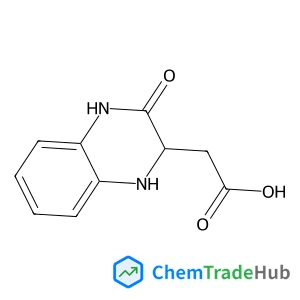
(3-Oxo-1,2,3,4-tetrahydro-2-quinoxalinyl)acetic acid
CAS Number:
136584-14-0
Molecular Formula:
C10H10N2O3
Sabri Messaoudi, Eric Furet, Régis Gautier, Eric Le Fur, Jean-Yves Pivan
The dimerization of MoO2(OH)(H2O)3+ to form Mo2O5(H2O)62+ has been studied by means of density functional calculations at the B3LYP/CEP-31G* level of theory, both in the gas-phase and in the solvent using a polarizable continuum model. Dissociative and concerted mechanisms were investigated, while it appeared that the associative pathway could be ruled out due the intrinsic instability of the ML6–O–ML5 intermediate that must be present in such process. From the two different monomer models used to study the dimerization reaction paths, the most stable reactant and product were obtained with two ML6 units in which the three H2O ligands describe a face of each octahedron. In this case, the dissociative path is preferred with respect to the concerted mechanism, both in vacuo and in solution. It was shown that solvent effects must be taken into account in order to obtain a product that is more stable than two non-interacting monomers, in agreement with experimental data. The reaction energy for the preferred mechanism in solution was computed to be within 1.5 kcal mol−1 of the experimental value.

Journal of Peptide Science

Russian Journal of General Chemistry

Current Opinion in Solid State & Materials Science

Russian Chemical Bulletin

Russian Journal of Bioorganic Chemistry

Chemical Communications

Drug Discovery Today

Russian Journal of Organic Chemistry

Journal of Saudi Chemical Society

Organic Process Research & Development
Pierre-Arnaud Artola, Bernard Rousseau, Carine Clavaguéra, Marion Roy, Dominique You, Gabriel Plancque
DOI: 10.1039/C7CP02743E
Simone Pezzotti, Daria Ruth Galimberti, Y. Ron Shen, Marie-Pierre Gaigeot
DOI: 10.1039/C7CP06110B
C. F. Woellner, L. D. Machado, P. A. S. Autreto, D. S. Galvao
DOI: 10.1039/C7CP07402F
Poomani Ram Kumar, Ebrahim M. Mothi, Mohan Ramesh, Arunkumar Kathiravan
DOI: 10.1039/C7CP07326G
V. V. Mulloyarova, M. A. Kostin, G. S. Denisov, I. G. Shenderovich, P. M. Tolstoy
DOI: 10.1039/C7CP08130H
Kenji Mishima, Hiroki Matsunaga
DOI: 10.1039/C8CP01253A
Anders S. Gertsen, Mads Koerstz, Kurt V. Mikkelsen
DOI: 10.1039/C8CP00588E
Francesco Stellato, Matteo Calandra, Francesco D'Acapito, Emiliano De Santis
DOI: 10.1039/C8CP04355H
Jiahao Chen, Thomas J. Giroux, Yen Nguyen, Atte A. Kadoma, Boyce S. Chang, Brett VanVeller, Martin M. Thuo
DOI: 10.1039/C7CP07531F
Cezhou Zhao, Chun Zhao, Weitao Su, Yannick J. Dappe, Richard J. Nichols
DOI: 10.1039/C8CP02877J
This compound is mainly used as an intermediate in the synthesis of antipsychoti...
Waste containing 1-(D-Ribofuranosyl)-1,4-dihydro-3-pyridinecarboxamide (CAS: 191...
2-Methyl-2-propanyl 3-bromo-3-(hydroxymethyl)-1-azetidinecarboxylate (CAS: 20079...
N-(4-Chloro-2-pyridinyl)acetamide (CAS: 245056-66-0) is a chemical compound with...
5-Chloro-2-hydroxybenzoic acid, also known as 5-chlorosalicylic acid, is an arom...
When handling 1,1-Dichloro-1-fluoroethane (CAS: 1717-00-6), it is important to u...
Fmoc-(2S,3R)-3-phenylpyrrolidine-2-carboxylic acid is a white crystalline solid ...
4-Amino-5-bromo-2-pyridinecarboxylic acid is primarily used as a precursor in th...
Handling this compound should be done with personal protective equipment (PPE) i...
When handling 8-bromo-2,2-dimethyl-3,4-dihydro-2H-1,4-benzoxazin-3-one, use prop...

Physical Chemistry Chemical Physics (PCCP) is an international journal co-owned by 19 physical chemistry and physics societies from around the world. This journal publishes original, cutting-edge research in physical chemistry, chemical physics and biophysical chemistry. To be suitable for publication in PCCP, articles must include significant innovation and/or insight into physical chemistry; this is the most important criterion that reviewers and Editors will judge against when evaluating submissions. The journal has a broad scope and welcomes contributions spanning experiment, theory, computation and data science. Topical coverage includes spectroscopy, dynamics, kinetics, statistical mechanics, thermodynamics, electrochemistry, catalysis, surface science, quantum mechanics, quantum computing and machine learning. Interdisciplinary research areas such as polymers and soft matter, materials, nanoscience, energy, surfaces/interfaces, and biophysical chemistry are welcomed if they demonstrate significant innovation and/or insight into physical chemistry. Joined experimental/theoretical studies are particularly appreciated when complementary and based on up-to-date approaches.
![5-Methyl-4,5,6,7-tetrahydropyrazolo[1,5-a]pyrazin-2-amine structure](https://static.chemtradehub.com/structs/122/1227210-33-4-8d64.webp "5-Methyl-4,5,6,7-tetrahydropyrazolo[1,5-a]pyrazin-2-amine structure")