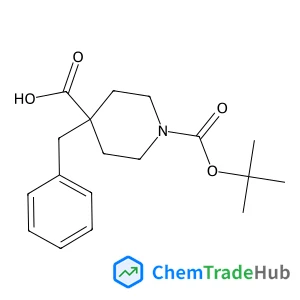
4-Benzyl-1-(tert-butoxycarbonyl)piperidine-4-carboxylic acid
CAS Number:
170838-87-6
Molecular Formula:
C18H25NO4
Using geometry optimization and DFT method at the B3LYP/6-31G* level of theory for C35H30, an equilibrium geometry is identified that has the form of a coplanar double-cage dodecahedrane. Vibrational frequencies and the IR spectrum are computed at the same level of theory. The heat of formation for C35H30 has been estimated in this paper. The heat of formation of C35H30 as well as the vibrational analysis indicates that this system enjoys sufficient stability to allow for its experimental preparation.
Andrea Sabatié-Gogova, Eric Renault, Gilles Montavon, Nicolas Galland
DOI: 10.1039/C1CP20512A
Ah-Young Jee, Seohyun Park, Minyung Lee
DOI: 10.1039/C1CP20835G
Shinobu Gonsui, Tetsuya Tsuda, Ken-ichi Fukui
DOI: 10.1039/C1CP20643E
Andreia Mota, Jason P. Hallett, Maxim L. Kuznetsov, Isabel Correia
DOI: 10.1039/C1CP20800D
Johan Scheers, Jagath Pitawala, Frederic Thebault, Jae-Kwang Kim, Jou-Hyeon Ahn, Aleksandar Matic, Per Jacobsson
DOI: 10.1039/C1CP21062A
Junki Nagakubo, Minoru Ashizawa, Tadashi Kawamoto, Akihiko Tanioka
DOI: 10.1039/C1CP21507H
L. Olivi, C. Dominici, F. Ziarelli
DOI: 10.1039/C1CP20346K
Haiping He, Yanjie Wang, Jingrui Wang, Zhizhen Ye
DOI: 10.1039/C1CP21527B
Yeonchoo Cho, Seung Kyu Min, Woo Youn Kim, Kwang S. Kim
DOI: 10.1039/C1CP20760A
Yoshinobu Akinaga, Jaewoon Jung, Seiichiro Ten-no
DOI: 10.1039/C1CP21001G
This compound is mainly used as an intermediate in the synthesis of antipsychoti...
Waste containing 1-(D-Ribofuranosyl)-1,4-dihydro-3-pyridinecarboxamide (CAS: 191...
2-Methyl-2-propanyl 3-bromo-3-(hydroxymethyl)-1-azetidinecarboxylate (CAS: 20079...
N-(4-Chloro-2-pyridinyl)acetamide (CAS: 245056-66-0) is a chemical compound with...
5-Chloro-2-hydroxybenzoic acid, also known as 5-chlorosalicylic acid, is an arom...
When handling 1,1-Dichloro-1-fluoroethane (CAS: 1717-00-6), it is important to u...
Fmoc-(2S,3R)-3-phenylpyrrolidine-2-carboxylic acid is a white crystalline solid ...
4-Amino-5-bromo-2-pyridinecarboxylic acid is primarily used as a precursor in th...
Handling this compound should be done with personal protective equipment (PPE) i...
When handling 8-bromo-2,2-dimethyl-3,4-dihydro-2H-1,4-benzoxazin-3-one, use prop...

Physical Chemistry Chemical Physics (PCCP) is an international journal co-owned by 19 physical chemistry and physics societies from around the world. This journal publishes original, cutting-edge research in physical chemistry, chemical physics and biophysical chemistry. To be suitable for publication in PCCP, articles must include significant innovation and/or insight into physical chemistry; this is the most important criterion that reviewers and Editors will judge against when evaluating submissions. The journal has a broad scope and welcomes contributions spanning experiment, theory, computation and data science. Topical coverage includes spectroscopy, dynamics, kinetics, statistical mechanics, thermodynamics, electrochemistry, catalysis, surface science, quantum mechanics, quantum computing and machine learning. Interdisciplinary research areas such as polymers and soft matter, materials, nanoscience, energy, surfaces/interfaces, and biophysical chemistry are welcomed if they demonstrate significant innovation and/or insight into physical chemistry. Joined experimental/theoretical studies are particularly appreciated when complementary and based on up-to-date approaches.