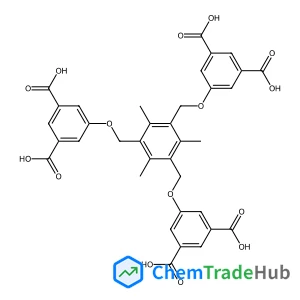
5,5',5''-(((2,4,6-Trimethylbenzene-1,3,5-triyl)tris(methylene))tris(oxy))triisophthalic acid
CAS Number:
1159974-70-5
Molecular Formula:
C36H30O15
Xufang Chen, Rhett C. Smith, John D. Protasiewicz
The reaction of phosphanylidene-σ4-phosphoranes ArPPMe3 (Ar = 2,6-Mes2C6H3 or 2,4,6-t-Bu3C6H2) with select ortho-quinones yields 1,3,2-dioxophospholanes, one of which shows interesting π-stacking of the aromatic groups in the solid state.
Miguel A. Soler, José Zúñiga, Alberto Requena, Adolfo Bastida
DOI: 10.1039/C6CP06776J
Vladislav S. Pervov
DOI: 10.1039/C7CP00518K
Sébastien Lhenry, Benoît Boichard, Yann R. Leroux, Pascale Even-Hernandez, Valérie Marchi, Philippe Hapiot
DOI: 10.1039/C6CP07143K
H. I. B. Banks, D. A. Little, J. Tennyson, A. Emmanouilidou
DOI: 10.1039/C7CP02345F
Mehdi Shakourian-Fard, Ganesh Kamath
DOI: 10.1039/C6CP07455C
Weitao Zheng, Yanming Ma, Changfeng Chen
DOI: 10.1039/C6CP07605J
Rodion V. Belosludov, Hannah M. Rhoda, Ravil K. Zhdanov, Vladimir R. Belosludov, Yoshiyuki Kawazoe, Victor N. Nemykin
DOI: 10.1039/C7CP90157G
Maria Dimitrova, Heike Fliegl, Dage Sundholm
DOI: 10.1039/C7CP02964K
Waste containing N-Methoxy-N-methyl-1,3-thiazole-5-carboxamide (CAS: 898825-89-3...
N-(4-Biphenylyl)dibenzo[b,d]furan-4-amine should be stored in a tightly sealed c...
The market for 3-Acetamido-5-amino-2,4,6-triiodobenzoic acid (CAS: 1713-07-1) is...
Benzyl 2-O-acetyl-3,4,6-tri-O-benzyl-beta-D-galactopyranoside (CAS: 61820-03-9) ...
2-Ethylpiperazine dihydrochloride (CAS: 438050-52-3) is regulated under the Glob...
1,1'-[1,3-Phenylenebis(methylene)]bis(3-methyl-1H-pyrrole-2,5-dione) (CAS: 11946...
Several alternatives can be used in the synthesis of 5-Fluoro-2-(1-pyrrolidinyl)...
Proper personal protective equipment (PPE) must be worn when handling this compo...
When handling 6-Bromoimidazo[1,2-a]pyridin-8-amine, it is important to wear appr...
Alternatives to (2S,4R)-4-(4-Nitrobenzyl)pyrrolidine-2-carboxylic acid hydrochlo...

ChemComm publishes urgent research which is of outstanding significance and interest to experts in the field, while also appealing to the journal’s broad chemistry readership. Our communication format is ideally suited to short, urgent studies that are of such importance that they require accelerated publication. Our scope covers all topics in chemistry, and research at the interface of chemistry and other disciplines (such as materials science, nanoscience, physics, engineering and biology) where there is a significant novelty in the chemistry aspects. Major topic areas covered include: Analytical Chemistry Catalysis Chemical Biology and medicinal chemistry Computational Chemistry and Machine Learning Energy and sustainable chemistry Environmental Chemistry Green Chemistry Inorganic Chemistry Materials Chemistry Nanoscience Organic Chemistry Physical Chemistry Polymer Chemistry Supramolecular Chemistry