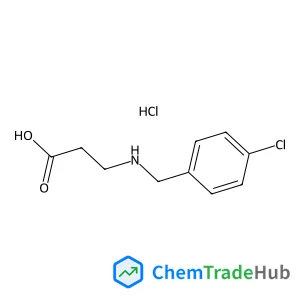
N-(4-Chlorobenzyl)-beta-alanine hydrochloride (1:1)
CAS Number:
1172479-10-5
Molecular Formula:
C10H13Cl2NO2
Melissa L. Golden, Marilyn V. Rampersad, Joseph H. Reibenspies, Marcetta Y. Darensbourg
The metal binding affinity of an (N2S2)Ni bridging metallothiolate ligand (Zn2+ < Ni2+ < Cu+) gives precedent for the observed heterogeneity in ACS/CODH.
Eudes Fileti, Vitaly V. Chaban
DOI: 10.1039/C6CP07667J
Thomas C. Preston, James F. Davies, Kevin R. Wilson
DOI: 10.1039/C6CP07711K
Arindam Mukhopadhyay, Vijay Kumar Maka, Jarugu Narasimha Moorthy
DOI: 10.1039/C6CP07720J
Kevin Jenni, Lena Scherthan, Isabelle Faus, Jennifer Marx, Cornelius Strohm, Marcus Herlitschke, Hans-Christian Wille, Peter Würtz, Volker Schünemann, Juliusz A. Wolny
DOI: 10.1039/C7CP03690F
Rajamani Krishna, Jasper M. van Baten
DOI: 10.1039/C7CP04101B
Ferran Feixas
DOI: 10.1039/C6CP07616E
M. C. Castrovilli, P. Markush, P. Bolognesi, P. Rousseau, S. Maclot, R. Delaunay, A. Domaracka, B. A. Huber, L. Avaldi
DOI: 10.1039/C7CP02233F
Miguel A. Soler, José Zúñiga, Alberto Requena, Adolfo Bastida
DOI: 10.1039/C6CP06776J
Waste containing N-Methoxy-N-methyl-1,3-thiazole-5-carboxamide (CAS: 898825-89-3...
N-(4-Biphenylyl)dibenzo[b,d]furan-4-amine should be stored in a tightly sealed c...
The market for 3-Acetamido-5-amino-2,4,6-triiodobenzoic acid (CAS: 1713-07-1) is...
Benzyl 2-O-acetyl-3,4,6-tri-O-benzyl-beta-D-galactopyranoside (CAS: 61820-03-9) ...
2-Ethylpiperazine dihydrochloride (CAS: 438050-52-3) is regulated under the Glob...
1,1'-[1,3-Phenylenebis(methylene)]bis(3-methyl-1H-pyrrole-2,5-dione) (CAS: 11946...
Several alternatives can be used in the synthesis of 5-Fluoro-2-(1-pyrrolidinyl)...
Proper personal protective equipment (PPE) must be worn when handling this compo...
When handling 6-Bromoimidazo[1,2-a]pyridin-8-amine, it is important to wear appr...
Alternatives to (2S,4R)-4-(4-Nitrobenzyl)pyrrolidine-2-carboxylic acid hydrochlo...

ChemComm publishes urgent research which is of outstanding significance and interest to experts in the field, while also appealing to the journal’s broad chemistry readership. Our communication format is ideally suited to short, urgent studies that are of such importance that they require accelerated publication. Our scope covers all topics in chemistry, and research at the interface of chemistry and other disciplines (such as materials science, nanoscience, physics, engineering and biology) where there is a significant novelty in the chemistry aspects. Major topic areas covered include: Analytical Chemistry Catalysis Chemical Biology and medicinal chemistry Computational Chemistry and Machine Learning Energy and sustainable chemistry Environmental Chemistry Green Chemistry Inorganic Chemistry Materials Chemistry Nanoscience Organic Chemistry Physical Chemistry Polymer Chemistry Supramolecular Chemistry