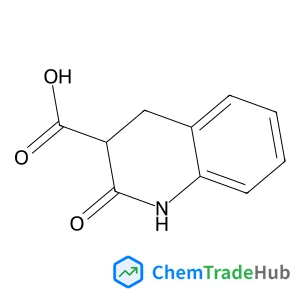
2-Oxo-1,2,3,4-tetrahydro-3-quinolinecarboxylic acid
CAS Number:
246867-17-4
Molecular Formula:
C10H9NO3
Franck Camerel, Charl F. J. Faul
In this communication we report on the facile combination of hydrogen bonding and the ionic self-assembly (ISA) process to produce organized materials and fiber-containing organogel superstructures from functionalised oligoelectrolytic building blocks.
Troy R. Hawkins
DOI: 10.1039/D1SE01742J
Ming Fang, Jishen Cao, Jianxiao Zou, Yating Song
DOI: 10.1039/D1SE01421H
Haruka Momose, Fumiaki Takagi, Sora Fujisawa
DOI: 10.1039/D1SE00914A
DOI: 10.1039/D1SE01193F
Zhenyu Xie, Daping Qiu, Min Li
DOI: 10.1039/D1SE01627J
Dongyue Sun, Matthieu Koepf, Serge Gambarelli, Jean-Marie Mouesca, Murielle Chavarot-Kerlidou, Vincent Artero
DOI: 10.1039/D1SE01267C
Alfonsina Abat Amelenan Torimtubun, Maria Méndez, José G. Sánchez, Josep Pallarès, Lluis F. Marsal
DOI: 10.1039/D1SE01107C
Ciler Özen, Keisuke Obata, Peter Bogdanoff, Fatwa F. Abdi
DOI: 10.1039/D1SE01475G
Zhihua Zhai, Guixing Jia, Yu Wang, Xiaoting Chen, Zhonghua Zhang
DOI: 10.1039/D1SE01535D
Farzaneh Hekmat, Mahdiyeh Shahi
DOI: 10.1039/D1SE00905B
When handling 2-Methyl-2-propanyl 5-amino-2-thiophenecarboxylate (CAS: 1498311-5...
5-Bromo-1,2-dichloro-3-fluorobenzene (CAS: 1000572-93-9) is a crystalline solid ...
(2R)-2-Amino-2-(4-bromophenyl)ethanol (CAS: 354153-64-3) should be stored in a c...
Methyl 4-(aminomethyl)tetrahydro-2H-pyran-4-carboxylate hydrochloride (CAS: 3627...
1,4-Dimethyl-1H-pyrazole-5-sulfonyl chloride is primarily used as an intermediat...
Dinaphtho[1,2-b:2',1'-d]furan is generally safe when handled with appropriate pe...
The market for 7-Methyl-7,9-dihydro-1H-purine-2,6,8(3H)-trione (CAS: 612-37-3) i...
2-(4-Chlorophenyl)malonaldehyde (CAS: 205676-17-1) is a colorless or light yello...
2-Methylchrysene (CAS: 3351-32-4) is typically synthesized via the reaction of c...
N-(6-aminopyrimidin-4-yl)acetamide (CAS: 89533-23-3) is generally considered saf...

ChemComm publishes urgent research which is of outstanding significance and interest to experts in the field, while also appealing to the journal’s broad chemistry readership. Our communication format is ideally suited to short, urgent studies that are of such importance that they require accelerated publication. Our scope covers all topics in chemistry, and research at the interface of chemistry and other disciplines (such as materials science, nanoscience, physics, engineering and biology) where there is a significant novelty in the chemistry aspects. Major topic areas covered include: Analytical Chemistry Catalysis Chemical Biology and medicinal chemistry Computational Chemistry and Machine Learning Energy and sustainable chemistry Environmental Chemistry Green Chemistry Inorganic Chemistry Materials Chemistry Nanoscience Organic Chemistry Physical Chemistry Polymer Chemistry Supramolecular Chemistry
methyl]-N,2-dimethyl-2-propanesulfinamide structure](https://static.chemtradehub.com/structs/256/2565792-50-7-8a26.webp "N-[(R)-[3-(Benzyloxy)-2-(dicyclohexylphosphino)phenyl](phenyl)methyl]-N,2-dimethyl-2-propanesulfinamide structure")