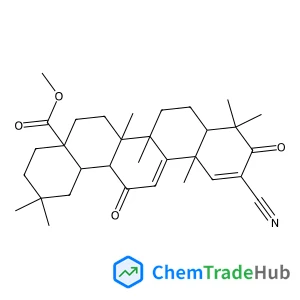
Methyl 2-cyano-3,12-dioxooleana-1,9(11)-dien-28-oate
CAS Number:
218600-53-4
Molecular Formula:
C32H43NO4
The fine structure λ constants are determined as a function of inter-nuclear separation, r, for the low-lying triplet states, a3Σu+ and c3Σ+g, in the helium dimer. To our knowledge, this is the first reported ab initio prediction of λversusr for the c3Σ+g state. The second-order spin–orbit contributions to the λ are found to be negligible, in agreement with previous studies, leaving λ determined only the vibrationally averaged spin–spin contribution in this study. The λ constants are predicted to be negative in the binding region around re, in agreement with experiment, and show small positive maxima at large r (near the dissociation limit). The calculated λ constant for the a3Σ+u state is λ = −0.0448 cm−1, which is 22% larger (in absolute value) than the experimental value of −0.0367 cm−1. Comparison with previous ab initio calculations for the a3Σ+u state indicates more accurate internuclear distance dependence of the spin splitting constant and better convergence to the λ constant for Be(3P), which is the united atom limit. The electric dipole transition moments for the spin-forbidden transitions a3Σ+u → X1Σ+g and 13Πu → X1Σ+g are calculated by the quadratic response method, taking into account spin–orbit coupling. For the a → X transition a good agreement with previous calculations is obtained.
Junghyun Choi, Pitchaimuthu Sudhagar, Joo Hyun Kim, Jiseok Kwon, Jeonghyun Kim, Chiaki Terashima, Akira Fujishima, Taeseup Song, Ungyu Paik
DOI: 10.1039/C6CP08199A
Zhanli Cao, Zhendong Li, Fan Wang, Wenjian Liu
DOI: 10.1039/C6CP07588F
DOI: 10.1039/C6CP07271B
Kamila Moor, Kristina Gudun, Zarina Yelemessova, Rostislav Bukasov
DOI: 10.1039/C6CP08254H
Carlie M. Novak, Ryan C. Fortenberry
DOI: 10.1039/C6CP08140A
L. A. Ferreira, V. N. Uversky, B. Y. Zaslavsky
DOI: 10.1039/C6CP08214A
Tânia F. G. G. Cova, Sandra C. C. Nunes, Alberto A. C. C. Pais
DOI: 10.1039/C6CP08081B
Ryansu Sai, Kazuhide Ueno, Kenta Fujii, Yohei Nakano, Naho Shigaki, Hiromori Tsutsumi
DOI: 10.1039/C6CP08386B
Riham El Kurdi, Digambara Patra
DOI: 10.1039/C6CP08607A
Guohai Deng, Xuelin Dong, Qifan Liu, Dingqing Li, Hongmin Li, Qiao Sun, Xiaoqing Zeng
DOI: 10.1039/C6CP08125H
When handling 4-(2-Furylmethyl)thiomorpholine 1,1-dioxide (CAS: 79206-94-3), it ...
When handling 4-Chloro-N-[2-(4-morpholinyl)ethyl]benzamide (CAS: 71320-77-9), it...
Waste containing this compound (CAS: 62921-74-8) should be handled according to ...
Waste containing (S)-Methyl 2-amino-3-cyclohexylpropanoate should be collected i...
This compound can be synthesized using a multi-step process involving the conjug...
There are several alternatives to (2E)-3-(3,4-Dichlorophenyl)acrylic acid in syn...
Ethyl 6-(2-nitrophenyl)imidazo[2,1-b][1,3]thiazole-3-carboxylate (CAS: 925437-84...
Waste containing 2-(1,3-Thiazol-2-yl)ethanamine (CAS: 18453-07-1) should be coll...
Methyl 5-iodo-2-methylbenzoate can be synthesized through the iodination of meth...
5-Chloro[1,2,4]triazolo[1,5-a]pyridine is commonly synthesized via the condensat...

Physical Chemistry Chemical Physics (PCCP) is an international journal co-owned by 19 physical chemistry and physics societies from around the world. This journal publishes original, cutting-edge research in physical chemistry, chemical physics and biophysical chemistry. To be suitable for publication in PCCP, articles must include significant innovation and/or insight into physical chemistry; this is the most important criterion that reviewers and Editors will judge against when evaluating submissions. The journal has a broad scope and welcomes contributions spanning experiment, theory, computation and data science. Topical coverage includes spectroscopy, dynamics, kinetics, statistical mechanics, thermodynamics, electrochemistry, catalysis, surface science, quantum mechanics, quantum computing and machine learning. Interdisciplinary research areas such as polymers and soft matter, materials, nanoscience, energy, surfaces/interfaces, and biophysical chemistry are welcomed if they demonstrate significant innovation and/or insight into physical chemistry. Joined experimental/theoretical studies are particularly appreciated when complementary and based on up-to-date approaches.
![[4-(Heptyloxy)phenyl]boronic acid structure](https://static.chemtradehub.com/structs/136/136370-19-9-ad33.webp "[4-(Heptyloxy)phenyl]boronic acid structure")