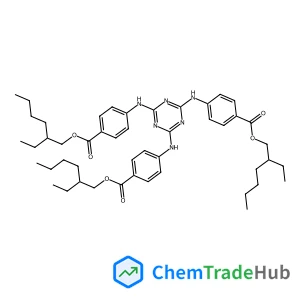
Tris(2-ethylhexyl) 4,4',4''-(1,3,5-triazine-2,4,6-triyltriimino)tribenzoate
CAS Number:
88122-99-0
Molecular Formula:
C48H66N6O6
A new perspective of electron transfer chemistry is described for fine control of electron transfer reactions including back electron transfer in the charge separated state of artificial photosynthetic compounds and its synthetic application. Fundamental electron transfer properties of suitable components of efficient electron transfer systems are described in light of the Marcus theory of electron transfer, in particular focusing on the Marcus inverted region, and they are applied to design multi-step electron transfer systems which can well mimic the function of a photosynthetic reaction center. Both intermolecular and intramolecular electron transfer processes are finely controlled by complexation of radical anions, produced in the electron transfer, with metal ions which act as Lewis acids. Quantitative measures to determine the Lewis acidity of a variety of metal ions are given in relation to the promoting effects of metal ions on the electron transfer reactions. The mechanistic viability of metal ion catalysis in electron transfer reactions is demonstrated by a variety of examples of chemical transformations involving metal ion-promoted electron transfer processes as the rate-determining steps, which are made possible by complexation of radical anions with metal ions.
A. K. Croft, H. M. Howard-Jones
DOI: 10.1039/B704966H
F. J. Aoiz, V. J. Herrero, M. P. de Miranda, V. Sáez Rábanos
DOI: 10.1039/B709161C
Klaus Funke, Prabhakar Singh, Radha Dilip Banhatti
DOI: 10.1039/B618788A
Matthias Roos, Harry E. Hoster, Achim Breitruck, R. Jürgen Behm
DOI: 10.1039/B708578H
Piotr M. Diakowski, Zhifeng Ding
DOI: 10.1039/B711448F
Tait Takatani
DOI: 10.1039/B709669K
Ethyl 3-cyclohexylpropanoate is a clear, colorless to light yellow liquid with a...
Waste containing 2-(Hydroxymethyl)-5-(methoxycarbonyl)-6-methyl-4-(2-nitrophenyl...
Waste containing 2,4,6-Tris(pentafluoroethyl)-1,3,5-triazine (CAS: 858-46-8) sho...
When handling Chloroac-nle-oh (CAS: 56787-36-1), it is essential to wear appropr...
Ethyl 6-phenylimidazo[2,1-b][1,3]thiazole-3-carboxylate is primarily used in the...
Alternatives to alpha-(2-Bromophenyl)benzylamine (CAS: 55095-15-3) in synthesis ...
Waste containing 2-Chloro-5-methoxypyridine (CAS: 139585-48-1) should be managed...
1-(4-Methoxyphenyl)-2,5-dimethyl-1H-pyrrole (CAS: 5044-27-9) is used in various ...
There are alternative reagents and compounds that can be used in the synthesis o...
Tungsten(IV) oxide, also known as tungsten dioxide, is a chemical compound with ...

Organic & Biomolecular Chemistry (OBC) publishes original and high impact research and reviews in organic chemistry. We welcome research that shows new or significantly improved protocols or methodologies in total synthesis, synthetic methodology or physical and theoretical organic chemistry as well as research that shows a significant advance in the organic chemistry or molecular design aspects of chemical biology, catalysis, supramolecular and macromolecular chemistry, theoretical chemistry, mechanism-oriented physical organic chemistry, medicinal chemistry or natural products. Articles published in the journal should report new work which makes a highly-significant impact in the field. Routine and incremental work is generally not suitable for publication in the journal. More details about key areas of our scope are below. In all cases authors should include in their article clear rationale for why their research has been carried out.


![2-{3-[4-(3-Chlorophenyl)-1-piperazinyl]propyl}[1,2,4]triazolo[4,3-a]pyridin-3(2H)-one hydrochloride (1:1) structure](https://static.chemtradehub.com/structs/253/25332-39-2-496e.webp "2-{3-[4-(3-Chlorophenyl)-1-piperazinyl]propyl}[1,2,4]triazolo[4,3-a]pyridin-3(2H)-one hydrochloride (1:1) structure")