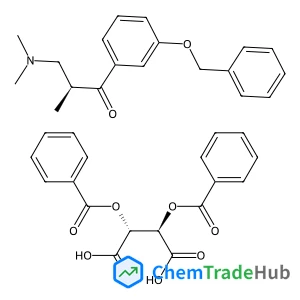
(S)-1-(3-(Benzyloxy)phenyl)-3-(dimethylamino)-2-methylpropan-1-one (2r,3r)-2,3-bis(benzoyloxy)succinate
CAS Number:
1004315-81-4
Molecular Formula:
C37H37NO10
Taowei Yang, Hongmei Sun, Meijuan Xu, Xian Zhang, Zhenghong Xu, Shangtian Yang
Lactobacillus plantarum CCTCC M209102 efficiently produces γ-aminobutyric acid (GABA) from L-glutamate, in which glutamate decarboxylase and pyridoxal kinase are involved in the transformation. Pyridoxal kinase catalyzes ATP-dependent phosphorylation of pyridoxal to produce pyridoxal-5′-phosphate, which is the cofactor required for glutamate decarboxylase to biotransform GABA from L-glutamate. Corynebacterium glutamicum G01 is a good producer of L-glutamate from glucose. However, it cannot yield GABA from L-glutamate due to the absence of glutamate decarboxylase and pyridoxal kinase. In this work, to realize the efficient one-step preparation of GABA from glucose without exogenous pyridoxal-5′-phosphate, the metabolic module from L-glutamate to GABA based on glutamate decarboxylase and pyridoxal kinase in L. plantarum was grafted into C. glutamicum. To further improve the GABA production, the pathways to by-product pools of L-arginine, L-proline and L-lysine were blocked using the insertional mutation technique. The engineered C. glutamicum APLGGP carrying argB::tacgad, proB::tacgad and dapA::tacplk could efficiently convert glucose into GABA in one-step without an exogenous co-factor. In fed-batch cultures, the recombinant C. glutamicum APLGGP produced 70.6 g L−1 GABA at 30 °C and 70 h through a two-stage pH control strategy. To our knowledge, this is the highest reported GABA production using glucose as a substrate, and this designed C. glutamicum should be an excellent candidate for producing GABA on an industrial scale. This work is expected to pave the way to redesign the bioreactor for efficient one-step biosynthesis of GABA from glucose without an exogenous co-factor.
Taku Satoh, Kimio Sumaru, Toshiyuki Takagi, Katsuki Takai, Toshiyuki Kanamori
DOI: 10.1039/C0CP01989E
H. Peter Lu
DOI: 10.1039/C0CP02860F
M. Weser, E. N. Voloshina, K. Horn, Yu. S. Dedkov
DOI: 10.1039/C1CP00014D
Xulin Pan, Ninghua Tan
DOI: 10.1039/C0CP02749A
Emmet J. O'Reilly, Lynn Dennany, Darren Griffith, Francois Moser, Tia E. Keyes, Robert J. Forster
DOI: 10.1039/C0CP02638G
José A. Rodriguez, Francesc Illas
DOI: 10.1039/C0CP02882G
Kenta Mizuse, Asuka Fujii
DOI: 10.1039/C1CP20207C
Alexander I. Serykh, Stanislav P. Kolesnikov
DOI: 10.1039/C0CP02088E
Sudip Chattopadhyay, Rajat K. Chaudhuri, Karl F. Freed
DOI: 10.1039/C0CP02106G
François Gaie-Levrel, Gustavo A. Garcia, Martin Schwell, Laurent Nahon
DOI: 10.1039/C0CP02798G
2-Methylbenzene-1,4-diamine dihydrochloride (CAS: 615-45-2) should be stored in ...
(1S,4S)-2,5-Diazabicyclo[2.2.1]heptane dihydrobromide is generally considered sa...
(6-Chloropyridazin-3-YL)methanamine finds applications in the pharmaceutical ind...
2-Fluoro-3-methylphenol is primarily used in the synthesis of pharmaceuticals, p...
When handling 3-Methoxy-4-nitrobenzonitrile, it is important to wear appropriate...
When handling 1,3-Oxazolo[4,5-b]pyridine-2(3H)-thione (CAS: 211949-57-4), it is ...
4-Ethynylbenzamide (CAS: 90347-86-7) falls under various regulatory guidelines i...
3-(2-Ethylphenyl)-2-thioxo-4-imidazolidinone is primarily used as an intermediat...
(2-Fluoro-6-methoxyphenyl)acetic acid, also known as 4-fluoro-3-methoxybenzoic a...
Market trends for 2-[4-(Hydroxymethyl)phenoxy]ethanol (CAS: 102196-18-9) indicat...

Green Chemistry provides a unique forum for the publication of innovative research on the development of alternative green and sustainable technologies. The scope of Green Chemistry is based on, but not limited to, the definition proposed by Anastas and Warner (Green Chemistry: Theory and Practice, P T Anastas and J C Warner, Oxford University Press, Oxford, 1998). Green chemistry is the utilisation of a set of principles that reduces or eliminates the use or generation of hazardous substances in the design, manufacture and application of chemical products. Green Chemistry is at the frontiers of this continuously-evolving interdisciplinary science and publishes research that attempts to reduce the environmental impact of the chemical enterprise by developing a technology base that is inherently non-toxic to living things and the environment. Submissions on all aspects of research relating to the endeavour are welcome. The journal publishes original and significant cutting-edge research that is likely to be of wide general appeal. To be published, work must present a significant advance in green chemistry. Papers must contain a comparison with existing methods and demonstrate advantages over those methods before publication can be considered. For more information please see this Editorial. Coverage includes the following, but is not limited to: Design (e.g. biomimicry, design for degradation/recycling/reduced toxicity…) Reagents & Feedstocks (e.g. renewables, CO2, solvents, auxiliary agents, waste utilization…) Synthesis (e.g. organic, inorganic, synthetic biology…) Catalysis (e.g. homogeneous, heterogeneous, enzyme, whole cell…) Process (e.g. process design, intensification, separations, recycling, efficiency…) Energy (e.g. renewable energy, fuels, photovoltaics, fuel cells, energy storage, energy carriers…) Applications (e.g. electronics, dyes, consumer products, coatings, pharmaceuticals, preservatives, building materials, chemicals for industry/agriculture/mining…) Impact (e.g. safety, metrics, LCA, sustainability, (eco)toxicology…) Green chemistry is, by definition, a continuously-evolving frontier. Therefore, the inclusion of a particular material or technology does not, of itself, guarantee that a paper is suitable for the journal. To be suitable, the novel advance should have the potential for reduced environmental impact relative to the state of the art. Green Chemistry does not normally deal with research associated with 'end-of-pipe' or remediation issues.
![3-[(3R,4R)-3-[(6-aminopyrimidin-4-yl)-methyl-amino]-4-methyl-1-piperidyl]-3-oxo-propanenitrile structure](https://static.chemtradehub.com/structs/164/1640971-60-3-83a4.webp "3-[(3R,4R)-3-[(6-aminopyrimidin-4-yl)-methyl-amino]-4-methyl-1-piperidyl]-3-oxo-propanenitrile structure")