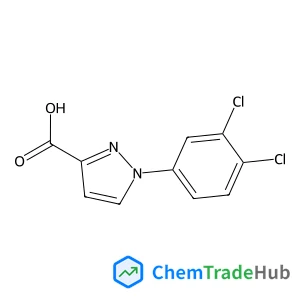
1-(3,4-Dichlorophenyl)-1H-pyrazole-3-carboxylic acid
CAS Number:
1152949-12-6
Molecular Formula:
C10H6Cl2N2O2
Noritsugu Kometani, Hidenori Doi, Kenji Asami, Yoshiro Yonezawa
Sensitized photoreduction of Ag+ ions and subsequent formation of colloidal Ag nanoparticles take place when an aqueous solution of a mixture of AgClO4, sodium dodecylsulfate (SDS) and benzophenone (BP) is irradiated with near-UV light. In this study, the mechanism and kinetics of the reaction have been studied by means of nanosecond laser flash photolysis, time-resolved emission spectroscopy and also steady-state photolysis. Benzophenone ketyl radial (BPK) is formed by the hydrogen abstraction reaction of the benzophenone triplet (BPT) from SDS, which reduces Ag+ ions. It is found that the yield of colloidal Ag nanoparticle formation decreases remarkably with increasing concentration of Ag+ ions, indicating the efficient quenching process of BPT by Ag+ ions. Rate constants for the oxidation of BPK as well as the quenching of BPT by Ag+ ions in SDS micellar solution are considerably larger than those expected in the bulk solution, reflecting that Ag+ ions and BP molecules are concentrated in the SDS micelles. The rate of colloidal Ag nanoparticle formation, VAg, and BP photobleach, VBP, under steady-state irradiation with near-UV light (λ = 365 nm) were evaluated and the dependence of VAg and VBP on the concentration of Ag+ ions is interpreted quantitatively in terms of rate constants estimated by laser flash photolysis.
Sibylle Müller, Klaus Müllen
DOI: 10.1039/B509220E
Nagendra K. Sharma, Krishna N. Ganesh
DOI: 10.1039/B506870C
Elizabeth Glogowski, Jinbo He, Thomas P. Russell, Todd Emrick
DOI: 10.1039/B503670D
Michihiro Shirakawa, Norifumi Fujita, Takahiro Tani, Kenji Kaneko, Seiji Shinkai
DOI: 10.1039/B506148B
Katsuhiro Maeda, Yasuaki Matsushita, Muneyoshi Ezaka
DOI: 10.1039/B507863F
Patrik Västilä, Jenny Wettergren, Hans Adolfsson
DOI: 10.1039/B505516D
Nicholas S. P. Watney, Zoltán A. Gál, Matthew D. S. Webster, Simon J. Clarke
DOI: 10.1039/B505208D
Waste containing N-Methoxy-N-methyl-1,3-thiazole-5-carboxamide (CAS: 898825-89-3...
N-(4-Biphenylyl)dibenzo[b,d]furan-4-amine should be stored in a tightly sealed c...
The market for 3-Acetamido-5-amino-2,4,6-triiodobenzoic acid (CAS: 1713-07-1) is...
Benzyl 2-O-acetyl-3,4,6-tri-O-benzyl-beta-D-galactopyranoside (CAS: 61820-03-9) ...
2-Ethylpiperazine dihydrochloride (CAS: 438050-52-3) is regulated under the Glob...
1,1'-[1,3-Phenylenebis(methylene)]bis(3-methyl-1H-pyrrole-2,5-dione) (CAS: 11946...
Several alternatives can be used in the synthesis of 5-Fluoro-2-(1-pyrrolidinyl)...
Proper personal protective equipment (PPE) must be worn when handling this compo...
When handling 6-Bromoimidazo[1,2-a]pyridin-8-amine, it is important to wear appr...
Alternatives to (2S,4R)-4-(4-Nitrobenzyl)pyrrolidine-2-carboxylic acid hydrochlo...

Physical Chemistry Chemical Physics (PCCP) is an international journal co-owned by 19 physical chemistry and physics societies from around the world. This journal publishes original, cutting-edge research in physical chemistry, chemical physics and biophysical chemistry. To be suitable for publication in PCCP, articles must include significant innovation and/or insight into physical chemistry; this is the most important criterion that reviewers and Editors will judge against when evaluating submissions. The journal has a broad scope and welcomes contributions spanning experiment, theory, computation and data science. Topical coverage includes spectroscopy, dynamics, kinetics, statistical mechanics, thermodynamics, electrochemistry, catalysis, surface science, quantum mechanics, quantum computing and machine learning. Interdisciplinary research areas such as polymers and soft matter, materials, nanoscience, energy, surfaces/interfaces, and biophysical chemistry are welcomed if they demonstrate significant innovation and/or insight into physical chemistry. Joined experimental/theoretical studies are particularly appreciated when complementary and based on up-to-date approaches.