












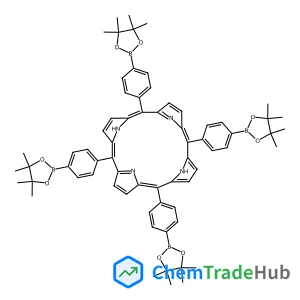
5,10,15,20-tetrakis(4-boronic acid pinacol ester phenyl) porphyrin
CAS Number:
1332748-00-1
Molecular Formula:
C68H74B4N4O8
K. Bernhard, S. Naumov
The radicals formed by electron transfer from 2,3-dihydrofuran, 2-methyl-4,5-dihydrofuran and 2,3-dimethyl-4,5-dihydrofuran to the laser induced triplet state of anthraquinone-2,6-disulfonic acid were studied in aqueous solution by Fourier transform electron paramagnetic resonance (FT EPR) in the nanosecond time-scale. With 2,3-dimethyl-4,5-dihydrofuran and 2-methyl-4,5-dihydrofuran as electron donor the radical cations were observed directly, whereas with 2,3-dihydrofuran as electron donors the radicals observed are successor radicals of the radical cations. The assignment of the radical structures was done by simulation of the experimental EPR spectra and was supported by quantum chemical density functional theory (DFT) calculations. In the experiments with 2-methyl-4,5-dihydrofuran only one OH−-adduct could be determined although other so far unknown radicals contribute to the measured spectra. With 2,3-dihydrofuran two OH−-adduct radicals and the deprotonated radical cation were detected together with contributions from a dimer radical. The rate constants of the electron transfer to the anthraquinone-2,6-disulfonate triplet and of the formation of the successor radicals from the primary 2,3-dihydrofuran radical cation were determined, respectively. The hyperfine coupling constants calculated by quantum chemical DFT method agree quite well with the experimental one.
Hong Wu, Chunyong Tian, Xiaokai Song, Chuang Liu, Dong Yang, Zhongyi Jiang
DOI: 10.1039/C3GC37129H
Marek Tobiszewski, Stefan Tsakovski, Vasil Simeonov, Jacek Namieśnik
DOI: 10.1039/C3GC36976E
Go Hamasaka, Takao Osako, Yoichi M. A. Yamada, Chao-Jun Li, Audrey Moores
DOI: 10.1039/C3GC40789F
R. B. Nasir Baig, Rajender S. Varma
DOI: 10.1039/C3GC40401C
Hu Wang, Li Li, Xing-Feng Bai, Wen-Hui Deng, Zhan-Jiang Zheng, Ke-Fang Yang
DOI: 10.1039/C3GC40991K
Jeremiah Toster, Qin Lin Zhou, Nicole M. Smith, K. Swaminathan Iyer, Federico Rosei, Colin L. Raston
DOI: 10.1039/C3GC40660A
Shaoyan Zhang, Guoli Fan, Feng Li
DOI: 10.1039/C3GC40658J
Jasmine Tomasek, Jürgen Schatz
DOI: 10.1039/C3GC41042K
David Obermayer, Alina M. Balu, Antonio A. Romero, Walter Goessler, Rafael Luque, C. Oliver Kappe
DOI: 10.1039/C3GC40307F
When handling 4-Methyl-6-(trifluoromethyl)quinoline (CAS: 40716-16-3), safety go...
4-(3,5-Difluorophenyl)aniline is an aromatic organic compound with the CAS numbe...
5-{[4-(Trifluoromethyl)phenyl]sulfanyl}-1,2,3-thiadiazole-4-carboxylic acid can ...
The market for 4-Benzylaniline hydrochloride (CAS: 6317-57-3) is steadily growin...
[3-(Diethylsulfamoyl)phenyl]boronic acid is generally considered safe when handl...
3-Bromo-2,5-dimethoxyaniline is mainly used in the pharmaceutical and chemical i...
N-Methyl-1-(5-methyl-1H-indol-3-yl)methanamine (CAS: 915922-67-7) is subject to ...
This compound is primarily used in the pharmaceutical industry for the synthesis...
2-Methyl-2-propanyl [(1S,3R)-3-aminocyclohexyl]carbamate (CAS: 1298101-47-9) sho...
Ethyl 2-bromo-4,4,4-trifluorobutanoate (CAS: 367-33-9) is utilized in the pharma...

Physical Chemistry Chemical Physics (PCCP) is an international journal co-owned by 19 physical chemistry and physics societies from around the world. This journal publishes original, cutting-edge research in physical chemistry, chemical physics and biophysical chemistry. To be suitable for publication in PCCP, articles must include significant innovation and/or insight into physical chemistry; this is the most important criterion that reviewers and Editors will judge against when evaluating submissions. The journal has a broad scope and welcomes contributions spanning experiment, theory, computation and data science. Topical coverage includes spectroscopy, dynamics, kinetics, statistical mechanics, thermodynamics, electrochemistry, catalysis, surface science, quantum mechanics, quantum computing and machine learning. Interdisciplinary research areas such as polymers and soft matter, materials, nanoscience, energy, surfaces/interfaces, and biophysical chemistry are welcomed if they demonstrate significant innovation and/or insight into physical chemistry. Joined experimental/theoretical studies are particularly appreciated when complementary and based on up-to-date approaches.
![6-Bromo-3-ethyl-3H-imidazo[4,5-b]pyridine structure](https://static.chemtradehub.com/structs/103/1033202-59-3-2a8f.webp "6-Bromo-3-ethyl-3H-imidazo[4,5-b]pyridine structure")
![Imidazo[1,2-c]pyrimidine structure](https://static.chemtradehub.com/structs/274/274-78-2-8b4c.webp "Imidazo[1,2-c]pyrimidine structure")





