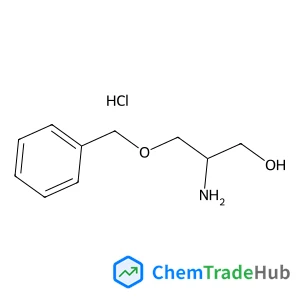
(R)-2-amino-3-(benzyloxy)propan-1-ol hydrochloride
CAS Number:
58577-95-0
Molecular Formula:
C10H16ClNO2
Ghasi Ram Dey, Sergej Naumov
Radical and ionic reactions were observed in the pulse radiolysis of thiophenols (ArSH=thiophenol, o-, m- and p-thiocresol or 2-thionaphthol) in n-butyl chloride solution. The main source of aromatic thiyl radicals is the reaction of butyl radicals with the thiols, which proceeds at 1.0–5.6×10⁸ dm3 mol−1 s−1. This radical generation path is completely quenched in the presence of oxygen. Under these conditions, only the electron transfer reaction between n-butyl chloride parent ions and the thiophenols remains and could be well analyzed. It takes place at a rate constant of about 1.5×10¹⁰ dm3 mol−1 s−1 and takes two parallel paths–common electron transfer yielding thiophenol radical cations and a more complex ionic reaction resulting directly in thiyl radicals. The latter is thought to proceed via an encounter complex geometry, ArSH···ClBu•+, in which electron transfer is directly followed by immediate deprotonation. The thiyl radicals and the thiol radical cations are characterized by their optical absorption spectra and their kinetic properties. Quantum chemical calculations underpin our mechanistic interpretation and provide information about the charge distribution and reactivity of the thiol radical cations.
Sylvie Beaufils, Sophie Rigault, Bernard Cabane, Mikael Lund, Valérie Lechevalier, Cécile Le Floch-Fouéré, Maryvonne Pasco, Gilles Pabœuf, Javier Pérez, Stéphane Pezennec
DOI: 10.1039/C6CP03867K
Ji Won Yang, Jeong Min Choi, Jun Yeob Lee
DOI: 10.1039/C6CP06308J
H. B. Ramalingam, R. Hari Krishna, B. M. Nagabhushana, R. Chandramohan, C. Shivakumara, J. Thirumalai, Tiju Thomas
DOI: 10.1039/C6CP04633A
Stephan Kohaut
DOI: 10.1039/C6CP04948F
Anand Narayanan Krishnamoorthy, Johannes Zeman, Christian Holm, Jens Smiatek
DOI: 10.1039/C6CP05909K
Alexey V. Bogdanov, Andrey Kh. Vorobiev
DOI: 10.1039/C6CP05815A
Alberto Privitera, Marcello Righetto, Dario Mosconi, Francesca Lorandi, Abdirisak A. Isse, Alessandro Moretto, Renato Bozio, Camilla Ferrante, Lorenzo Franco
DOI: 10.1039/C6CP05981C
Antonius P. J. Jansen, Ravi Agrawal, Leonardo Spanu
DOI: 10.1039/C6CP04719J
Indrani Coondoo, Neeraj Panwar, Reddithota Vidyasagar
DOI: 10.1039/C6CP06244J
Wissam A. Saidi
DOI: 10.1039/C6CP04769F
Ethyl 4-chlorothieno[2,3-b]pyridine-5-carboxylate (CAS: 59713-58-5) can be synth...
5-Methyl-1H-indole-3-carbaldehyde (CAS: 52562-50-2) is subject to various regula...
(1,3-Dimethyl-2,4-dioxo-1,2,3,4-tetrahydro-5-pyrimidinyl)boronic acid is a white...
Waste containing Sulfocostunolide A (CAS: 1016983-51-9) should be handled with c...
When handling Murraxocin (CAS: 88478-44-8), ensure proper personal protective eq...
Formvar (CAS: 63148-64-1) is an alkyd resin characterized by a high molecular we...
(S)-4-benzyl-2-((benzyloxy)methyl)morpholine is generally safe when handled with...
Methyl 1-(5-bromo-2-pyrimidinyl)cyclopropanecarboxylate (CAS: 1447607-69-3) is p...
2-Methyl-1-phenyl-1-propanamine hydrochloride (CAS: 24290-47-9) is generally con...
3-(4-Bromophenyl)-2-methylpropanoic acid is synthesized through a multi-step pro...

Physical Chemistry Chemical Physics (PCCP) is an international journal co-owned by 19 physical chemistry and physics societies from around the world. This journal publishes original, cutting-edge research in physical chemistry, chemical physics and biophysical chemistry. To be suitable for publication in PCCP, articles must include significant innovation and/or insight into physical chemistry; this is the most important criterion that reviewers and Editors will judge against when evaluating submissions. The journal has a broad scope and welcomes contributions spanning experiment, theory, computation and data science. Topical coverage includes spectroscopy, dynamics, kinetics, statistical mechanics, thermodynamics, electrochemistry, catalysis, surface science, quantum mechanics, quantum computing and machine learning. Interdisciplinary research areas such as polymers and soft matter, materials, nanoscience, energy, surfaces/interfaces, and biophysical chemistry are welcomed if they demonstrate significant innovation and/or insight into physical chemistry. Joined experimental/theoretical studies are particularly appreciated when complementary and based on up-to-date approaches.