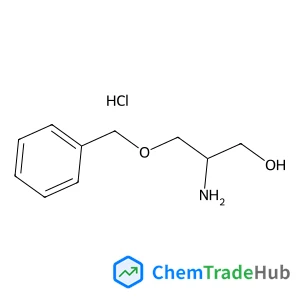
(R)-2-amino-3-(benzyloxy)propan-1-ol hydrochloride
CAS Number:
58577-95-0
Molecular Formula:
C10H16ClNO2
Denis J. Robinson, Lucinda Davies, Neil McGuire, Darren F. Lee, Paul McMorn, David J. Willock, Graeme W. Watson, Philip C. Bulman Page, Donald Bethell
A combined experimental and molecular simulation study of the oxidation of thioethers with hydrogen peroxide using Ti-containing zeolites as catalysts is described and discussed. Two aspects of reaction selectivity were explored. First, regioselectivity was studied for the oxidation of allyl methyl thioether with TS-1 as catalyst, and only products for the oxidation at sulfur, i.e., the sulfoxide and sulfone, were observed. Second, shape-selective oxidation was studied using four isomeric butyl methyl thioethers. For n-, iso- and sec-butyl methyl thioethers the dominant product in the TS-1 catalysed reaction was the sulfone, but for tert-butyl methyl thioether, the dominant product was from partial oxidation to the sulfoxide. Molecular simulations were used to investigate the origin of this effect. For all substrates used in this study, the oxidation of the thioether to the sulfoxide was found to occur readily by a non-catalysed solution reaction and this was studied in detail. However, the oxidation of the sulfoxide to the sulfone was only observed in the catalysed reactions. It was observed that the non-catalysed reaction can be suppressed by carrying out the catalysed reaction in the presence of a base, 1,8-diazabicyclo[5.4.0]undec-7-ene (DBU), that is too large to diffuse into the intracrystalline pore structure of TS-1. In the presence of DBU, the rate of reaction with TS-1 as catalyst was much lower and the relative ratios of the sulfoxide and sulfone products can be explained through a combination of intramolecular steric hindrance and the shape selectivity of the zeolite.

Journal of Heterocyclic Chemistry

Fibre Chemistry

Proceedings of the National Academy of Sciences of the United States of America

Journal of Physics and Chemistry of Solids

European Journal of Wood and Wood Products

Journal of Organometallic Chemistry

Pure and Applied Chemistry

Planta Medica

Kinetics and Catalysis

Journal of Medicinal Chemistry
Ángel Berenguer-Murcia, Ramiro R. Ruiz-Rosas, Jaime García-Aguilar, Khanin Nueangnoraj, Hirotomo Nishihara, Emilia Morallón, Takashi Kyotani, Diego Cazorla-Amorós
DOI: 10.1039/C3CP51945G
Diego R. Alcoba, Luis Lain, Alicia Torre, Ofelia B. Oña, Eduardo Chamorro
DOI: 10.1039/C3CP50736J
Yi-Min Wei, Jing-Hong Liang, Zhao-Bin Chen, Xiao-Shun Zhou, Bing-Wei Mao, Oscar A. Oviedo, Ezequiel P. M. Leiva
DOI: 10.1039/C3CP50473E
C. Marchetti, R. Lazzaroni, D. Jore, M. Gardès-Albert
DOI: 10.1039/C3CP50602A
Arnaud Spangenberg, Rémi Métivier, Kunihiro Shibata, Arnaud Brosseau, Johan Grand, Jean Aubard, Pei Yu, Tsuyoshi Asahi, Keitaro Nakatani
DOI: 10.1039/C3CP50770J
Zuofeng Chen, Christopher R. K. Glasson, Patrick L. Holland, Thomas J. Meyer
DOI: 10.1039/C3CP51946E
Jan Rossmeisl, Rizwan Ahmed, Vladimir Tripković, Mårten E. Björketun
DOI: 10.1039/C3CP51083B
Tae-Jun Ha, Prashant Sonar, Ananth Dodabalapur
DOI: 10.1039/C3CP51478A
Jose Tharun, George Mathai, Roshith Roshan, Amal Cherian Kathalikkattil, Kim Bomi, Dae-Won Park
DOI: 10.1039/C3CP51158H
Yuko S. Yamamoto, Ken Hirano, Tomomi Ishido, Norio Murase, Tamitake Itoh
DOI: 10.1039/C3CP51494C
Ethyl 4-chlorothieno[2,3-b]pyridine-5-carboxylate (CAS: 59713-58-5) can be synth...
5-Methyl-1H-indole-3-carbaldehyde (CAS: 52562-50-2) is subject to various regula...
(1,3-Dimethyl-2,4-dioxo-1,2,3,4-tetrahydro-5-pyrimidinyl)boronic acid is a white...
Waste containing Sulfocostunolide A (CAS: 1016983-51-9) should be handled with c...
When handling Murraxocin (CAS: 88478-44-8), ensure proper personal protective eq...
Formvar (CAS: 63148-64-1) is an alkyd resin characterized by a high molecular we...
(S)-4-benzyl-2-((benzyloxy)methyl)morpholine is generally safe when handled with...
Methyl 1-(5-bromo-2-pyrimidinyl)cyclopropanecarboxylate (CAS: 1447607-69-3) is p...
2-Methyl-1-phenyl-1-propanamine hydrochloride (CAS: 24290-47-9) is generally con...
3-(4-Bromophenyl)-2-methylpropanoic acid is synthesized through a multi-step pro...

Physical Chemistry Chemical Physics (PCCP) is an international journal co-owned by 19 physical chemistry and physics societies from around the world. This journal publishes original, cutting-edge research in physical chemistry, chemical physics and biophysical chemistry. To be suitable for publication in PCCP, articles must include significant innovation and/or insight into physical chemistry; this is the most important criterion that reviewers and Editors will judge against when evaluating submissions. The journal has a broad scope and welcomes contributions spanning experiment, theory, computation and data science. Topical coverage includes spectroscopy, dynamics, kinetics, statistical mechanics, thermodynamics, electrochemistry, catalysis, surface science, quantum mechanics, quantum computing and machine learning. Interdisciplinary research areas such as polymers and soft matter, materials, nanoscience, energy, surfaces/interfaces, and biophysical chemistry are welcomed if they demonstrate significant innovation and/or insight into physical chemistry. Joined experimental/theoretical studies are particularly appreciated when complementary and based on up-to-date approaches.