













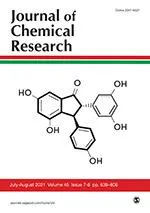
Journal of Chemical Research
Basic Information
Brief Name:
J CHEM RES
Impact Factor:
1
ISSN:
1747-5198
Research Field:
CHEMICAL
h-index:
27
Self-citation Rate:
23.4%
Articles per Year:
60
SCI Index Status:
Science Citation Index Expanded
Journal Website:
https://journals.sagepub.com/home/CHL
Journal Introduction:
From 1st January 2021, Journal of Chemical Research will become a fully open access journal. To facilitate this transition, all articles first submitted on or after 1st August 2020 will be subject to an open access article processing charge, and will be published under a Creative Commons license. The APC for this journal is 2000 USD (plus tax where applicable). The APC will be payable on acceptance if the article is accepted after peer review. The Journal of Chemical Research is a peer reviewed journal that publishes full-length review and research papers in all branches of experimental chemistry. The journal fills a niche by also publishing short papers, a format which favours particular types of work, e.g. the scope of new reagents or methodology, and the elucidation of the structure of novel compounds. Though welcome, short papers should not result in fragmentation of publication, they should describe a completed piece of work. The Journal is not intended as a vehicle for preliminary publications. The work must meet all the normal criteria for acceptance as regards scientific standards. Papers that contain extensive biological results or material relating to other areas of science may be diverted to more appropriate specialist journals. Areas of coverage include: Organic Chemistry Inorganic Chemistry Materials Chemistry Crystallography Computational Chemistry
CiteScore
CiteScore
2.3
SJR
0.241
SNIP
0.353
| Subject | Rank | Percentile |
|---|---|---|
ChemistryGeneral Chemistry |
246 / 408 | 39% |
Journal Statistics
Issues/Year
Review Cycle
Article Processing Fee
Submission Information
Submission Website:
http://www.sciencereviews2000.co.uk/member_area/register.phpRecommended Journals
Related Articles
The British Pharmaceutical Codex, 1934. Fourth supplement: Part I, monographs (amendments)
Other
DOI: 10.1039/AN942670265C
Proceedings of the Society of Public Analysts and other Analytical Chemists
Other
DOI: 10.1039/AN938630775A
You might also like
Compound Q&A
What is Ethyl 3-cyclohexylpropanoate (CAS: 10094-36-7)?
Ethyl 3-cyclohexylpropanoate is a clear, colorless to light yellow liquid with a...
10094-36-7Ethyl 3-cyclohexylpr...
Compound Q&A
How should waste containing 2-(Hydroxymethyl)-5-(methoxycarbonyl)-6-methyl-4-(2-nitrophenyl)nicotinic acid (CAS: 34783-31-8) be handled?
Waste containing 2-(Hydroxymethyl)-5-(methoxycarbonyl)-6-methyl-4-(2-nitrophenyl...
34783-31-82-(Hydroxymethyl)-5-...
Compound Q&A
How should waste containing 2,4,6-Tris(pentafluoroethyl)-1,3,5-triazine (CAS: 858-46-8) be handled?
Waste containing 2,4,6-Tris(pentafluoroethyl)-1,3,5-triazine (CAS: 858-46-8) sho...
858-46-82,4,6-Tris(pentafluo...
Compound Q&A
What precautions should be taken when handling Chloroac-nle-oh (CAS: 56787-36-1)?
When handling Chloroac-nle-oh (CAS: 56787-36-1), it is essential to wear appropr...
56787-36-1Chloroac-nle-oh
Compound Q&A
What industries use Ethyl 6-phenylimidazo[2,1-b][1,3]thiazole-3-carboxylate (CAS: 752244-05-6)?
Ethyl 6-phenylimidazo[2,1-b][1,3]thiazole-3-carboxylate is primarily used in the...
752244-05-6Ethyl 6-phenylimidaz...
Compound Q&A
Are there alternatives to alpha-(2-Bromophenyl)benzylamine (CAS: 55095-15-3) in synthesis?
Alternatives to alpha-(2-Bromophenyl)benzylamine (CAS: 55095-15-3) in synthesis ...
55095-15-3alpha-(2-Bromophenyl...
Compound Q&A
How should waste containing 2-Chloro-5-methoxypyridine (CAS: 139585-48-1) be handled?
Waste containing 2-Chloro-5-methoxypyridine (CAS: 139585-48-1) should be managed...
139585-48-12-Chloro-5-methoxypy...
Compound Q&A
What industries use 1-(4-Methoxyphenyl)-2,5-dimethyl-1H-pyrrole (CAS: 5044-27-9)?
1-(4-Methoxyphenyl)-2,5-dimethyl-1H-pyrrole (CAS: 5044-27-9) is used in various ...
5044-27-91-(4-Methoxyphenyl)-...
Compound Q&A
Are there alternatives to 3-Bromo-5-(N-Boc)aminomethylisoxazole (CAS: 903131-45-3) in synthesis?
There are alternative reagents and compounds that can be used in the synthesis o...
903131-45-33-Bromo-5-(N-Boc)ami...
Compound Q&A
What is Tungsten(IV) oxide (CAS: 12036-22-5)?
Tungsten(IV) oxide, also known as tungsten dioxide, is a chemical compound with ...
12036-22-5Tungsten(IV) oxide
Recommended Compounds




Recommended Suppliers





Disclaimer
This page provides academic journal information for reference and research purposes only. We are not affiliated with any journal publishers and do not handle publication submissions. For publication-related inquiries, please contact the respective journal publishers directly.
If you notice any inaccuracies in the information displayed, please contact us at support@chemtradehub.com. We will promptly review and address your concerns.