


Compound Q&A
What are the physical and chemical properties of (3-Amino-1H-pyrazol-5-yl)acetic acid (CAS: 174891-10-2)?
Answer
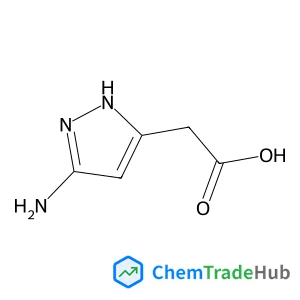
(3-Amino-1H-pyrazol-5-yl)acetic acid is a white crystalline solid with a molecular weight of approximately 174.2 g/mol. It is slightly soluble in water and ethanol. This compound is known for its basic nature and can react with acids to form salts. It is also reactive towards nucleophiles and can undergo substitution reactions.
About
CAS No
174891-10-2
English Name
(3-Amino-1H-pyrazol-5-yl)acetic acid
Molecular Formula
C5H7N3O2
Molecular Weight
141.13 g/mol
SMILES
C1=C(NN=C1N)CC(=O)O
InChIKey
WROZCSTUPGWSLS-UHFFFAOYSA-N
Last Updated: 2025-10-19 13:36
